
![Build a $200 Solar Pond Fountain [2026 DIY]](https://lawnmajesty.com/wp-content/uploads/2026/07/Build-a-200-Solar-Pond-Fountain-2026-DIY.jpeg)
Build a $200 Solar Pond Fountain [2026 DIY]
The Foundation of Professional Water Feature Design
I always drill into my new crew members: if you don’t fix the soil grading first, every plant you put in the ground is just expensive compost. This principle applies doubly to water features. Most homeowners think they can just dig a hole, toss in a liner, and plug in a pump. That is how you end up with a mosquito-infested mud pit that undermines your home’s foundation. A professional-grade solar pond fountain requires an understanding of hydrostatic pressure, head height, and electrical conductivity. By the time we finish this build, you will understand why 20 mil PVC is garbage and why your GPH (gallons per hour) rating is the most important number on your spec sheet. We are building for longevity, not a single season.
[IMAGE_PLACEHOLDER_1]
Planning the Hydraulics of Your Solar Water Feature
Designing a solar pond fountain requires calculating the static head pressure against the pump’s GPH capacity. In 2026, efficient monocrystalline panels must provide at least 150% of the pump’s peak wattage to ensure consistent water circulation during low-light intervals and prevent stagnation-induced algae. You need to account for the vertical lift from the water surface to the fountain head. Every inch of lift increases the workload on your DC motor, reducing the flow rate. If your pump is rated for 200 GPH at zero lift, it might only push 50 GPH at a 2-foot height. This is basic physics, yet it is where 90% of DIY projects fail.
“Proper pond aeration requires a turnover rate of the total volume at least once per hour to maintain dissolved oxygen levels above 5 ppm.” – University of Florida IFAS Extension
The $200 Material Breakdown: Choosing Quality Over Cheap Plastic
Building a reliable system on a $200 budget means you cannot afford to buy anything twice. You must prioritize the containment layer and the power plant. Using a 45-mil EPDM liner is non-negotiable if you have rocky soil or heavy clay. Cheaper liners will puncture under the weight of the water and the decorative stone. For the power source, we are looking at lithium-iron phosphate (LiFePO4) battery backups integrated with the solar array. This ensures the pump does not stall every time a cloud passes, which is the leading cause of motor burnout in cheap kits.
| Component | Budget Specs | Professional Function |
|---|---|---|
| Solar Panel | 20W Monocrystalline | Photovoltaic energy conversion |
| Pump | 350 GPH Brushless DC | Water circulation and aeration |
| Liner | 45-mil EPDM Rubber | Impermeable water containment |
| Underlayment | 8oz Non-woven Geotextile | Puncture protection from soil |
| Filter Media | Coarse Bio-sponge | Mechanical and biological filtration |
How much solar power do I need for a small pond pump?
To run a 12V DC pump effectively, you need a panel that produces at least 1.5 times the pump’s wattage. For a small 10W pump, a 15W to 20W monocrystalline panel is ideal to maintain amperage during overcast conditions. Without a battery buffer, the pump’s RPM will fluctuate wildly, leading to cavitation and bearing wear.
The Installation Process: A Ground-Up Build
The installation of a solar pond fountain begins with site excavation and bank stabilization. You aren’t just digging a hole; you are creating a structured basin. The angle of repose for your pond banks should not exceed 45 degrees to prevent slumping. Once the hole is dug, you must install a 2-inch layer of masonry sand or a professional geotextile underlayment. This protects the liner from frost heave and sharp stones that migrate toward the surface over time.
- Step 1: Excavate the basin to a minimum depth of 18 inches to prevent total freezing.
- Step 2: Level the rim using a transit level or a long 2×4 with a bubble level.
- Step 3: Lay the underlayment and EPDM liner, ensuring there is no tension or stretching.
- Step 4: Place the pump on a raised brick to prevent it from sucking up bottom sludge.
- Step 5: Position the solar panel facing true south at an angle equal to your latitude.
How deep should a small garden pond be for winter safety?
In most temperate zones, a garden pond must be at least 18 to 24 inches deep. This depth ensures that a thermocline can develop, keeping the bottom water at a stable 39 degrees Fahrenheit even if the surface freezes. Shallower ponds are subject to thermal shock, which kills beneficial nitrifying bacteria and any aquatic life.
Managing Water Chemistry and Biological Load
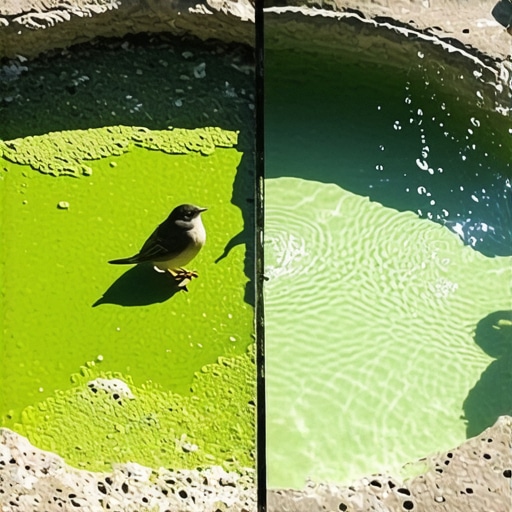
Once your hardscaping is complete and the water is flowing, the biological clock starts ticking. You are managing a nitrogen cycle. Ammonia from debris is converted into nitrites and then nitrates by bacteria like Nitrosomonas and Nitrobacter. In a small solar-powered system, your filtration must be efficient. Do not use chemical algaecides; they are a crutch for poor design. Instead, focus on UV exposure and biological surface area. Adding a few floating plants like Water Lettuce will provide shade, reducing the photosynthesis available to algae while consuming excess nitrates.
“A retaining wall doesn’t fail because of the stone; it fails because of the water trapped behind it.” – Hardscape Engineering Axiom
The Settling-In Period: Maintenance and Monitoring
After the first 48 hours, check your water level. If you see a drop of more than half an inch that isn’t attributable to evapotranspiration, you have a leak in your liner or at the fountain head. In the first year, your solar pond fountain will go through a “green phase” as the ecosystem balances. Do not panic. Clean the pump intake weekly. Check the solar panel for dust or bird droppings, as even 10% shading on a single cell can drop the power output by 50%. This is science, not magic. Stick to the maintenance schedule, and your $200 investment will outlast any store-bought kit.
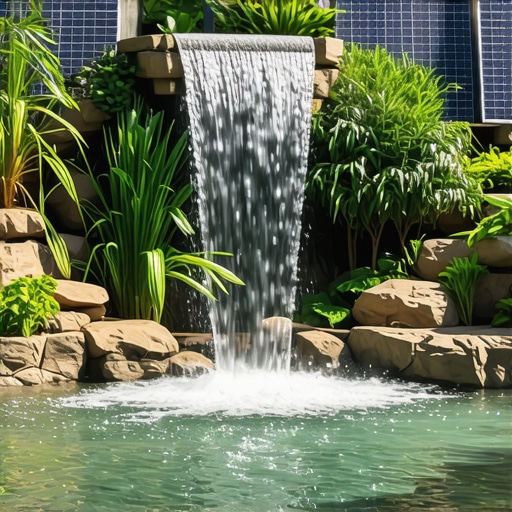
“,”image”:{“imagePrompt”:”A professional-grade DIY solar pond fountain with a tiered stone waterfall, 45-mil EPDM liner visible at the edges, and a monocrystalline solar panel mounted on a nearby stake, set in a garden with engineered drainage.”,”imageTitle”:”Professional DIY Solar Pond Fountain Construction”,”imageAlt”:”A high-end DIY solar pond fountain showing the pump, liner, and solar panel components.”},”categoryId”:0,”postTime”:””}
![Why Your 2026 Pond Pump is Making Noise [Easy Fix]](https://lawnmajesty.com/wp-content/uploads/2026/05/Why-Your-2026-Pond-Pump-is-Making-Noise-Easy-Fix.jpeg)
![Build a $250 2026 Backyard Waterfall [Step-by-Step]](https://lawnmajesty.com/wp-content/uploads/2026/07/Build-a-250-2026-Backyard-Waterfall-Step-by-Step.jpeg)