
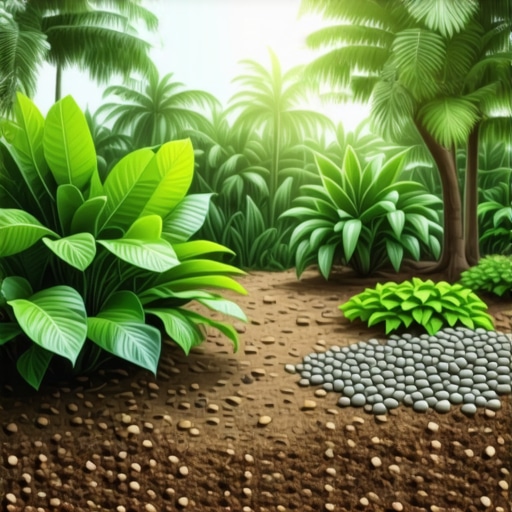
The Best Mulch Types for Keeping Tropical Gardens Cool
Why Tropical Mulching Requires a Different Engineering Approach
Tropical mulching requires heavy organic matter and high-porosity materials to mitigate high soil temperatures and manage rapid decomposition rates. Unlike temperate zones, tropical gardens face intense UV radiation and microbial activity that can deplete a thin mulch layer in months, necessitating a 3-4 inch thermodynamic barrier.
I always drill into my new crew members: if you don’t fix the soil grading first, every plant you put in the ground is just expensive compost. The same logic applies to mulch. You can buy the most expensive eucalyptus chips in the state, but if you do not understand the physics of the soil surface, you are throwing money into a hole. In the tropical heat of zones 10 and 11, the sun does not just wilt leaves; it bakes the rhizosphere. When soil temperatures exceed 90 degrees Fahrenheit, root growth stops. At 100 degrees, the fine feeder roots start to die. This is not gardening; it is a battle against thermal energy. We use mulch as a heat shield, not a decoration.
“Mulch serves as a thermal buffer, reducing the amplitude of soil temperature fluctuations at the 2- to 4-inch depth by as much as 10 to 15 degrees Fahrenheit.” – University of Florida IFAS Extension
The Physics of Material Selection for Heat Mitigation
Not all mulch is created equal when it comes to the albedo effect and thermal conductivity. In tropical garden design, we avoid dark, dyed mulches. Black mulch is a heat sink. It absorbs solar radiation and transfers that energy directly into the topsoil. For landscaping projects in high-heat zones, we look for lighter-colored, coarse-textured materials that reflect light and trap air. Air is a magnificent insulator. A loose, coarse mulch layer creates a series of ‘dead air’ pockets that prevent the sun’s energy from migrating downward.
| Mulch Material | Decomposition Rate | Thermal Insulation | Porosity Level |
|---|---|---|---|
| Eucalyptus Chips | Slow | High | Excellent |
| Pine Bark Nuggets | Medium | High | Good |
| Melaleuca Mulch | Slow | Very High | Excellent |
| Straw/Salt Hay | Rapid | Medium | Very High |
How deep should mulch be in a tropical garden?
For effective lawn care and hardscaping integration, a 3-4 inch mulch layer is the standard for tropical thermal protection. Anything thinner than 3 inches fails to provide adequate insulation, while layers exceeding 5 inches can lead to anaerobic soil conditions and root rot due to restricted gas exchange.
You have to watch the root flares. I see it every day. A ‘pro’ crew comes in and piles mulch up against the trunk of a palm or a hibiscus like they are building a volcano. That is a death sentence. It traps moisture against the bark, invites fungal pathogens, and creates a bridge for termites. You leave a two-inch gap around the base. No exceptions. We are trying to cool the roots, not suffocate the vascular system of the plant.
“Coarse-textured mulches provide better gas exchange for the root zone than fine-textured or plastic mulches, which can lead to anaerobic conditions in heavy rainfall areas.” – USDA Forest Service
The Engineering of Eucalyptus and Melaleuca
In Florida and similar climates, we lean heavily on Eucalyptus and Melaleuca. These are not just sustainable choices; they are superior engineering materials. Eucalyptus is high in oils that naturally repel many insects. It also breaks down slower than standard hardwood. Melaleuca, an invasive species harvested for mulch, is even better. It does not float. In a tropical downpour, your standard pine straw or light wood chips will wash right off the bed and into your drainage grates. Melaleuca stays put. It knits together. This is crucial for maintaining the soil microbiology beneath. If the mulch moves, the soil bakes. Don’t let it move.
Managing the Nitrogen Drawdown
When you dump a heavy load of fresh wood chips, the microbes go into a feeding frenzy. They need nitrogen to break down all that carbon. If you are not careful, those microbes will rob the nitrogen from your plants. This is called nitrogen drawdown. In my firm, we always apply a light dusting of a high-nitrogen organic fertilizer before we lay the mulch. This feeds the decomposition process without starving the plants. It is a scientific approach to garden design. You are managing a chemical reaction, not just spreading wood.
Tropical Mulching Checklist
- Soil Prep: Remove all perennial weeds and ensure the grade slopes away from structures.
- Pre-Hydration: Water the soil deeply before applying mulch. Never apply mulch to bone-dry soil.
- Depth Gauge: Use a literal ruler. Three inches is the minimum for heat protection.
- Flare Clearance: Keep mulch 2-3 inches away from the stems and trunks.
- Texture Check: Opt for large nuggets or coarse chips to allow for maximum oxygen flow.
How much mulch do I need for a 100 square foot garden bed?
To achieve a 3-inch depth over 100 square feet, you will need exactly 25 cubic feet of mulch. This equates to roughly 12.5 bags of standard 2-cubic-foot mulch or a slightly less than one cubic yard if ordering in bulk. Buying in bulk is almost always more cost-effective for larger landscaping projects.
The Settling Phase and Long-Term Maintenance
The first 48 hours after installation are critical. If you get a heavy rain, you need to check your drainage points. Mulch can act as a dam if it wasn’t spread with the grade in mind. Over the first year, that 4-inch layer will settle into a 3-inch mat. That is the sweet spot. Don’t go topping it off every three months because the color faded. If the color bothers you, rake the top inch to expose the unweathered material. Adding too much mulch too often leads to a ‘thatch’ layer that water cannot penetrate. You’ll end up with a hydrophobic garden where the plants are dying of thirst while the mulch is soaking wet. It’s a rookie mistake. Don’t make it.
![Stop 2026 Tree Bark Damage from Weed Whackers [Fix]](https://lawnmajesty.com/wp-content/uploads/2026/05/Stop-2026-Tree-Bark-Damage-from-Weed-Whackers-Fix.jpeg)