Why Your New Tree is Dying (and How to Save It)
Why Your New Tree is Dying (and How to Save It)
You spent $500 on a 2 inch caliper Red Maple, hired a crew to stick it in the dirt, and now, six months later, the canopy is thinning and the leaves are turning brown at the margins. It is not just bad luck. It is bad engineering. Most trees do not die because of pests or drought; they die because of poor installation techniques that violate basic biological laws. In my twenty years of running a landscaping firm, I have seen more trees killed by ‘professional’ installers than by Mother Nature herself. Landscaping is not just aesthetic; it is applied biology. If you ignore the physics of the soil and the anatomy of the tree, you are just throwing money into a compost pile.
The Forensic Autopsy: Identifying the Death Spiral
To diagnose a dying tree, you must examine the root flare, soil compaction levels, and planting depth to identify vascular restriction or anaerobic conditions. Most failures start at the base, where the trunk meets the soil, and manifest as canopy dieback or stunted leaf growth within the first two years of installation.
I always drill into my new crew members: if you do not fix the soil grading first, every plant you put in the ground is just expensive compost. I remember a job last October in a high-end subdivision. The homeowner had twenty Green Giant Arborvitaes that were all turning a sickly rust color. The previous contractor had used a skid steer to level the site, packing the clay soil until it had the density of concrete. Then, they dug ‘post holes’ barely wider than the root balls and dropped them in. Those trees were not growing; they were drowning in underground buckets of water that could not drain. I had to tell the client that their $8,000 privacy screen was terminal. We had to rip it all out, remediate the soil structure, and start from scratch. That is the cost of ignoring engineering in the landscape.
“The number one cause of early mortality in urban trees is improper planting depth leading to adventitious root development and stem girdling.” – Penn State Extension
The Silent Killer: Why Deep Planting Suffocates Root Systems
Planting a tree too deep is the most common mistake in modern landscaping, as it buries the root flare and cuts off oxygen to the rhizosphere. When the flare is buried, the bark is subjected to constant moisture, leading to rot and the development of stem-girdling roots.
A tree breathes through its roots. Specifically, it requires gas exchange through macropores in the soil. When you bury a tree deeper than it grew in the nursery, you are placing the sensitive cambium layer under the soil line. Bark is designed to protect the tree from the air, not from subterranean moisture. This constant dampness causes the bark to decay, allowing fungal pathogens like Phytophthora to enter the vascular system. Furthermore, the tree will often attempt to send out ‘adventitious’ roots from the buried trunk. These roots do not grow outward; they grow in circles around the trunk. As the tree grows in diameter, these roots act like a slow-motion garrote, eventually cutting off the flow of water and nutrients from the ground to the canopy. If you cannot see the root flare, your tree is on a countdown to failure. It is that simple.
How do I know if my tree is planted too deep?
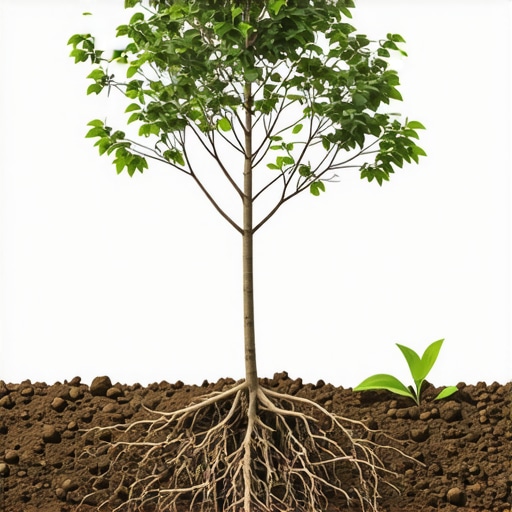
Look at the base of the trunk. It should flare out like a bell where it meets the soil. If the trunk looks like a telephone pole going straight into the ground, it is too deep. You need to carefully excavate the excess soil until you find the first structural root. This is the true soil line.
The Teacup Effect: Soil Amendment Mistakes
The teacup effect occurs when a planting hole is backfilled with rich organic matter in heavy clay soil, creating a subterranean basin that traps water and drowns roots. To prevent this, you must use native soil for backfill to ensure consistent hydraulic conductivity and encourage outward root growth.
| Feature | Big-Box Store Trees | Professional Nursery Stock |
|---|---|---|
| Root Structure | Often severely pot-bound or girdled | Root-pruned for lateral expansion |
| Soil Media | Peat-heavy, dries out instantly | Field-grown or mineral-based substrate |
| Canopy Form | Mass-produced, often lacks central leader | Structurally pruned for long-term health |
| Hardiness | Often pushed with high nitrogen for color | Hardened off for local climate zones |
Many homeowners think they are doing a favor by filling a hole with 100 percent bagged potting soil. In reality, you are creating a physical barrier. Water moves differently through different soil textures. When it hits the boundary between your ‘good’ soil and the native clay, it stops. This creates a bathtub effect where the roots sit in standing water. Furthermore, the roots will refuse to leave the ‘good’ soil, circling the hole instead of anchoring into the surrounding landscape. You must use the dirt you dug out of the hole. If the soil is truly terrible, you amend the entire bed, not just the hole. You want those roots to hunt for nutrients and water, forcing them to establish a wide, stable base.
Stop the Volcano: The Proper Way to Mulch
Mulch volcanoes, which are high mounds of mulch piled against the trunk, trap heat and moisture against the bark while encouraging rodent damage and fungal rot. Proper mulching involves a flat, two to three inch layer of organic material that stops several inches short of the tree trunk.
- Maintain a 3 inch depth maximum to allow for oxygen diffusion.
- Keep mulch 6 inches away from the trunk to prevent bark decay.
- Use arborist wood chips instead of dyed mulch for better nutrient cycling.
- Extend the mulch ring to the drip line of the tree to reduce competition from turf.
Turf grass is the enemy of a young tree. Grass is a nitrogen hog and has a fibrous root system that out-competes young tree roots for every drop of water. By creating a wide mulch ring, you eliminate that competition and mimic the forest floor. But you must resist the urge to build a mountain of mulch. These ‘volcanoes’ are a hallmark of lazy contractors. They hold moisture against the trunk, inviting wood-boring insects and rot. I have seen trunks that were completely hollowed out by rot under a pile of mulch while the homeowner thought they were being helpful. Don’t be that person. Keep the flare dry and the root zone moist.
“A tree is a biological system that depends on gas exchange through the root system as much as it does on photosynthesis in the leaves.” – ISA Arborist Manual
Engineering Hydration: Beyond the Garden Hose
Proper irrigation for new trees requires deep, infrequent watering that reaches the entire root ball, rather than frequent shallow sprays that only dampen the surface. Most new trees need 10 to 15 gallons of water per week, delivered slowly to ensure deep soil penetration and prevent runoff.
The biggest mistake is watering for five minutes every day. This only wets the top inch of soil, encouraging roots to stay near the surface where they will bake in the summer heat. You want to force those roots down. A slow trickle from a hose for thirty minutes once or twice a week is far more effective. You are looking for a deep soak that reaches 12 inches into the ground. Check the soil moisture by sticking a finger 3 inches into the dirt. If it is damp, leave it alone. Over-watering is just as lethal as drought. Roots need to breathe, and saturated soil has no room for oxygen. If the leaves are turning yellow and falling off while the soil is soaking wet, you are drowning the tree. Stop the water and let the soil dry out until it feels like a wrung-out sponge.
How much water does a newly planted tree need?
A general rule is 2 to 3 gallons of water per inch of trunk diameter every time you water. For a 2 inch tree, that is about 5 to 6 gallons. In peak summer heat, you may need to do this three times a week, but always check the soil moisture first to avoid anaerobic conditions.
[IMAGE_PLACEHOLDER_1]
Long-Term Management: The Establishment Phase
A tree is not ‘established’ until it has been in the ground for one year for every inch of trunk diameter. That means a 3 inch tree needs three years of close monitoring. Do not fertilize a stressed tree. High-nitrogen fertilizers force the tree to produce top growth that the damaged or struggling root system cannot support. Focus on root health first. Use mycorrhizal inoculants if the soil is poor. These beneficial fungi form a symbiotic relationship with the roots, effectively increasing their surface area for water and nutrient uptake. Most importantly, keep the mowers and weed-whackers away. One hit from a string trimmer can strip the bark and kill a young tree in a single season. Protection is just as important as hydration. Build a sturdy mulch ring and let the tree do its work.