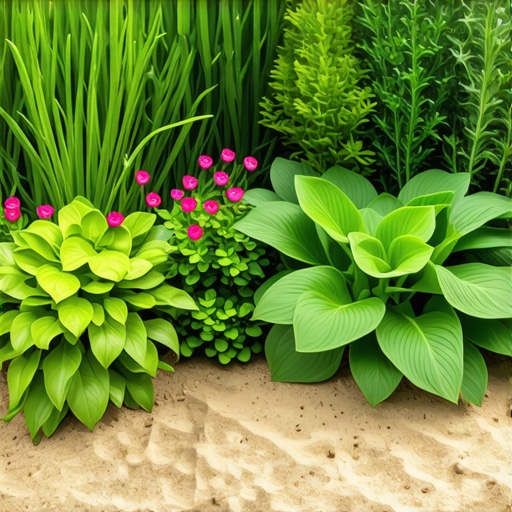
5 Plants That Thrive in 2026 Sandy Soil [Low Water]
The Physics of Sandy Soil: Why Your Garden Is Starving
Sandy soil characteristics include high macroporosity and low cation exchange capacity (CEC), meaning it lacks the electrical charge necessary to hold onto vital nutrients like potassium and magnesium. In the 2026 landscape environment, where erratic precipitation and heat spikes are the norm, managing sandy loam requires an engineering mindset focused on hydrostatic pressure and nutrient stabilization. I always drill into my new crew members: if you don’t fix the soil grading first, every plant you put in the ground is just expensive compost. You can buy the most expensive nursery stock in the state, but if you drop it into a 12-inch hole of pure silica without addressing the drainage logic, you are just performing a slow-motion burial. Sandy soil acts like a sieve. It doesn’t just let water pass; it facilitates the leaching of nitrogen, leaving your plants stunted and chlorotic. We see this every time a ‘mow-and-blow’ hack tries to install a high-end perennial bed. They dig, they drop, they leave. Two months later, the homeowner is looking at a graveyard of scorched foliage because the contractor didn’t understand the microscopic reality of the rhizosphere.
“Sandy soils have low water-holding capacity and high infiltration rates, which leads to rapid leaching of nitrate-nitrogen and other mobile nutrients.” – Penn State Extension
How do I stop water from draining too fast in sandy soil?
To mitigate excessive drainage in sandy soil, you must incorporate high-surface-area organic matter such as biochar or leaf mold to increase the water-holding capacity of the soil matrix. This isn’t about just dumping topsoil on top. You need to mechanically integrate amendments to a depth of 8 to 12 inches to prevent the formation of a hydrophobic layer. If you ignore the subsurface mechanics, the water will simply sit at the interface between the new soil and the sand, leading to root rot despite the sandy base. It is a paradox of physics. [image_placeholder_1]
5 High-Performance Plants for Sandy Soil
Selecting plants for sandy soil in 2026 requires looking for species with waxy cuticles, deep taproots, and low transpiration rates. These five selections are engineered by nature to survive the harsh realities of high-drainage environments. 1. Agastache (Giant Hyssop): This is a powerhouse for sandy regions. It thrives in USDA zones 5-9 and requires almost zero supplemental nitrogen. Its roots are aggressive and can find moisture in the interstitial spaces between sand grains where other plants fail. 2. Perovskia atriplicifolia (Russian Sage): A staple for xeriscaping. It prefers a pH that is slightly alkaline, which is common in many sandy coastal regions. It is virtually immune to the heat-island effect. 3. Panicum virgatum (Switchgrass): This native grass is a soil stabilizer. Its root system can reach depths of 10 feet. This isn’t just for aesthetics; it provides structural integrity to the soil, preventing erosion during heavy 2026 storm events. 4. Echinacea pallida (Pale Purple Coneflower): Unlike the common purple coneflower, the pallida variety has a long taproot specifically evolved for drought. It doesn’t just tolerate sand; it demands the drainage sand provides. 5. Yucca filamentosa (Adam’s Needle): This is the ultimate ‘set it and forget it’ plant for sandy loam. It uses its thick, leathery leaves to store moisture and can withstand the highest PSI of wind and heat.
| Plant Species | Root Type | Water Need | Soil pH Preference |
|---|---|---|---|
| Agastache | Fibrous/Spreading | Low | 6.0 – 8.0 |
| Russian Sage | Woody Taproot | Very Low | 7.0 – 8.5 |
| Switchgrass | Deep Fibrous | Moderate/Low | 5.5 – 7.5 |
| Pale Coneflower | Deep Taproot | Low | 6.0 – 7.0 |
| Yucca | Fleshy Rhizome | Minimal | 5.5 – 8.5 |
What are the best drought-tolerant shrubs for sandy yards?
The best drought-tolerant shrubs for sandy environments include Arctostaphylos (Manzanita) and Myrica pennsylvanica (Northern Bayberry), which utilize mycorrhizal fungi to scavenge nutrients in low-CEC environments. These shrubs are critical for garden design because they provide the structural framework for a landscape while requiring 70 percent less water than traditional ornamental evergreens. Stop planting Boxwoods in the sand. They will die. They are a moisture-hungry species that cannot handle the rapid dry-down cycles of a sandy site. Use Dwarf Coniferous species or Cercocarpus (Mountain Mahogany) instead. These plants have evolved to handle the high-UV and low-moisture profile of the 2026 climate.
The Hardscape Connection: Managing Drainage and Erosion
In a sandy yard, your hardscaping is your skeleton. Because sand shifts and migrates, your base-layer compaction is everything. If you are building a patio on sandy soil, you cannot just throw down some stone dust. You need a modified gravel base compacted to at least 95 percent Proctor density. Without this, the first heavy rain will wash out the fines, and your $20,000 investment will look like a topographical map of the Grand Canyon. Drainage is king. In sandy sites, we often install French drains not to move water away from the house, but to move it into deep infiltration galleries where it can recharge the local water table rather than running off the surface.
“The stability of any landscape feature, from a perennial bed to a stone wall, begins with the management of hydrostatic pressure and soil density.” – ICPI Technical Manual
Sandy soil is prone to ‘piping,’ where water creates underground tunnels that can lead to sudden sinkholes under pavers. We prevent this by using high-quality geotextile fabrics that allow water through but keep the sand particles in place. Don’t skip the fabric. It is the cheapest insurance policy you will ever buy for your yard. One layer of woven stabilization fabric can mean the difference between a patio that lasts 30 years and one that fails in three.
The 2026 Maintenance Protocol for Sandy Landscapes
Maintenance in a sandy landscape is about precision, not volume. Forget the ‘weekly mow’ mentality. Lawn care in sandy soil requires raising the deck height of your mower to at least 4 inches to shade the soil and reduce evaporation. You should also be looking at pre-emergent applications that don’t rely on heavy irrigation to activate.
- Inspect Root Flares: Never bury the flare. Sandy soil often shifts and can ‘drown’ a tree base.
- Monitor pH: Sandy soils drift toward acidity. Use dolomitic lime to stabilize the 6.5 range.
- Top-Dress with Compost: Apply a 1/4-inch layer of organic compost twice a year to build CEC.
- Irrigation Audit: Check for ‘clogged emitters.’ Sand particles love to find their way into drip lines.
Infrequent, deep watering is the only way to train roots to go deep. If you water for 10 minutes every day, you are creating a ‘lazy’ root system that will fry the second the temperature hits 95 degrees. Water for an hour, once a week. Force those roots to chase the moisture down. It is a biological imperative. If they don’t find the water, they don’t survive the season. This is the difference between a professional landscape and a DIY disaster. It takes grit, knowledge, and a respect for the soil’s chemistry.