
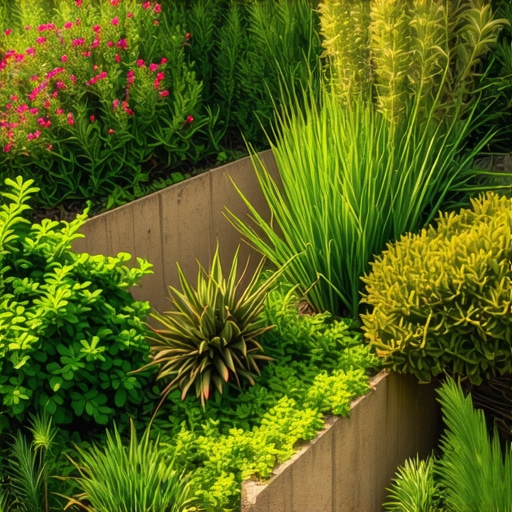
5 2026 Best Plants for High Sun Clay Sloped Retaining Wall
The Hardscape Autopsy: Why Most Sloped Plantings Fail
I recently got called out to tear up a $30,000 patio and retaining wall system that was sinking because the previous contractor didn’t understand the physics of clay. They threw down some landscape fabric, piled on a few inches of topsoil, and called it a day. Within two seasons, the hydrostatic pressure from the heavy clay behind the wall forced the stones to blow out, and the plants they’d installed were literally drowning in a bathtub of trapped water. Most people look at a high-sun clay slope and think about color. I look at it and see 120 pounds per cubic foot of potential structural failure. If you don’t solve the drainage and soil structure first, you are just throwing money into a hole. Clay is composed of microscopic, plate-like particles that pack so tightly they prevent oxygen and water from moving. On a slope, this creates a slick-plane that can cause entire sections of turf or garden beds to slide down the hill during a 2-inch rain event. We aren’t just gardening here; we are performing soil stabilization and civil engineering at a residential scale.
Understanding the High-Sun Clay Environment
Clay soil on high-sun slopes requires plants with aggressive, deep root systems and extreme heat tolerance to manage soil compaction and moisture fluctuations. Success depends on selecting species that can penetrate dense subsoil and hold the bank while withstanding the relentless 2026 UV index.
“A retaining wall doesn’t fail because of the stone; it fails because of the water trapped behind it.” – Hardscape Engineering Axiom
How do you stop erosion on a clay slope?
To stop erosion on a clay slope, you must establish a multi-tiered root system using native grasses and deep-rooted perennials that act as biological anchors. Mechanical stabilization, such as geogrid or terrace walls, should be paired with shredded hardwood mulch to prevent surface runoff and maintain soil moisture levels in high-heat zones. Avoid stone mulch on slopes; it heats the soil and offers zero structural grip.
The Engineering Checklist for Sloped Retaining Walls
- Test Soil pH and CEC: Clay often has high Cation Exchange Capacity but locked nutrients. Know your numbers before you dig.
- Install a Toe Drain: Every retaining wall needs a 4-inch perforated pipe wrapped in silt-sock, buried in clean #57 stone.
- Manage Hydrostatic Pressure: Backfill the 12 inches directly behind the wall with gravel, not soil.
- Grade for Drainage: Ensure a 2% slope away from any structures or the wall’s face.
- Avoid Soil Inversion: Do not flip your soil layers; amend the existing clay with coarse organic matter to keep the horizons intact.
5 Best 2026 Plants for Clay Slopes and Retaining Walls
When selecting plants for 2026, we are looking for “functional cultivars”: plants bred for higher thermal resilience and specific root architectures. These aren’t just pretty; they are workers. These species were chosen because they handle the high-sun exposure of a south-facing slope while thriving in heavy clay.
| Plant Species | Root Structure | Sun Requirement | 2026 Benefit |
|---|---|---|---|
| Little Bluestem (Schizachyrium scoparium) | Deep Fibrous (5-8ft) | Full Sun | Extreme Erosion Control |
| Russian Sage (Salvia yangii) | Woody Rhizomatous | Full Sun | Heat Reflection & Pollinators |
| Amsonia ‘Blue Ice’ | Dense Crown | Full Sun / Part Shade | Clay Tolerance & Stability |
| Panicum ‘Heavy Metal’ | Vertical Anchor | Full Sun | Wind & Salt Resistance |
| Creeping Phlox (Phlox subulata) | Mat-forming | Full Sun | Surface Armor |
1. Little Bluestem (Schizachyrium scoparium)
Little Bluestem is the king of the prairie for a reason. Its roots can reach depths of eight feet. In a clay environment, these roots create channels for water to move vertically rather than sheeting off the surface. By 2026, we are seeing more homeowners opt for the ‘Twilight Zone’ or ‘Blue Heaven’ cultivars which offer better structural integrity, meaning they won’t flop over when the clay gets saturated. It provides year-round interest and, more importantly, year-round soil stabilization. It is a bulletproof choice for the top of a retaining wall where wind and sun are most intense.
2. Russian Sage (Salvia yangii)
Russian Sage thrives in the high-pH, lean environments often found in clay-heavy construction sites. It is nearly impossible to kill once established. Its silver foliage reflects a significant portion of solar radiation, keeping the micro-climate around the retaining wall slightly cooler.
“Clay soils have a high water-holding capacity but low permeability, leading to increased lateral earth pressure on structures during heavy rain events.” – Cornell University Agricultural Extension
This plant doesn’t mind the dry-down cycles of a sunny slope and requires zero supplemental fertilizer, which prevents the “soft growth” that attracts pests.
3. Amsonia ‘Blue Ice’ (Blue Star)
Amsonia is a workhorse for clay. It develops a thick, almost woody crown that is incredibly difficult for weeds to penetrate. In the context of a sloped garden design, Amsonia acts as a mid-level stabilizer. Its foliage turns a brilliant gold in the fall, but its real value is beneath the surface. It handles the “expansion and contraction” cycle of clay soils better than almost any other perennial. It won’t heaved out of the ground during a freeze-thaw cycle.
4. Switchgrass (Panicum virgatum) ‘Heavy Metal’
If you have a large slope, you need biomass. ‘Heavy Metal’ Switchgrass is a metallic-blue variety that stands perfectly upright even in high winds. Its root system is massive. It creates a biological “rebar” within the clay. In my 20 years of landscaping, I have never seen a slope fail where Switchgrass was properly established. It is also highly resistant to the deer and rabbits that often plague suburban hardscaping projects.
5. Creeping Phlox (Phlox subulata)
Every slope needs a “skin.” Creeping Phlox provides a dense, evergreen mat that protects the clay from the physical impact of raindrops. Rainfall on bare clay creates a “crust” that prevents water infiltration; Phlox breaks that impact. It is best used right at the edge of the retaining wall stones, where it can drape over the side. This draping effect hides the hard lines of the hardscaping and provides a cooling effect for the stone surface, extending the life of your polymeric sand joints. It is a critical component of lawn care alternatives for difficult grades.
What are the best drought-tolerant plants for clay soil?
The best drought-tolerant plants for clay soil are those that can survive the “saturation-to-cracking” cycle. Species like Liatris spicata, Echinacea purpurea, and Asclepias tuberosa have evolved to handle the oxygen-deprived environment of wet clay while maintaining deep enough taproots to find moisture during August droughts. Avoid succulents that require perfect drainage, as they will rot during the winter wet season in clay.
Maintenance: Why Most DIYers Kill Their Slope in Year Two
Don’t scalp your grasses. I see it every year. Homeowners treat their ornamental grasses like a lawn care project and cut them to the ground in October. Leave them up. The dead foliage protects the crown from the ice and prevents the clay from eroding during winter rains. Cut them back in late March, just before new growth starts. Also, stop over-watering. Clay holds water. If you keep your irrigation on a standard timer, you are going to drown your root systems and cause a slope failure. Feel the soil two inches down. If it’s cool and damp, leave it alone. Hard work in the beginning saves your back in the end. Get the engineering right, pick the plants that actually want to be there, and stop listening to the hacks at the big-box stores. Your wall will still be standing in 20 years. Don’t skip the drainage. It will rot.
![4 Drought-Tolerant Perennials for 2026 Full Sun [Zone 8]](https://lawnmajesty.com/wp-content/uploads/2026/05/4-Drought-Tolerant-Perennials-for-2026-Full-Sun-Zone-8.jpeg)
![5 Deer-Proof Shrubs for 2026 Privacy Hedges [Full Sun]](https://lawnmajesty.com/wp-content/uploads/2026/05/5-Deer-Proof-Shrubs-for-2026-Privacy-Hedges-Full-Sun.jpeg)