
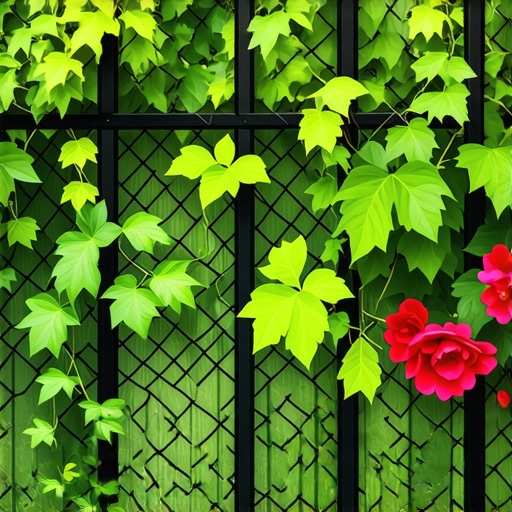
The Best Vines for Covering a Boring Chain Link Fence
Engineering Your Fence Screen: The Professional Approach to Site Assessment
Selecting The Best Vines for Covering a Boring Chain Link Fence requires matching USDA Hardiness Zones with the vine’s climbing mechanism—whether tendrils, twining stems, or adventitious roots—to ensure the 9-gauge steel fabric can support the mature dry weight and wind load of the foliage. Most homeowners treat a fence as a static object, but once you introduce biological growth, it becomes a dynamic structural system. I always drill into my new crew members: if you don’t fix the soil grading first, every plant you put in the ground is just expensive compost. Last year, I saw a rookie try to plant five-gallon Crossvines into a hole packed with construction debris and compacted clay. He didn’t check the compaction levels. If that soil is over 200 PSI, those roots will never penetrate the subsoil. They will just circle the hole until the plant chokes itself out. You have to break the glaze on the side of the hole and ensure the drainage moves away from the fence post footings. If water sits at the base of your posts, you are inviting rust and frost heave. Don’t skip the site prep. It is the difference between a fence that looks great in three years and one that is leaning into the neighbor’s yard because the weight of the wet foliage became too much for the saturated soil to hold. You need to understand the physics of your fence before you buy a single plant. A standard residential chain link fence uses 11-gauge or 9-gauge wire. If you have 11-gauge wire with no top rail, you cannot plant a woody vine like Wisteria. It will crush the wire. You need to know your equipment. Check your terminal posts. Are they set in concrete? How deep? If they aren’t at least 24 inches down, a heavy vine in a high-wind event acts like a sail and will pull the entire line over.
“The selection of climbing plants must account for the ultimate weight and wind-resistance of the mature canopy to prevent structural collapse of the supporting framework.” – University of Florida IFAS Extension
How much weight can a chain link fence hold for plants?
A standard 9-gauge chain link fence with a top rail and posts set in concrete can typically support 25 to 50 pounds of lateral force per linear foot, depending on the wind load and the density of the vine canopy. Overloading the fence with heavy, woody species like Trumpet Creeper can lead to post failure or mesh sagging during heavy rain or snow. You have to calculate the wet weight. When a vine is soaked with an inch of rain, its weight triples. If your fence is old and the galvanized coating is peeling, the acidity from certain organic mulches or the moisture held against the wire by the leaves will accelerate corrosion. This is why I prefer evergreen vines for screening; they don’t drop a massive load of acidic leaf litter into the mesh every autumn. Let’s look at the numbers. A mature Bignonia capreolata can weigh several hundred pounds over a 20-foot span. If your tension wire isn’t tight, that weight will pull the mesh away from the posts. I always tell my clients to tighten the tension bars and carriage bolts before we even think about digging. If the hardware is rusted, replace it now. It won’t get easier once the vine is covering it.
Top Performing Species for Screening and Privacy
When selecting your species, you need to categorize them by how they climb. This isn’t just botanical trivia; it dictates how much maintenance you will be doing for the next decade. Twining vines, like Lonicera sempervirens, wrap their stems around the wire. They are generally safe for the fence. Tendril climbers, like Clematis, use small curly appendages to grab the mesh. These are lightweight and excellent for 11-gauge fences. Then you have the heavy hitters like Campsis radicans that use aerial rootlets. These can actually get into the crevices of your fence hardware and cause problems. Avoid the invasive hacks. Don’t plant English Ivy. It’s a pest that will eventually migrate into your trees and your siding. Stick to native or non-aggressive cultivars that offer high density without the destructive habits.
| Vine Species | Growth Rate | Weight Category | USDA Zone |
|---|---|---|---|
| Carolina Jessamine | Moderate | Medium | 7-9 |
| Crossvine | Fast | Heavy | 6-9 |
| Trumpet Honeysuckle | Moderate | Light | 4-9 |
| Clematis (Group 3) | Slow/Moderate | Ultra-Light | 4-8 |
| Silver Lace Vine | Aggressive | Medium | 4-7 |
What are the fastest growing vines for a chain link fence?
The fastest growing vines for immediate screening are Crossvine (Bignonia capreolata) and Silver Lace Vine (Fallopia baldschuanica), which can grow 10 to 15 feet in a single season once their root systems are established in well-drained, nutrient-rich soil. However, speed comes with a cost. Fast growth means you’ll be out there with the bypass pruners twice a year. If you don’t keep up, the vine will start to ‘rat-tail’—the bottom will get woody and bare while the top gets heavy and messy. I prefer a more controlled approach. Use a balanced fertilizer, something with a lower middle number like a 10-4-12, to encourage strong stem growth and root health rather than just a quick flush of leaves. Avoid the cheap 10-10-10 from the big-box stores. It has too many salts and will eventually degrade your soil microbiology. You want your vine to be a long-term asset, not a short-term project that dies after three years of salt buildup.
The Professional Installation Protocol
Installation is where most people fail. They dig a hole right next to the fence post. Don’t do that. You’re digging into the concrete footer. You want to plant at least 12 to 18 inches away from the fence. This gives the root flare room to expand and prevents the roots from being constricted by the concrete.
- Conduct a percolation test: Dig a 12-inch hole, fill with water, and ensure it drains within 4 hours.
- Dig the planting hole twice as wide as the root ball but no deeper.
- Check for girdling roots and prune them to prevent future self-strangulation.
- Amend the backfill with 10% organic compost if you’re dealing with heavy clay.
- Install a drip-line irrigation system with 1.0 GPH emitters at the root zone.
- Apply 3 inches of hardwood mulch, keeping it 2 inches away from the stem to avoid rot.
When you’re putting the plant in, look for the root flare—the point where the stem widens into the roots. If you bury that, the plant will eventually die from stem rot. I see ‘mulch volcanoes’ everywhere, and it drives me crazy. It’s a slow death sentence. Keep the mulch flat. You want the soil to breathe. Once the plant is in, don’t just tie it to the fence with plastic wire. Use soft garden twine or specialized clips that allow for stem expansion. If you use something that doesn’t stretch, you’ll girdle the plant as it grows.
“A retaining wall doesn’t fail because of the stone; it fails because of the water trapped behind it. Similarly, a fence-climbing vine fails when the root zone is suffocated by poor drainage or improper planting depth.” – Hardscape Engineering Axiom
How do I maintain vines on a chain link fence?
Maintenance is about managing the biomass. You need to perform thinning cuts to allow airflow through the center of the vine. If the center becomes a dense mat of dead leaves and twigs, you’re creating a breeding ground for scale, aphids, and powdery mildew. Airflow is your best friend. Every spring, look for dead wood and remove it. If the vine is getting too heavy for the top rail, perform rejuvenation pruning by cutting back a third of the oldest stems to the ground. This forces new, flexible growth from the base. Check your tension wire annually. If the vine is pulling the mesh down, you may need to install additional bracing. It is a constant battle between the plant’s desire to grow up and gravity’s desire to pull it down. You are the referee. Keep the plant healthy with deep, infrequent watering. You want to force those roots to go deep into the soil. One inch of water per week, delivered slowly, is the gold standard. Don’t just spray the leaves with a hose; that’s how you get fungal diseases. Water the soil, not the foliage.
![Why Your 2026 Hydrangeas Won't Bloom [3 Common Reasons]](https://lawnmajesty.com/wp-content/uploads/2026/05/Why-Your-2026-Hydrangeas-Wont-Bloom-3-Common-Reasons.jpeg)