
Best 2026 Rocks for Dry Creek Bed Drainage
Best 2026 Rocks for Dry Creek Bed Drainage: Engineering Your Landscape for Maximum Runoff Control
A dry creek bed is not a decoration. It is a hydraulic conveyance system designed to manage the kinetic energy of stormwater and protect your property from structural erosion. As a veteran hardscape foreman with two decades in the dirt, I have seen too many homeowners and ‘mow-and-blow’ contractors treat drainage like a craft project. They buy some bags of pea gravel, toss them over thin plastic, and act surprised when the first 2-inch rainstorm turns their yard into a muddy canal. In 2026, the standard for residential drainage has shifted toward heavy-duty, engineered solutions that prioritize hydraulic conductivity and slope stability over mere aesthetics.
I recently got called out to tear up a $30,000 patio and ‘dry creek’ that was sinking into a literal swamp. The previous contractor, clearly a hack, used rounded river slicks exclusively on a 12 percent grade without any subgrade compaction or proper geotextile lining. When the spring rains hit, the water didn’t stay in the channel. It migrated under the rock, liquified the uncompacted soil, and created a massive void that eventually collapsed the adjacent paver patio. We had to excavate 40 tons of saturated mud and start from scratch. This is the cost of ignoring engineering. If you do not respect the physics of water flow, your landscape will fail. It is that simple.
What are the best 2026 rocks for dry creek bed drainage?
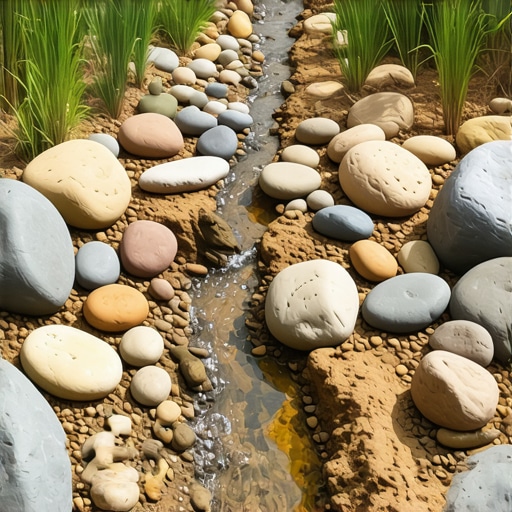
The best rocks for dry creek bed drainage in 2026 consist of a technical mixture of angular riprap, crushed granite, and oversized river jacks. These materials provide the frictional interlocking and void space necessary to slow water velocity, prevent scouring, and facilitate deep-soil infiltration during heavy stormwater events.
[image_placeholder]
How deep should the rock layer be for a dry creek bed?
For a functional drainage system, your rock layer should be at least three times the diameter of your average stone size. If you are using 4-inch to 8-inch stones, your trench needs to be 12 to 18 inches deep. This depth allows for a properly compacted subgrade, a layer of 4-ounce non-woven geotextile fabric, and enough aggregate to withstand the hydrostatic pressure of moving water. Anything shallower is just a cosmetic surface treatment that will wash away in a heavy downpour.
| Rock Material | Size Range (Inches) | Primary Function | Durability Rating |
|---|---|---|---|
| Angular Riprap (Type R-3/R-4) | 4 – 12 | Base stabilization and velocity reduction | High (Exceptional) |
| River Jacks (Smooth/Round) | 3 – 8 | Aesthetic top layer and channel lining | Medium (Prone to migration) |
| Crushed Granite (3/4″) | 0.75 – 1.5 | Filling voids and locking larger stones | High (High Friction) |
| Large Anchor Boulders | 18 – 36 | Deflecting flow at bends and corners | Maximum |
“A dry creek bed is only as effective as its ability to dissipate energy. Without the correct D50 stone sizing, water will eventually excavate its own path under or around your installation.” – Hardscape Engineering Axiom
What is the best rock size for drainage?
In 2026, we utilize a ‘tri-modal’ distribution for stone sizing. You need large 12-inch anchor stones to hold the banks, 4-inch to 6-inch intermediate stones for the main channel bed, and 1.5-inch crushed aggregate to fill the gaps. This mimics a natural mountain stream. Using a single size of rock creates too much uniform void space, which can allow water to run underneath the rocks and erode the soil beneath your fabric. You want the stones to ‘nest’ together like a puzzle. This creates a stable bed that stays put even when the water is moving at 5 feet per second.
When selecting your materials, you must account for the specific gravity of the rock. Granite and basalt are the kings of the 2026 market because of their high density and resistance to chemical weathering. Avoid soft limestones if you have acidic soil; they will eventually dissolve and leach calcium into your garden beds, spiking the pH and potentially killing off your acid-loving plants like azaleas or blueberries. It is a biological disaster waiting to happen. Use your head. Check your soil pH before you buy 10 tons of rock that will change your soil chemistry forever.
- Step 1: Survey the site with a laser level to ensure a minimum 2 percent slope.
- Step 2: Excavate the channel, removing all organic matter and soft topsoil.
- Step 3: Compact the subgrade to 95 percent Proctor density using a vibratory plate compactor.
- Step 4: Install a 4oz or 6oz non-woven needle-punched geotextile fabric. Do not use woven ‘weed barrier’ plastic.
- Step 5: Place your largest ‘anchor’ boulders at the curves and steepest parts of the run.
- Step 6: Fill the remaining channel with your graduated aggregate mix.
- Step 7: Test the flow with a high-volume hose to identify any pooling or backsplash.
“Soil erosion is a physical process that can be modeled and mitigated through the strategic application of riprap and vegetative buffers.” – Agricultural Extension Technical Bulletin
The Science of Geotextiles and Drainage
Stop using thin black plastic. In 2026, if I see a contractor using 1-mil plastic under a dry creek bed, I know they are a hack. Plastic is a ‘slip-n-slide’ for water. It prevents the soil from breathing and causes water to build up massive pressure underneath the lining. You must use a non-woven geotextile. This fabric allows water to permeate through into the subsoil while keeping the fine soil particles from mixing with your clean stone. This is called ‘filtration’ and ‘separation’ in civil engineering. Without it, your rocks will eventually sink into the mud and disappear. It will rot. Your creek bed will turn into a weed-choked ditch within two seasons. Don’t skip this. Spend the extra money on professional-grade 4oz fabric. It is the backbone of the entire system.
Future-Proofing Your Drainage Engineering
Landscape management in 2026 requires an understanding of ‘Information Gain.’ The old advice was to just dig a ditch. Modern engineering tells us to create ‘check dams’ within the creek bed. These are small ridges of larger stone that force the water to pool slightly before overflowing into the next section. This ‘step-pool’ geometry is what the pros use to manage high-velocity runoff on steep hillsides. It slows the water down, which is the goal. Slow water is safe water. Fast water is a wrecking ball. If you have a slope greater than 10 percent, you must integrate check dams. No exceptions. Failure to do so will result in your rock ending up in the street or your neighbor’s yard after the first major storm. Get your transit out and measure your elevations accurately. Precision is the difference between a dry basement and a flooded nightmare.

![Build a $350 Pondless Waterfall [2026 DIY]](https://lawnmajesty.com/wp-content/uploads/2026/06/Build-a-350-Pondless-Waterfall-2026-DIY.jpeg)
![Why Your 2026 Backyard Pond is Green [Algae Fix]](https://lawnmajesty.com/wp-content/uploads/2026/05/Why-Your-2026-Backyard-Pond-is-Green-Algae-Fix.jpeg)
![Why Your 2026 Pond Pump is Making Noise [Easy Fix]](https://lawnmajesty.com/wp-content/uploads/2026/05/Why-Your-2026-Pond-Pump-is-Making-Noise-Easy-Fix.jpeg)