
How to Sharpen Mower Blades Without Removing the Deck
Why Your Lawn Looks Brown Even After Watering
If your grass tips look white, frayed, or shredded after a cut, your mower blades are dull. This mechanical failure creates jagged entry points for pathogens like Pythium and Rhizoctonia, leading to a lawn that looks desiccated and grey despite adequate irrigation. A dull blade doesn’t cut; it smashes, and that impact stress stalls the grass plant’s metabolic recovery for up to 48 hours. I always drill into my new crew members: if you don’t fix the soil grading first, every plant you put in the ground is just expensive compost, but if you don’t keep your blades razor-sharp, you are just a butcher with a motor. I’ve seen $10,000 irrigation installs rendered useless because the homeowner was using a blade that hadn’t seen a grinder in three seasons. The resulting leaf-shredding led to massive moisture loss through the torn tissue. It’s a preventable disaster. To maintain a high-end landscape, blade maintenance must be a weekly ritual, not an annual afterthought.
“A clean cut minimizes the surface area of the wound on the grass blade, reducing the risk of disease and water loss.” – University of California Agriculture and Natural Resources
The Mechanics of the In-Situ Sharpening Method
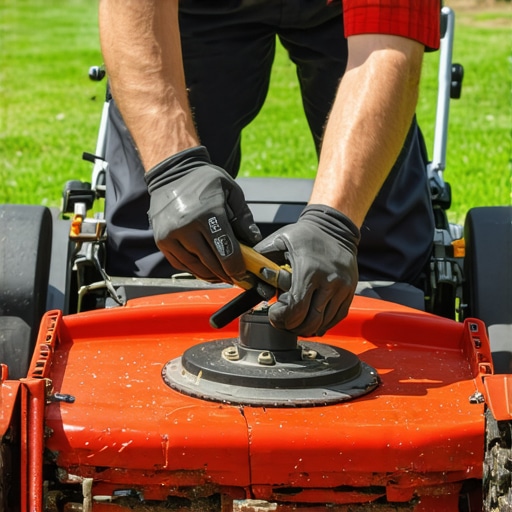
Sharpening mower blades without removing the deck involves using an angle grinder or a specialized drill-mounted sharpening stone while the mower is tilted and secured. This technique saves time for professional landscape contractors who manage 50 plus properties per week but requires strict adherence to safety protocols and tool angles. Most residential mowers have a blade tip speed of roughly 19,000 feet per minute. At those speeds, even a minor nick or a dull edge acts like a hammer. By sharpening on the machine, you maintain the 30-degree bevel without the hassle of unbolting the spindle, which often involves fighting rusted bolts or seized nuts. It will rot the lawn if you wait too long. Check the edge every 10 hours of operation. Don’t skip this.
Is it safe to sharpen mower blades without removing them?
Yes, sharpening blades while they are attached to the deck is safe as long as the spark plug wire is disconnected and the mower is tilted so the carburetor and air filter face upward. This prevents oil from draining into the combustion chamber or the air intake, which can cause permanent engine damage or starting failures. Use a set of heavy-duty jack stands or a mower lift to secure the deck. Never rely on a hydraulic jack alone. If the mower falls while you are under it, the results are catastrophic. We use 2-ton stands even for a 300-pound zero-turn. Safety is non-negotiable.
| Tool Type | Precision Level | Removal Required? | Best For |
|---|---|---|---|
| Angle Grinder | High | No | Professional Crews |
| Drill-Mounted Stone | Medium | No | Homeowners |
| Flat Metal File | Low | Yes/No | Minor Touch-ups |
| Bench Grinder | Maximum | Yes | Total Reshaping |
The Forensic Autopsy of a Dull Cut
When we diagnose a failing lawn, we look at the cellular level of the grass blade. A sharp blade leaves a clean, straight line across the top of the leaf. A dull blade leaves a white, stringy fiber hanging from the tip. This is the vascular tissue of the plant being ripped out. In high-nitrogen environments, this open wound is a magnet for fungal spores. If you are applying high-end fertilizers but your lawn looks like straw, the blade is your primary suspect. You are essentially inviting Brown Patch to a buffet. The physics are simple: a 30-degree bevel is the sweet spot for durability and sharpness. Anything steeper and the edge rolls; anything shallower and the blade won’t penetrate the cellulose. Use a 60-grit flapper disc on an angle grinder for the best results. It removes less material than a hard grinding wheel and reduces the risk of overheating the metal. If the metal turns blue, you’ve ruined the temper. It is now trash.
What tools do I need for under-deck blade sharpening?
To sharpen a blade under the deck, you need a 4.5-inch angle grinder with a 60-grit flap disc, a pair of leather work gloves, safety goggles, and a rag to clean the blade surface. A specialized blade balancer is also helpful if you suspect an uneven edge, though this is harder to use while the blade is mounted. Professional landscapers also keep a wire brush handy to clear away dried mulch and grass buildup from the blade surface before grinding. This allows you to see the actual metal edge rather than just the caked-on organic matter. One inch of thatch buildup on the blade can throw the balance off as much as a missing chunk of steel. Clean it first.
“Blade balance is critical; a variance of even 0.5 ounces can cause vibration that destroys the engine’s crankshaft bearings over time.” – Small Engine Mechanics Handbook
- Disconnect the spark plug wire to prevent accidental startup.
- Drain the fuel tank or seal the cap to avoid leaks.
- Tilt the mower with the carburetor facing up.
- Clean the underside of the deck of all debris.
- Maintain a consistent 30-degree angle with your grinder.
- Check the blade for cracks; if cracked, replace immediately.
The Contrarian Reality of Blade Replacement
While most internet guides tell you to replace blades every season, the truth is that a high-quality hardened steel blade can last 200 hours if maintained properly with in-situ sharpening. The key is removing the absolute minimum amount of material. Most people grind too much. You aren’t making a sword; you are creating a surgical edge for a plant. Also, ignore the myth that blades need to be “razor” sharp. If they are too sharp, the edge will nick the first time it hits a pebble or a stray piece of hardwood mulch. You want it “butter knife” sharp. This provides the necessary durability to withstand the 200-degree heat generated by friction within the deck housing. If you live in a region with sandy soil, like coastal Florida, your blades will wear down 40% faster due to the abrasive nature of the silica being sucked into the deck. In these micro-climates, you don’t just sharpen; you inspect for thinning of the “lift” or the curved part of the blade that creates the vacuum. Once that lift is gone, the blade won’t pull the grass upright, and you’ll get an uneven cut regardless of sharpness. Know your soil. Know your tools. Stop being a hack.

![Stop 2026 Lawn Burn: 3 Mowing Height Rules [Tips]](https://lawnmajesty.com/wp-content/uploads/2026/05/Stop-2026-Lawn-Burn-3-Mowing-Height-Rules-Tips.jpeg)