
3 Signs Your Retaining Wall is About to Fail
The Forensic Autopsy of a Sinking Hardscape
A retaining wall fails when the lateral earth pressure exerted by the backfill exceeds the structural resistance of the wall assembly, typically due to poor drainage or inadequate base compaction. I recently got called out to tear up a $30,000 patio that was sinking because the previous contractor used ‘dirt’ as backfill instead of clean-washed 57 stone. The weight of the saturated soil, coupled with a lack of a proper drainage chimney, created a hydraulic ram effect that pushed the wall three inches out of plumb in a single season. It was a disaster. I had to tell the homeowner that their ‘savings’ on the initial bid just cost them a full rebuild. It was avoidable. Don’t let your property become a case study in structural neglect. We are going to look at the physics of why these structures fail and what you need to look for before the first crack appears. No fluff. Just engineering reality.
1. The Forward Lean or ‘Rotation’ of the Wall Face
Wall rotation occurs when the gravitational center of the structure shifts forward because the base material has settled or the surcharge load from behind is too great. If you see a lean, the wall is already in an active state of failure. Retaining walls are designed with a ‘batter’—a slight backward lean—to counteract the natural tendency of soil to push outward. When that batter disappears and the wall looks vertical or, worse, tilts toward your lawn, the friction between the blocks or stones has been compromised. The base was likely not excavated to the proper depth. We typically dig at least 6 to 12 inches below grade to establish a compacted modified gravel base. If your contractor skipped the plate compactor, the wall will move. It is inevitable. It will rot the soil structure.
“A retaining wall doesn’t fail because of the stone; it fails because of the water trapped behind it.” – Hardscape Engineering Axiom
2. Horizontal Cracking and Block Separation
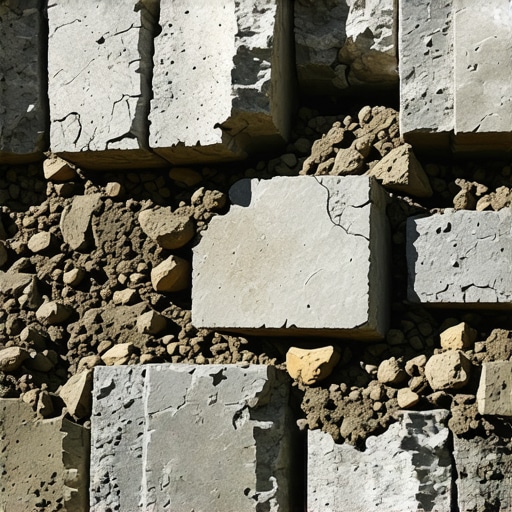
Horizontal cracking in masonry or separation between segmented blocks indicates that the internal reinforcement, such as geogrid, is either missing or has snapped under tension. In wood walls, this shows up as bowing. In concrete or stone, you will see ‘stair-step’ cracking or long horizontal fissures. This is not just ‘settling.’ It is a sign that the hydrostatic pressure is higher than the shear strength of your materials. When water cannot escape through the wall, it adds thousands of pounds of weight. Saturated soil weighs roughly 110 pounds per cubic foot. Do the math. A 10-foot stretch of wall holding back 4 feet of wet earth is fighting a war against gravity. Without geogrid buried back into the ‘inflection point’ of the soil, the wall is just a stack of heavy paperweights. Fix it now. Do not wait for the next heavy rain.
3. The Appearance of Efflorescence and Clogged Weep Holes
Efflorescence is the white, powdery salt deposit left on the wall face after water evaporates, signaling that moisture is migrating through the structure rather than through the designated drainage system. If you see white stains, your drainage pipe is likely crushed or non-existent. A professional build requires a 4-inch perforated SDR-35 pipe wrapped in a non-woven geotextile fabric. This pipe must be ‘daylighted’—meaning it has an exit point for the water to escape. If your weep holes are bone dry after a storm but the wall face is soaking wet, you have a terminal drainage failure. The water is building up behind the wall, increasing the pore pressure. This is the silent killer of hardscapes.
How much does it cost to fix a leaning retaining wall?
The cost to repair a failing wall usually exceeds the cost of the original installation by 30 to 50 percent because it involves excavation and disposal of the failed materials. Expect to pay between $60 and $150 per square foot for a professional remediation that includes proper footings and drainage. Shortcuts are expensive.
Can a leaning retaining wall be straightened?
Rarely. Once a wall has rotated significantly, the internal soil friction is lost and the base is compromised. Attempting to ‘jack’ a wall back into place without excavating the backfill is a temporary fix that fails within 24 months. You must remove the surcharge load, reset the base, and rebuild.
| Wall Material | Primary Failure Mode | Critical Red Flag |
|---|---|---|
| Timber/Wood | Rot and Bowing | Fungal growth at the soil line |
| Segmental Block | Rotation/Tipping | Gap larger than 1/4 inch between courses |
| Natural Stone | Joint Separation | Mortar falling out in chunks |
| Poured Concrete | Horizontal Cracking | Water weeping through the crack itself |
- Check for ‘daylight’ at the end of your drainage pipes every spring.
- Inspect the ‘batter’ of the wall using a 4-foot level.
- Look for sinkholes forming 3 to 5 feet behind the wall cap.
- Clear away mulch volcanoes that block the bottom drainage outlets.
“Structural stability in gravity walls is dependent on the interface friction between the unit and the soil.” – NCMA Design Manual
The reality of landscaping is that the most important parts are the ones you never see. The gravel, the fabric, the pipe, and the compaction. If you focus on the ‘picturesque’ look of the stone and ignore the engineering behind it, you are just building a very expensive pile of rubble. Most ‘mow-and-blow’ guys don’t understand the difference between 2A modified and 2B clean stone. They will use whatever is cheapest. That is why I spend half my year tearing out work that is only three years old. Professional hardscaping is about managing water. Everything else is secondary. Keep your weep holes clear and your base deep. That is how you win.
![Why Your Retaining Wall Is Bulging [2026 Drainage Fix]](https://lawnmajesty.com/wp-content/uploads/2026/09/Why-Your-Retaining-Wall-Is-Bulging-2026-Drainage-Fix.jpeg)
![Build a $50 2026 Rain Barrel System [Save Water]](https://lawnmajesty.com/wp-content/uploads/2026/07/Build-a-50-2026-Rain-Barrel-System-Save-Water.jpeg)

![Fix Cracked Driveways: 3 Cold-Patch Rules [2026 DIY]](https://lawnmajesty.com/wp-content/uploads/2026/06/Fix-Cracked-Driveways-3-Cold-Patch-Rules-2026-DIY.jpeg)