5 Low-Water Shrubs for 2026 Foundation Beds
The Engineering of a Resilient Foundation Bed
Foundation bed success depends on soil bulk density and macropore space to ensure gas exchange for root respiration. When you plant low-water shrubs, you must mitigate hydrostatic pressure and ensure a 2% positive grade away from the foundation to prevent basement seepage. I always drill into my new crew members: if you don’t fix the soil grading first, every plant you put in the ground is just expensive compost. Most homeowners see a bed as a place for mulch and color. I see it as a critical drainage system that happens to have biology living in it. Last season, I walked onto a job site where a homeowner had spent four grand on nursery stock and stuck it all in a trench that was basically a bathtub of heavy clay. Within three months, the Phytophthora root rot had claimed every single plant. We had to excavate 18 inches of sludge and start from the subgrade up. You cannot fight physics with a bag of fertilizer.
“A retaining wall doesn’t fail because of the stone; it fails because of the water trapped behind it.” – Hardscape Engineering Axiom
How deep should a foundation bed be?
A professional foundation bed should have a depth of at least 12 to 18 inches of loosened soil to allow for taproot penetration and lateral root expansion. This depth ensures that low-water shrubs can access moisture stored deep in the soil profile during extreme 100-degree heat cycles. Roots are not just anchors. They are hydraulic pumps. If the soil is compacted to a high bulk density, the roots cannot penetrate the peds. They will spiral. We call this root girdling, and it is a slow death sentence. For a 2026 build, we are looking at soil volumes that support 5 to 10 years of growth without needing constant intervention.
The Selection: 5 Top Low-Water Shrubs for 2026
Choosing shrubs for 2026 requires looking at USDA Hardiness Zone shifts and evapotranspiration rates to ensure the plants can survive on ambient rainfall once established. Here is the technical breakdown of the best cultivars for modern foundation beds.
| Shrub Species | Mature Height | Root Structure | Soil pH Preference |
|---|---|---|---|
| Texas Sage (Desperado) | 5 feet | Deep Taproot | 7.0 to 8.5 |
| Gro-Low Sumac | 2 feet | Fibrous/Spreading | 5.5 to 7.5 |
| Bluebeard (Caryopteris) | 3 feet | Woody Lateral | 6.0 to 8.0 |
| Little-Leaf Boxwood | 4 feet | Dense Fibrous | 6.5 to 7.2 |
| Dwarf Walter’s Viburnum | 3 feet | Branching Lateral | 5.5 to 7.0 |
1. Texas Sage (Leucophyllum frutescens ‘Desperado’)
This is not your average box store shrub. The ‘Desperado’ cultivar is engineered for high-alkalinity soils and extreme drought. It functions on a cellular level by using trichomes (small hairs) on the leaves to reflect sunlight and reduce transpiration pull. If you plant this in a wet, boggy area, it will rot in 48 hours. It needs crushed limestone or decomposed granite in the backfill to ensure the drainage rate exceeds 2 inches per hour. Do not over-amend with peat moss. It hates organic richness.
2. Gro-Low Sumac (Rhus aromatica)
For low-profile foundation needs, this sumac is a workhorse. It provides slope stabilization through its aggressive fibrous root system. Its xylem vessels are narrow, which is a biological adaptation to prevent cavitation (air bubbles in the water column) during severe drought. It is virtually immune to the 100-degree spikes we are seeing in recent summers. We use it to wrap around the corners of hardscape walls where the soil temperature is highest due to thermal mass.
3. Bluebeard (Caryopteris x clandonensis)
Bluebeard is a sub-shrub that requires hard pruning in late winter to maintain its structural integrity. It is a pollinator magnet that thrives in sandy loam. From an engineering perspective, it is excellent for secondary foundation rows because it doesn’t hold heavy snow loads that could crush smaller perennials beneath it. It requires 0.5 inches of water per week during its first year, then almost nothing.
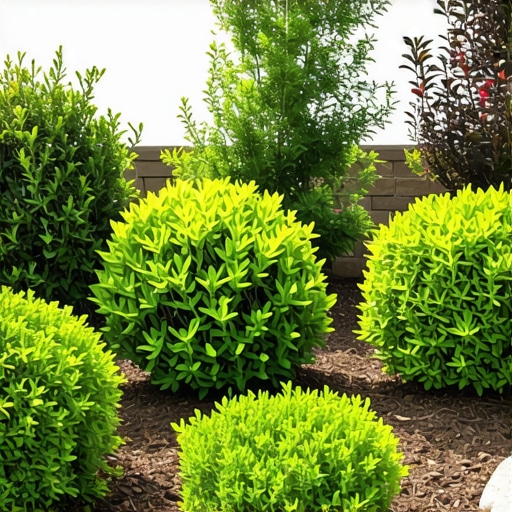
4. Little-Leaf Boxwood (Buxus microphylla)
Forget the old English boxwoods that die if you look at them wrong. The 2026 standard is the microphylla species. It has a thicker cuticle layer on the leaf, which prevents moisture loss. We install these using a root flare exposure technique. If you bury the flare, you suffocate the phloem. It will look fine for a year and then turn bronze and die. Check the soil pH; they prefer a neutral 7.0.
5. Dwarf Walter’s Viburnum (Viburnum obovatum)
This is a native powerhouse. It offers a dense branching habit that acts as a natural privacy screen at a low height. Its drought tolerance comes from its ability to enter summer dormancy if the water table drops too low. Once established, its roots are deep enough to find moisture where others fail. It is the perfect anchor for the windward side of a house.
“Water management is the single most important factor in the longevity of foundation plantings.” – Penn State Agricultural Extension
What is the best low-maintenance shrub for a house foundation?
The best low-maintenance shrub for a house foundation is the Rhus aromatica ‘Gro-Low’ because of its resistance to pests, soil-borne pathogens, and its ability to thrive in poorly graded soils. It requires minimal pruning and survives on natural precipitation after the first 12 months of establishment. It won’t outgrow its space and hit your siding, which saves you from the 2-per-year hedge trimming cycle that most homeowners hate.
The Installation Checklist: Avoid the Hack Methods
- Test Soil pH: Use a digital tester. Don’t guess.
- Check Grading: Use a 4-foot level to ensure 2% slope away from the house.
- Excavate Properly: The hole must be 2 times wider than the root ball.
- Scarify the Walls: If you use an auger, the walls will be glazed. Scrape them with a shovel so roots can penetrate.
- Locate Utilities: Call 811. Don’t hit a gas line for a $50 shrub.
- Drip Irrigation: Install 0.9 GPH emitters directly at the root zone, not the trunk.
- Mulch Depth: Exactly 3 inches. Never touch the bark.
Hardscaping and planting are two sides of the same coin. If you have a paver walkway adjacent to your foundation bed, you must account for polymeric sand runoff and base material leaching. High-pH runoff from concrete can spike your soil chemistry to an 8.5, which will turn your Viburnum yellow from iron chlorosis. I see it every day. Contractors finish the patio, leave the lime-heavy gravel in the beds, and the plants suffer. We use a geotextile fabric barrier between the hardscape base and the planting soil to prevent this migration. It is an extra step, but it is the difference between a 3-year garden and a 30-year garden. Stop buying plants at the grocery store. Go to a wholesale nursery where the stock has been hardened off to your local micro-climate. Your foundation is the most expensive asset you own. Treat the land around it with the same engineering respect you give the roof over your head.