The best way to level an uneven lawn
The Engineering of a Level Grade
Lawn unevenness is fundamentally a failure of subgrade stability or surface density management which leads to hazardous depressions and poor drainage. By utilizing soil-specific amendments and professional topdressing techniques, you can restore a flat, safe, and healthy turf surface that facilitates efficient water infiltration and prevents mower scalping.
I always drill into my new crew members: if you don’t fix the soil grading first, every plant you put in the ground is just expensive compost. I have spent two decades watching homeowners throw thousands of dollars at high-end sod and irrigation systems only to have the entire project fail because they ignored the three inches of differential settlement in their backyard. You can buy the most expensive Kentucky Bluegrass on the market, but if it is sitting in a low spot with zero oxygen exchange, it will rot. My job is to see the yard as a structural system. When I walk onto a property, I am looking for the hydrostatic pressure points, the soil compaction ratios, and the way the grade handles 2 inches of rain in an hour. If you think leveling a yard is just about dumping a bag of dirt into a hole, you are the reason my phone never stops ringing with repair calls. We do things the right way: based on soil physics and engineering standards.
The Physical Mechanics of Soil Displacement
Lawn unevenness is primarily driven by differential settlement where varying soil densities respond inconsistently to moisture loads. By identifying low-density pockets or decaying organic matter like old stump roots, you can apply targeted structural fill to stop the ankle-breaker cycle before applying cosmetic topdressing.
Most unevenness starts under the surface. In many new developments, contractors bury construction debris or leave large tree roots in the ground. As that organic matter decomposes, it creates a void. Gravity and rain do the rest. The soil above collapses, and suddenly you have a four-inch dip that breaks lawnmower blades. Another culprit is the freeze-thaw cycle. In regions with heavy clay, water gets trapped in the pore spaces, expands by 9 percent when it freezes, and heaves the soil upward. When it thaws, it doesn’t always settle back into the same place. This creates a lumpy, micro-topography that is impossible to mow at a consistent height. Scalping the high spots exposes the crown of the grass to the sun, killing the plant, while the low spots collect water and promote fungal pathogens like Pythium or Rhizoctonia. You are not just fixing a bump: you are fixing the biology of the yard.
“A retaining wall doesn’t fail because of the stone; it fails because of the water trapped behind it.” – Hardscape Engineering Axiom
How much soil do I need for leveling a yard?
Calculating material volume is the first step in avoiding the hack contractor mistake of under-ordering. For a topdressing application at a depth of 0.25 inches across 1,000 square feet, you need roughly 0.8 cubic yards of material. Always factor in a 15 percent compaction rate when ordering bulk sand or compost mixes to ensure you have enough mass to fill the voids. To find your specific volume, multiply your square footage by the desired depth in feet. For example, a 2,000 square foot area needing a 1-inch fill requires 6 cubic yards of material after accounting for settling. Don’t eyeball it. Use a transit level or a string line to find the true depth of your depressions.
The Science of Topdressing: The Top-Down Cure
Topdressing involves applying a custom 70/30 sand-to-compost mix across the turf canopy to fill voids without suffocating the grass crown. This technique improves soil microbiology and macropore space, allowing for better oxygen exchange and drainage in the root zone while gradually leveling the surface.
If the dip is less than an inch, topdressing is your best tool. But don’t use just any dirt. I see people buying cheap bags of topsoil from big-box stores that are 50 percent uncomposted wood chips. That wood will rob your soil of nitrogen as it breaks down, yellowing your grass. We use a mix of screened masonry sand and high-quality leaf compost. The sand provides the structural stability: it does not compact and it does not wash away. The compost provides the Cation Exchange Capacity (CEC) needed to hold onto nutrients. We apply it when the grass is in its peak growing season. For cool-season grasses like Fescue, that is the fall. For warm-season grasses like Bermuda, it is late spring. You want the grass to be able to grow through the layer of sand quickly. If you bury the crown and the plant is dormant, it will die. Simple as that.
| Issue Depth | Material Required | Methodology |
|---|---|---|
| 0-1 inch | Mason Sand/Compost Mix | Surface Topdressing |
| 1-3 inches | Screened Loam + Seed | Core Aeration + Targeted Filling |
| Over 3 inches | Structural Fill Dirt | Excavation and Re-grading |
What is the best sand for leveling a lawn?
The gold standard for lawn leveling is washed masonry sand, also known as ASTM C144 sand. Avoid play sand or beach sand, which have rounded grains that shift underfoot. Masonry sand features sub-angular grains that lock together, providing a firm base for grass roots to penetrate while allowing for maximum drainage. Concrete sand (ASTM C33) can also be used for deeper fills, but masonry sand is easier to spread through a spreader or drag mat without clumping.
Professional Leveling Checklist
- Mow Low: Drop your mower height to 1.5 inches to expose the soil surface.
- Dethatch: Use a power rake to remove the lignin-heavy organic layer that prevents soil contact.
- Core Aerate: Pull 3-inch plugs to relieve compaction and create channels for the new soil.
- Dry Materials: Ensure your leveling mix is bone-dry so it flows into the aeration holes.
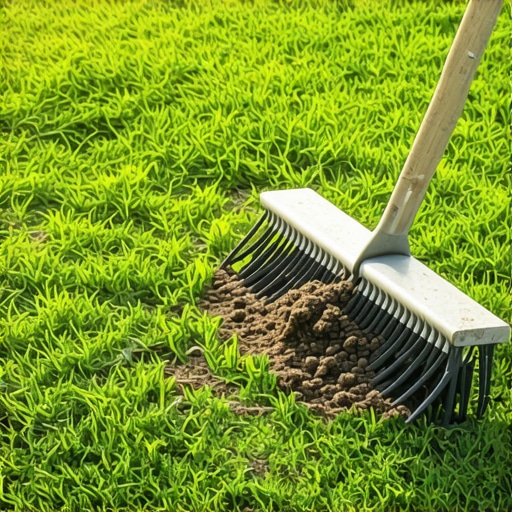
- Drag Mat: Use a heavy steel drag mat or a leveling rake to distribute the mix evenly.
- Water In: Immediate irrigation settles the particles into the voids and prevents the sand from heating up and burning the blades.
Addressing Structural Grading and Hydrostatic Pressure
Severe unevenness often indicates a grading failure where the pitch of the land directs water toward the foundation or traps it in stagnant pools. Correcting this requires mechanical excavation and the installation of subsurface drainage solutions like French drains to manage water velocity and soil saturation.
If you have a six-inch drop over a ten-foot span, sand isn’t going to save you. You have a drainage problem. Water is the most destructive force in landscaping. When soil stays saturated, it loses its shear strength and turns into a slurry. This is why patios sink and lawns become bogs. In these cases, we have to strip the sod, bring in a skid steer, and re-establish a 2 percent slope away from the house. We use structural fill dirt, compact it in 2-inch lifts using a plate compactor with at least 3,000 PSI of centrifugal force, and then finish with a layer of topsoil. If you don’t compact the soil in layers, it will settle unevenly within six months, and you are right back where you started. I see hacks do this all the time: they dump six inches of dirt, rake it flat, and walk away. That yard will be a roller coaster by next spring.
“Soil compaction is the hidden killer of turf health; without pore space, roots cannot breathe or absorb nutrients regardless of fertilizer application.” – Penn State Agricultural Extension
The Maintenance Cycle for Long-Term Flatness
Once the lawn is level, your work is not done. Soil is a living, moving entity. You must manage the NPK ratios (Nitrogen, Phosphorus, Potassium) to ensure the root system is strong enough to hold the new soil in place. Use a high-phosphorus starter fertilizer after leveling to stimulate root elongation. Monitor the yard for new settling. In the first year, expect to do a follow-up topdressing. This is not a one-and-done process; it is a management strategy. Stop over-watering. Deep, infrequent watering forces roots to chase moisture down into the soil, which naturally anchors the ground. Shallow watering creates a weak, surface-level root system that does nothing for soil stability. Keep your mower blades sharp and never take off more than one-third of the grass blade at once. If you treat your lawn like a golf course, it will look like one. If you treat it like an afterthought, it will look like a cow pasture. Compact or fail. The choice is yours.