How to kill crabgrass without killing your lawn
How to Kill Crabgrass Without Killing Your Lawn: The Professional’s Eradication Blueprint
You see those thick, lime-green clumps of ugly, spreading blades choking out your expensive fescue? That is crabgrass, and it is a biological opportunist. Most homeowners react by running to a big-box store, grabbing a jug of whatever has a picture of a dead weed on it, and soaking their yard. Two weeks later, the crabgrass is still there, but the lawn is yellow and dying. This is the hallmark of a hack. If you want to kill crabgrass without killing your lawn, you have to understand the chemistry of selective herbicides and the physics of soil health. It is about a surgical strike, not carpet bombing.
The Chemical Nightmare: A Forensic Look at DIY Failures
A homeowner called me in a panic after they completely torched their front lawn by applying three times the recommended rate of a cheap MSMA-based herbicide they found in a clearance bin. Their lawn looked like a tactical nuclear strike had hit it. Dead. Brown. Crispy. They didn’t realize that high temperatures turn many ‘safe’ herbicides into scorched-earth chemicals. In their attempt to save $50 on professional-grade Prodiamine, they ended up with a $6,000 sod bill. They ignored the label, ignored the air temperature, and ignored the biology of their turf. They treated their lawn like a rug rather than a living, breathing ecosystem. I had to tell them the truth: their soil was now toxic, and their lawn was dead because they prioritized speed over science.
Why Crabgrass Dominates Your Turf: The Forensic Diagnosis
Crabgrass thrives because it is a C4 carbon fixation plant that outcompetes your C3 cool-season grasses during high heat, capitalizing on thin turf, low mowing heights, and nutrient-deficient soil. When your lawn goes dormant in the 90-degree heat of July, crabgrass is just getting started. It utilizes a more efficient photosynthetic pathway that allows it to continue growing when your fescue or bluegrass is literally gasping for air. To kill it, you must exploit its specific biological weaknesses without triggering the same response in your desired turf.
“Crabgrass (Digitaria spp.) is a summer annual that germinates when soil temperatures at a 2-inch depth reach 55 to 58 degrees F for several consecutive days.” – Penn State Center for Turfgrass Science
How to kill crabgrass without killing your lawn?
To kill crabgrass without killing your lawn, you must use selective post-emergent herbicides like Quinclorac while temperatures are below 85 degrees, or prevent its growth entirely using pre-emergent barriers such as Dithiopyr or Prodiamine in early spring. The key is proper calibration of your sprayer and maintaining a 4-inch mowing height to naturally shade out the seeds. You are not just applying a chemical; you are managing a competitive biological environment where the strongest root system wins.
The Mechanical Error: Stop Scalping Your Lawn
Most people mow their lawns far too short. If you are cutting your grass at 2 inches, you are inviting disaster. You are exposing the soil surface to direct sunlight, which is the literal ‘on’ switch for crabgrass seed germination. I tell my crew: set the decks to 4 inches. A tall canopy creates shade. Shade prevents the 150,000 seeds per crabgrass plant from ever seeing the light they need to sprout. It is basic physics. Don’t be a hack. Raise your mower blade. High grass equals deep roots. It is that simple.
The Chemistry of Eradication: Pre-Emergent vs. Post-Emergent
| Treatment Type | Common Chemical Name | Mechanism of Action | Optimal Timing |
|---|---|---|---|
| Pre-Emergent | Prodiamine / Dithiopyr | Prevents cell division in the root tip of germinating seeds. | Early Spring (Soil Temp 55°F) |
| Post-Emergent | Quinclorac | Absorbed by foliage; inhibits cellulose biosynthesis. | Early Summer (Small Clumps) |
| Organic Control | Corn Gluten Meal | Suppresses root development of germinating seeds (Less effective). | Early Spring |
The table above shows the reality of the battle. If you miss the pre-emergent window, you are fighting an uphill battle. Pre-emergents create a vapor barrier in the top half-inch of soil. When the crabgrass seed tries to push its first root through that barrier, the chemical shuts down the root’s ability to divide. The plant dies before you ever see it. This is the only way to manage large-scale infestations in high-end landscaping. If you are already seeing the crabgrass, you are in ‘rescue mode.’ That is when you need Quinclorac, but you must use a methylated seed oil (MSO) surfactant to make it stick to the waxy leaf of the crabgrass. Otherwise, it just rolls off and hits your grass, wasting your money and potentially damaging the lawn.
The Professional Eradication Checklist
- Soil Temperature Monitoring: Do not guess. Buy a $10 soil thermometer. When the ground hits 55 degrees at a 2-inch depth, you have 48 hours to get your pre-emergent down.
- Core Aeration: Perform this in the fall. You need to pull 3-inch plugs to relieve compaction. Compacted soil is the best friend of crabgrass and the enemy of fescue.
- Nitrogen Timing: Stop fertilizing in the heat of summer. You are just feeding the crabgrass. Save your nitrogen for the fall when the fescue is actually growing.
- Calibrated Application: A ‘handful’ of granules is not a measurement. Use a broadcast spreader and calculate your square footage. 3 lbs per 1,000 square feet means exactly that.
- Irrigation Logic: Water deep and infrequent. You want 1 inch of water per week in a single session. This forces fescue roots to go 6 inches deep. Crabgrass has shallow roots. If you water for 10 minutes every day, you are literally nursing the crabgrass.
What is the best temperature to spray for crabgrass?
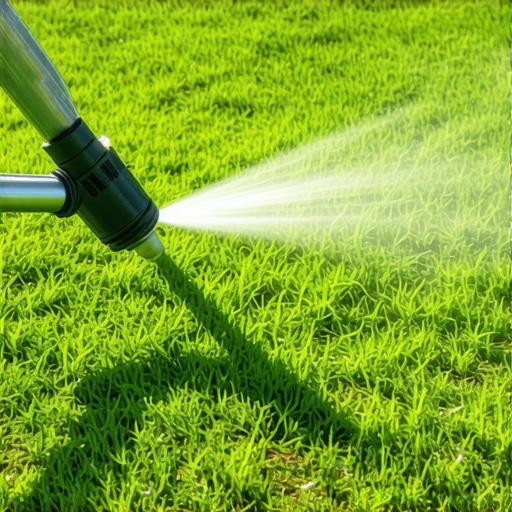
The ideal temperature for applying post-emergent herbicide is between 60 and 80 degrees Fahrenheit. If you spray when it is 90 degrees or higher, the stomata on the grass blades are closed to prevent moisture loss, meaning they won’t absorb the chemical, and the high heat will cause the herbicide to volatilize, potentially burning your turf. Professional lawn care requires a weather app and a thermometer, not just a free Saturday. If the sun is baking the yard, leave the sprayer in the truck. You will do more harm than good.
“Selective control of weeds in turfgrass depends on the ability of the herbicide to disrupt the growth of the weed without affecting the metabolism of the desired grass species.” – Texas A&M AgriLife Extension
How much modified gravel do I need for a patio base?
While we are talking about soil and grading, remember that landscaping isn’t just about what grows; it’s about the foundation. If you are installing a hardscape feature like a patio to replace a weed-infested area, you need 6 inches of modified 2A gravel (crushed limestone) compacted in 2-inch lifts. Use a plate compactor. If the tamper doesn’t bounce off the surface, it isn’t ready. This prevents settling and the pooling of water that creates the damp conditions crabgrass loves. Don’t build on a weak foundation.
Remediating a Failed Lawn: The Recovery Plan
If your lawn is currently 50% crabgrass, the forensic autopsy is clear: your turf is too thin. In the fall, you need to perform a ‘reset.’ This involves scalping the crabgrass (since it’s an annual, it will die in the first frost anyway), power-raking the debris, and over-seeding with a high-quality turf-type tall fescue. Do not buy seed from a big-box store; it contains ‘weed seed’ and ‘crop seed’ on the label. Go to a professional turf supply house and get a 99.9% pure seed. Then, apply a starter fertilizer with Mesotrione. This is a specific chemical that allows grass seed to grow while preventing weeds from germinating. It is the only exception to the ‘no pre-emergent during seeding’ rule. It is expensive, but it works. In the spring, you follow up with a standard pre-emergent program. This two-step punch is how we turn a weed-patch into a golf course. It takes time. It takes patience. It takes an understanding of the nitrogen cycle. Don’t skip the aeration. Soil needs to breathe. If you don’t fix the compaction, the crabgrass will be back next July. It is an engineering problem as much as a biological one.
![Why Your 2026 Zoysia Lawn is Patchy [3 Soil Fixes]](https://lawnmajesty.com/wp-content/uploads/2026/05/Why-Your-2026-Zoysia-Lawn-is-Patchy-3-Soil-Fixes.jpeg)