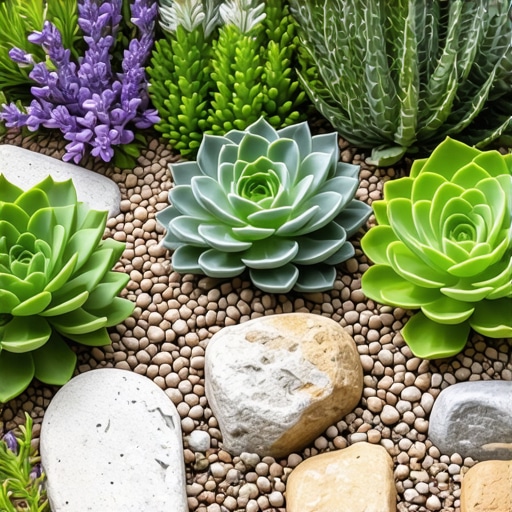
The best plants for a low-maintenance rock garden
The Hard Science of Rock Garden Engineering
The best plants for a low-maintenance rock garden are those that evolved to survive in high-drainage, low-nutrient environments, specifically species like Sedum, Sempervivum, and Thymus serpyllum, which thrive when planted in a hardscaped substrate of 50% grit and 50% organic matter. Success depends on soil grading and preventing hydrostatic pressure buildup.
I always drill into my new crew members: if you don’t fix the soil grading first, every plant you put in the ground is just expensive compost. Most homeowners think a rock garden is just tossing some boulders on a hill and sticking a few succulents in the gaps. That is how you end up with a weed-infested swamp by the following spring. I’ve seen it a thousand times. You have to understand the microscopic reality of the yard. We aren’t just decorating; we are managing fluid dynamics and cation exchange capacities. If your base layer isn’t compacted and your drainage isn’t calculated, the frost-heave will spit those expensive boulders right out of the ground. Don’t skip the prep. It’s the difference between a legacy landscape and a weekend mistake.
“Rock gardens require a substrate that mimics the high-drainage, low-nutrient environments of alpine scree slopes, where pore space exceeds capillary retention.” – International Agronomy Manual
How do you prepare soil for a rock garden?
Soil preparation for a professional-grade rock garden requires a radical departure from standard lawn care logic. You aren’t looking for rich, black topsoil. You need a gritty, lean mix. We typically aim for a 1:1:1 ratio of coarse horticultural grit, sharp sand, and a low-nitrogen leaf mold. This prevents the root girdling often seen in heavy clay soils. If the soil is too rich, your alpine plants will grow too fast, become structurally weak, and rot the moment the humidity spikes. It will rot. You need to measure the pH; most rock garden favorites like Aubrieta prefer a slightly calcareous (alkaline) environment, whereas others might need acidity. Don’t guess. Test.
Which plants thrive in a rocky environment?
The selection of plant material must be based on USDA hardiness zones and the specific micro-climate of your garden design. We focus on ‘xeric’ species—plants that have adapted to minimize transpiration. Sedum spurium, for instance, uses Crassulacean Acid Metabolism (CAM) to breathe at night, saving water. Then you have the Sempervivums (Hen and Chicks), which are essentially structural tanks. They wedge into crevices where nothing else survives. For ground cover, Thymus serpyllum (Creeping Thyme) provides high-density foliage that suppresses weed germination through sheer physical competition.
“A retaining wall doesn’t fail because of the stone; it fails because of the water trapped behind it.” – Hardscape Engineering Axiom
| Plant Species | Growth Habit | Drainage Requirement | Light Exposure |
|---|---|---|---|
| Sedum (Stonecrop) | Spreading/Mat | High (Grit-heavy) | Full Sun |
| Sempervivum | Rosette | Extreme (Crevices) | Full Sun |
| Armeria maritima | Clumping | Moderate/High | Full Sun/Part Shade |
| Phlox subulata | Carpet | High | Full Sun |
| Lithodora | Trailing | High (Acidic soil) | Full Sun |
When installing these, the root flare is your god. Plant too deep, and the crown rots. Period. We use a 1-inch layer of pea gravel or chicken grit around the base of every plant. This isn’t just for looks. It’s a mulch that doesn’t hold moisture against the stem. It’s a physical barrier against fungal pathogens. It also prevents the soil from splashing onto the foliage during heavy rain. We call this ‘top-dressing’ for a reason. It is the final engineering layer.
- Excavate the site to at least 12 inches to remove all invasive turf and weed seeds.
- Install a non-woven geotextile fabric if the subsoil is heavy clay to prevent soil migration.
- Place structural boulders first, burying them at least 1/3 of their height for stability.
- Backfill with a custom grit-and-loam mix, tamping in 3-inch lifts.
- Install plants using the ‘pocket’ method, ensuring no air gaps around the root ball.
- Finish with a 1-inch mineral mulch to regulate soil temperature.
Landscaping at this level is about managing the ‘settling-in’ period. For the first year, even ‘low-maintenance’ plants need deep, infrequent watering to force roots to chase moisture down into the grit. Don’t spray them every day with a garden hose. That’s for amateurs. You want to deliver exactly 1 inch of water per week, applied directly to the base. This forces the root system to expand. If the roots stay shallow, the winter freeze will kill them. Once they are established, you can basically walk away. That is the goal of true engineering: building a system that sustains itself. Don’t let the ‘mow-and-blow’ guys tell you otherwise. This is biology, not decoration.