The best way to fix a patchy lawn
The Professional Guide to Fixing a Patchy Lawn: A Horticultural Engineering Approach
A patchy lawn is a symptom of systemic failure, usually hidden beneath the surface in the soil profile. To fix it properly, you must move beyond the superficial application of seed and look at the underlying biology. Most residential turf fails because of a breakdown in the soil-plant-water relationship. When you see bare spots, you are looking at an environment that has become hostile to life. Fixing it requires a forensic approach to soil chemistry, compaction levels, and species selection.
Why is my lawn patchy?
To fix a patchy lawn, you must first diagnose the soil compaction, thatch accumulation, or nutrient deficiencies causing the die-back. Effective restoration involves core aeration, top-dressing with organic matter, and selecting site-specific seed varieties like Heat-Tolerant Tall Fescue to ensure long-term turf health and root development.
A homeowner called me in a panic after they completely torched their front lawn by applying a high-nitrogen ‘quick green’ synthetic fertilizer during a ninety-degree heat wave in July. The soil was literally crunchy. The nitrogen salts had sucked every drop of moisture out of the root zone through osmotic pressure, effectively mummifying the grass from the inside out. This is a classic case of what I call the Chemical Nightmare. The soil biology was dead. The beneficial fungi were gone. We had to wait for the salts to leach out and then rebuild the entire microbial community from scratch. This is why you never take advice from a big-box store teenager in a vest. They sell products; I sell results based on soil science.
“A lawn that is over-fertilized with nitrogen without regard for soil pH or phosphorus levels is a lawn built on a foundation of cards.” – Penn State Center for Turfgrass Science
The Soil Chemistry Autopsy
Before you touch a spreader, you need a soil test. Period. You are looking for two primary metrics: pH and Cation Exchange Capacity (CEC). If your soil pH is below 6.0, your grass cannot access the nutrients you are feeding it. The phosphorus and potassium become chemically locked in the soil particles. You can pour fertilizer on it all day, and the grass will still starve. Adding pelletized lime is often the first step in remediation, but it takes months to move through the soil profile. We calculate the lime requirement based on the buffer pH, not just the target pH. This is the difference between a contractor and a hack.
How much modified gravel do I need for a patio base?
While we are discussing site prep, it is worth noting that hardscape failures often mirror lawn failures: poor base preparation. For a standard residential patio, you need a minimum of 6 inches of compacted modified gravel (2A or CR-6) to ensure structural stability and proper drainage. This base must be mechanically compacted in 2-inch lifts to reach 95 percent Proctor density, preventing future settling and pavers shifting.
The Anatomy of Compaction and Thatch
Soil compaction is the silent killer of urban lawns. In a healthy soil profile, 50 percent of the volume is pore space, split between water and air. When you have heavy foot traffic or equipment, that pore space collapses. The roots can no longer breathe, and carbon dioxide builds up to toxic levels. This is why you see patches near walkways or where the dog runs. You can’t just throw seed on compacted clay and expect it to grow. The roots will hit that hardpan and turn sideways, creating a weak, shallow root system that dies at the first sign of heat.
Thatch is another hurdle. A thin layer of thatch (0.5 inches) is beneficial, but anything more acts like a sponge, soaking up light rain and preventing it from reaching the soil. It also harbors pathogens and insects. If your lawn feels spongy, you have a thatch crisis. You need to mechanically remove it or use biological dethatchers to break down the lignin and cellulose.
Markdown Table: Grass Seed Performance Comparison
| Grass Variety | Germination Window | Drought Tolerance | Traffic Rating | Ideal Soil pH |
|---|---|---|---|---|
| Kentucky Bluegrass | 14 to 28 Days | Low | High | 6.0 to 7.0 |
| Tall Fescue | 7 to 14 Days | High | Medium | 5.5 to 7.5 |
| Perennial Ryegrass | 5 to 7 Days | Moderate | Very High | 6.0 to 7.0 |
| Fine Fescue | 10 to 21 Days | High | Low | 5.0 to 6.5 |
Notice the germination window for Kentucky Bluegrass. Most DIYers give up after two weeks and think the seed failed. It didn’t. It is just slow. This is why we often use a mix. The Ryegrass acts as a ‘nurse crop’ to stabilize the soil, while the Bluegrass takes its time to establish a permanent sod.
The Restoration Checklist
- Mow the existing turf to 1.5 inches to allow sunlight to reach the soil.
- Perform a double-pass core aeration, pulling 3-inch plugs to relieve compaction.
- Apply a thin layer of screened leaf compost (0.25 inches) to introduce organic matter.
- Broadcast high-quality, endophytic-enhanced seed at the recommended rate.
- Use a starter fertilizer with a high phosphorus (P) ratio to stimulate root growth.
- Water for 15 minutes twice daily until germination occurs.
It will rot. If you over-water and leave the soil saturated, the seeds will rot before they ever sprout. You want moist, not muddy. The first three weeks are critical. Do not walk on it. Do not let the dog on it. It is a nursery, not a playground.
How much grass seed do I need for a patchy lawn?
For overseeding patchy areas, you should apply 4 to 6 pounds of seed per 1,000 square feet, depending on the grass species and seed size. Larger seeds like Tall Fescue require higher poundage, while Kentucky Bluegrass has more seeds per pound, allowing for a lower application rate to achieve optimal coverage and germination density.
Information gain: Most people buy seed at big-box stores. Stop doing that. Those bags often contain up to 2 percent ‘crop seed’ or ‘weed seed.’ That sounds small, but in a 50-pound bag, that is thousands of weed seeds you are intentionally planting. Go to a professional turf supply house and buy ‘Blue Tag’ certified seed. It is 99.9 percent weed-free. It costs more because it is worth more.
“Hydrostatic pressure is the enemy of any vertical structure in the landscape; if you don’t provide a path for water, the water will provide a path for failure.” – Hardscape Engineering Axiom
This quote applies to lawns too. If your yard has standing water, you don’t have a seed problem; you have a grading problem. You need to fix the slope to move water away from the house at a rate of 1 inch of drop per 1 foot of run for the first 10 feet. Without proper grading, your new seed will just wash away or drown in the next thunderstorm.
Seeding Depth and Soil Contact
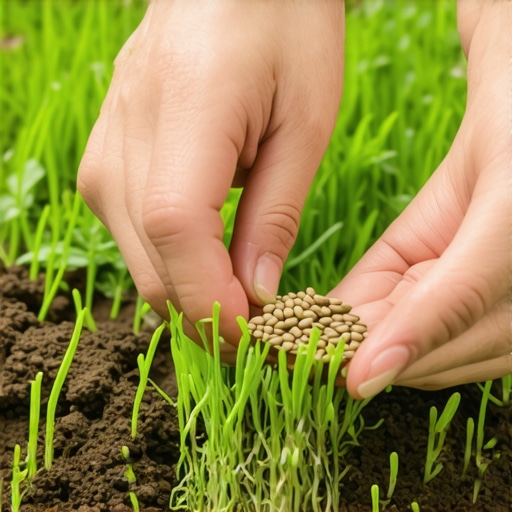
Seed-to-soil contact is the most overlooked factor in lawn repair. A seed sitting on top of a dead grass blade or a rock will not grow. It needs to be tucked into the soil at a depth of 1/8 to 1/4 inch. This is why we use a slit seeder or a power overseeder for large-scale restorations. These machines cut a groove in the soil and drop the seed directly into it. If you are doing it by hand, use a hard-tooth rake to scuff the surface until you see raw dirt. If you don’t see dirt, don’t drop seed. It is that simple.
Long-Term Maintenance Strategy
Once the patches are filled, the job isn’t over. You need to change how you mow. Most people scalp their lawns at 2 inches. This is a death sentence. Set your mower to 3.5 or 4 inches. Tall grass shades the soil, keeping it cool and reducing evaporation. It also allows the plant to produce more energy through photosynthesis, which leads to deeper roots. Deep roots are the only thing that will save your lawn during an August drought. Water deeply and infrequently. One inch of water per week, applied in a single session, is better than ten minutes of misting every day. You want to force the roots to grow down deep to find the water. Don’t be a hack. Be a steward of the soil.