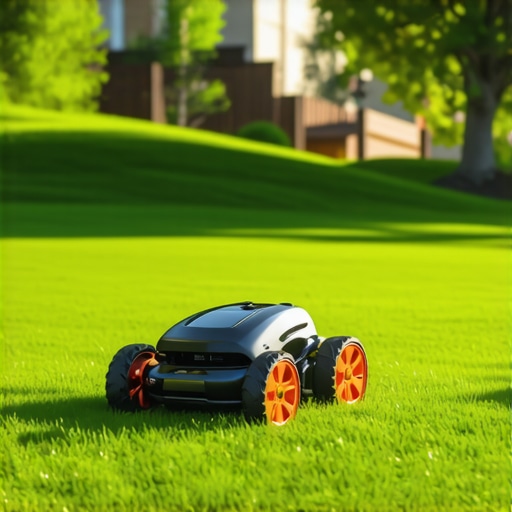
Best 2026 Battery Mowers for Quarter-Acre Lots
Engineering the Perfect Cut: The Truth About 2026 Battery Mowers for Quarter-Acre Lots
Successful lawn management starts long before you pull the trigger on a new mower. For a quarter-acre lot, the decision between 60V and 80V platforms isn’t about marketing fluff; it is about blade tip speed and soil bulk density. Most homeowners buy for convenience, but as a professional, I buy for torque and weight distribution. If your mower is too heavy, you are compacting the soil, crushing the macropores that allow oxygen to reach the root zone. 80% of the work in a high-end landscape happens in the planning phase. You need to understand the mechanical load required to shear your specific grass species without tearing the vascular tissue.
Why 2026 is the Tipping Point for Quarter-Acre Battery Tech
The 2026 battery mower market for quarter-acre lots has shifted toward high-density lithium-ion cells and brushless motor efficiency, providing enough runtime to manage 10,890 square feet on a single charge. These units now match the torque output of 160cc gas engines without the hydrocarbon emissions or vibration fatigue common in older models.
A homeowner called me in a panic last summer after they completely torched their front lawn. They weren’t using chemicals. They were using an old, heavy gas mower with a dull blade and a slow-leaking fuel cap. The combination of gasoline-soaked soil and the mechanical tearing of the grass blades—rather than clean slicing—created a pathogen highway. By the time I arrived, the Pythium blight had wiped out 40% of their turf. We had to excavate two inches of soil, remediate the pH balance, and start over. This is why I advocate for the new generation of battery equipment; they are lighter, cleaner, and the blade speed is digitally regulated to prevent ‘bogging’ which leads to turf bruising.
“Maintaining sharp mower blades is essential for plant health; dull blades tear the grass tissue, increasing water loss and susceptibility to disease.” – University of Minnesota Extension
How much battery capacity do I need for 0.25 acres?
For a standard quarter-acre lot, you need a minimum of 5.0Ah (Amp-hours) at 56V or 60V to finish the job without a mid-mow recharge. If you are bagging thick Tall Fescue or St. Augustine, the resistance increases the draw on the motor. In these cases, I recommend a dual-port system or a single 7.5Ah battery. Do not trust ‘up to 60 minutes’ claims. Those are measured under zero-load conditions on a concrete pad, not in the real world of thick turf and 2-inch clippings.
[image_placeholder_1]
The Materials Breakdown: Carbon Fiber vs. Steel Decks
Selecting a mower deck material involves a trade-off between durability and maneuverability; carbon fiber decks in 2026 offer superior weight reduction to prevent soil compaction, while stamped steel decks provide the vacuum pressure necessary for high-lift bagging in dense landscaping environments.
| Mower Model (2026 Class) | Voltage / Ah | Deck Material | Best For… |
|---|---|---|---|
| Ego Power+ Select Cut XP | 56V / 10.0Ah | Polymer | Thick St. Augustine |
| Milwaukee M18 FUEL Dual | 36V (2×18) / 12.0Ah | Steel | Commercial-grade Durability |
| Greenworks Pro 80V | 80V / 4.0Ah | Steel | Heavy Mulching |
| Ryobi 40V HP Brushless | 40V / 6.0Ah | Polymer | Precision Maneuvering |
Are electric mowers better for thick St. Augustine or Tall Fescue?
Electric mowers are often superior for these grasses because of ‘smart’ torque. Modern brushless motors sense the resistance on the blade. When you hit a thick patch of St. Augustine, the controller dumps more current into the motor to maintain RPMs. Gas mowers often cough and lose blade speed, resulting in a ragged cut. For Tall Fescue, which prefers a 3.5 to 4-inch height of cut, the lightweight nature of battery mowers prevents the ‘rutting’ that happens when heavy gas units sink into soft, well-irrigated soil.
The Installation of a Maintenance Routine
Maintenance on these machines is microscopic compared to gas, but it is not zero. You must check the underside of the deck after every mow. If clippings build up, they disrupt the laminar flow of air. This ruins the ‘lift’ required to stand the grass up for a clean cut. I tell my crew: if the blade isn’t sharp enough to cut paper, it isn’t sharp enough to cut my clients’ grass. It will rot. Sharpness is non-negotiable.
- Blade Sharpening: Every 20 hours of use.
- Underside Cleaning: Use a plastic scraper, never a metal one that can score the deck.
- Battery Storage: Never store at 0% or 100% in a freezing garage; keep them at 40-60% in a climate-controlled space.
- Tire Pressure: Ensure even PSI to maintain a level deck height.
“Soil compaction from heavy equipment reduces the pore space necessary for oxygen and water infiltration, leading to anaerobic conditions in the root zone.” – Penn State Center for Turfgrass Science
Adapting to Your Micro-Climate
In regions with heavy red clay, like Georgia, or the Pacific Northwest where the ground stays saturated, weight is your enemy. A heavy mower on wet clay is a recipe for a ‘surface seal’ that prevents nutrients from reaching the roots. In these zones, go for the lightest polymer-deck battery mower you can find. If you are in a sandy loam area like Florida, the high-lift capacity of a steel deck is better for sucking up the sand and debris that can dull your blades prematurely. Always call 811 before you start any major hardscaping or grading project, but for mowing, just keep your eyes on the moisture levels. Don’t mow when it’s soggy. It’s a waste of time and health.


![Why Your 2026 Grass Seed Isn't Growing [3 Critical Mistakes]](https://lawnmajesty.com/wp-content/uploads/2026/05/Why-Your-2026-Grass-Seed-Isnt-Growing-3-Critical-Mistakes.jpeg)