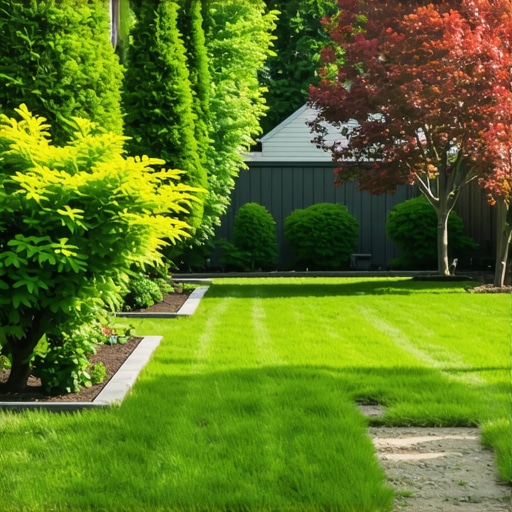
Best 2026 Trees for Small Suburban Backyards
The Engineering of a Living Asset: Why Planning Trumps Aesthetics
For the 2026 planting season, the selection of small suburban trees has shifted from mere visual appeal to high-performance biological engineering. Choosing the right tree for a small backyard requires evaluating mature canopy spread, root system architecture, and the specific pH requirements of the soil to ensure long-term structural integrity and minimal maintenance costs. Most homeowners make the mistake of buying a tree based on its appearance at the nursery without calculating the 10-year growth trajectory. A tree is a 40-year investment that must survive compacted urban soils, fluctuating water tables, and the heat island effect of nearby hardscaping. I always drill into my new crew members: if you don’t fix the soil grading and analyze the drainage first, every plant you put in the ground is just expensive compost. I have seen too many $500 specimens die within 18 months because someone forgot that roots need 20% oxygen in the soil to breathe. If you plant a tree in a hole that acts like a clay bowl, you are just drowning it in a very expensive bathtub.
“The single most common cause of young tree death in the landscape is improper planting depth and the subsequent lack of root flare oxygenation.” – International Society of Arboriculture (ISA) Planting Manual
The Anatomy of the Root Flare and Why It Matters
When we talk about planting in 2026, we are looking at a market dominated by cultivars bred for urban resilience. However, the best genetics in the world cannot save a tree planted too deep. The root flare, that widening at the base of the trunk where wood meets roots, must remain visible at the soil surface. I recently had an apprentice bury a row of Paperbark Maples (Acer griseum) three inches too deep. I made him dig every single one of them up by hand. Why? Because the bark on the trunk is not designed to be submerged in moist soil. It will rot. When it rots, the phloem dies, and the tree cannot transport sugars to the roots. It is a slow, agonizing death that homeowners often mistake for a lack of fertilizer. We do not use the big-box store logic of “deep and tight.” We dig wide, shallow holes, three times the width of the root ball, to ensure the lateral roots can penetrate the compacted suburban subsoil without meeting immediate resistance.
Top Tree Cultivars for 2026 Suburban Landscapes
The best trees for 2026 are those that balance a height limit of 15 to 25 feet with a genetic resistance to common local pathogens such as powdery mildew or leaf spot. Selecting cultivars like the ‘Autumn Brilliance’ Serviceberry or the ‘Rising Sun’ Redbud provides high environmental value while fitting into tight 20-foot by 20-foot backyard envelopes common in modern suburban developments. These species are chosen because they do not have aggressive, infrastructure-damaging root systems that would threaten patio foundations or sewer lines. We look at the specific growth rate: a tree that grows 24 inches a year might look great now, but in a small yard, it becomes a liability within a decade. We want trees that put their energy into wood density and root establishment, not just vertical reach.
| Tree Species/Cultivar | Mature Height (ft) | Root System Type | Best Soil pH Range | 2026 Resilience Rating |
|---|---|---|---|---|
| Amelanchier ‘Autumn Brilliance’ | 15-20 | Non-Invasive Fibrous | 5.5 – 7.5 | High (Drought/Cold) |
| Carpinus caroliniana ‘Palisade’ | 20-25 | Deep Tap/Lateral | 6.0 – 7.8 | High (Wind Resistance) |
| Cercis canadensis ‘Rising Sun’ | 12-15 | Spreading | 6.5 – 8.0 | Medium (Heat Tolerant) |
| Acer griseum (Paperbark) | 20-25 | Compact Lateral | 5.0 – 7.0 | High (Pest Resistant) |
How much space does a small backyard tree need?
A small suburban tree typically requires a minimum of 8 to 10 feet of clearance from any permanent structure, including house foundations and retaining walls. This distance ensures that the mature canopy does not scrape against siding and that the root zone has enough uncompacted soil volume to support the tree’s hydration needs during peak August heat. If you have a 400-square-foot patio, you need to be looking at trees with a mature spread of no more than 15 feet. Anything larger will result in constant pruning cycles that stress the tree and invite opportunistic fungi to enter the pruning wounds.
What are the best trees to plant near a patio?
When planting near hardscaping, species with non-aggressive root systems like the Japanese Maple (Acer palmatum) or the American Hornbeam (Carpinus caroliniana) are the professional choice. These trees do not exhibit the same “heaving” behavior as larger maples or oaks, which can lift 400-pound pavers or crack 4-inch concrete slabs. We always install a physical root barrier if the planting pocket is within 3 feet of a high-end paver installation. We use a 18-inch deep HDPE (High-Density Polyethylene) barrier to deflect roots downward, away from the modified gravel base of the patio. This is the difference between a landscape that lasts 5 years and one that lasts 50.
“Urban soils are frequently characterized by high bulk density and reduced pore space, necessitating the use of species with high anaerobic tolerance and specific mycorrhizal associations.” – USDA Forest Service Urban Forestry Technical Report
The Soil Microbiology Factor: Beyond Nitrogen, Phosphorus, and Potassium
The success of a 2026 landscape installation depends more on the soil’s biological activity than on chemical fertilizers. Most suburban yards are biological deserts due to heavy grading and the removal of topsoil during house construction, requiring the reintroduction of mycorrhizal fungi and organic matter to support tree health. When I walk onto a site, I am looking at the soil structure. Is it platy? Is it massive? If I cannot push a soil probe 12 inches into the ground with one hand, the tree is going to struggle. We use a process called vertical mulching for existing trees, but for new 2026 installs, we incorporate 10% high-quality compost into the backfill. We do not use 50/50 mixes. Too much organic matter in a hole creates a “pot effect” where the roots refuse to leave the soft, nutrient-rich hole to enter the tougher native soil. We want the roots to hunt. We want them to find the moisture. We use a 3-inch layer of triple-shredded hardwood mulch, but we keep it 4 inches away from the trunk. No mulch volcanoes. I will fire a guy on the spot if I see mulch piled against the bark. It creates a bridge for moisture and insects to bypass the tree’s natural defenses.
- Step 1: Call 811 to mark underground utilities. Never assume depth.
- Step 2: Excavate a hole 3x the width of the root ball with sloped sides to encourage lateral root penetration.
- Step 3: Locate the true root flare by removing excess soil from the top of the nursery ball.
- Step 4: Set the tree on undisturbed soil to prevent settling.
- Step 5: Backfill with native soil, tamping lightly with hands, not boots, to remove large air pockets.
- Step 6: Water immediately with 10-15 gallons to settle the soil and eliminate microscopic air gaps.
Year One: The Critical Establishment Phase
Once the tree is in the ground, the work has just begun. The first 365 days determine if the tree will thrive or merely survive. A newly planted tree requires approximately 1 inch of water per week, delivered slowly to the root zone via drip irrigation or a soaker hose, rather than high-pressure surface watering. I tell my clients to think of the tree like a patient in recovery. The root system has been severed or cramped in a pot for years. It needs consistent, deep hydration to rebuild its fine root hairs. We don’t use the “set it and forget it” approach with lawn sprinklers. Lawn sprinklers only penetrate the top 2 inches of soil. That is great for turf grass, but it is useless for a tree. You need a slow trickle that reaches 12 to 18 inches deep. If you see the leaves wilting or showing scorched edges in July, you have already failed the hydration test. The tree is sacrificing its foliage to save its core. By the time the leaves turn brown, the damage to the vascular system is already done. Keep the soil moist like a wrung-out sponge, not a swamp. This is the science of 2026 landscaping. It is about precision, not guesswork.