
Build a $150 2026 River Rock Swale [Easy DIY]
How to Build a $150 River Rock Swale for Professional 2026 Yard Drainage
I recently got called out to tear up a $30,000 patio that was sinking because the previous contractor failed to understand basic hydrostatic pressure. The pavers were heaving and the mortar joints had turned to powder. Why? Because water was pooling against the foundation with nowhere to go. If they had spent $150 on a properly engineered river rock swale, that patio would still be level today. This is not about making a pretty garden feature; it is about civil engineering on a residential scale. Most DIYers and low-bid ‘landscapers’ treat drainage as an afterthought. They throw some rocks in a ditch and call it a day. That is how you end up with a mosquito-breeding mud pit. A real swale is a functional piece of infrastructure designed to manage water velocity and infiltration rates.
The Engineering Logic of a Functional River Rock Swale
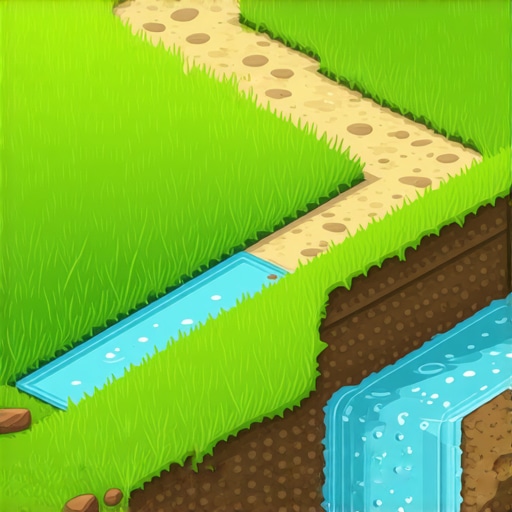
A river rock swale or dry creek bed is a graded depression designed to direct stormwater runoff away from structures using gravity and permeable layers. By utilizing 4-ounce non-woven geotextile fabric and varied stone diameters, you create a path of least resistance that prevents soil erosion while allowing groundwater recharge.
“A retaining wall doesn’t fail because of the stone; it fails because of the water trapped behind it.” – Hardscape Engineering Axiom
Before you touch a shovel, you must understand your soil. If you are dealing with heavy clay, your infiltration rate is near zero. This means your swale acts strictly as a flume. If you have sandy loam, your swale will act as a bio-retention cell. You need a minimum 1 percent slope. That is a 1-inch drop for every 8 feet of run. Anything less and the water stays put. Anything more than 5 percent and the water moves too fast, stripping your rock and scouring the soil underneath. I have seen guys try to build these on flat ground; it just creates a linear pond. Do not be that guy.
Site Analysis and Material Selection
Successful drainage projects require precise topographical assessment and the use of industrial-grade materials rather than big-box store equivalents. Using angular rip-rap for the base and smooth river rock for the surface ensures structural stability and hydraulic efficiency during peak 100-year rain events.
| Material | Unit Quantity | Estimated Cost | Drainage Function |
|---|---|---|---|
| 4oz Non-Woven Geotextile | 25 Linear Ft | $45.00 | Soil separation and filtration |
| 1-3 Inch River Rock | 1 Ton (Bulk) | $65.00 | Surface armoring and aesthetics |
| 3/4 Inch Clean Stone | 0.5 Ton | $30.00 | Sub-grade stabilization |
| Marking Paint/Flags | 1 Can | $10.00 | Utility and grade mapping |
How much modified gravel do I need for a patio base?
For a standard residential patio, you need 4 to 6 inches of compacted 21A or 57 stone. To calculate the volume, multiply the square footage by the depth in feet, then divide by 27 to get cubic yards. Standard compaction requires a 95 percent Proctor density to prevent future settling.
What is the best rock for a drainage swale?
The best rock for a swale is a mix of 2-inch to 6-inch river stones. Smooth stones allow water to flow with less turbulence, while the variation in size ensures the rocks interlock. Avoid pea gravel; it is too light and will wash away in a heavy downpour.
Step-by-Step Construction: The Forensic Build
The first step is the ‘Proof Roll.’ Walk the line. If your boots sink, the subgrade is saturated and must be dried before excavation. Dig your trench at least 18 inches wide and 8 inches deep. Shape it like a ‘U’, not a ‘V’. A ‘V’ shaped trench concentrates force at a single point and will cause the fabric to tear. Lay your 4-ounce non-woven geotextile. Do not use the woven ‘weed barrier’ junk. Woven fabric is for stabilization under driveways; non-woven is for drainage. It lets water through but keeps the silt out. Overlap your seams by at least 12 inches. Pin it down. If you skip the pins, the fabric will shift as you pour the stone. It will rot the project from the inside out. Don’t skip this.
- Call 811 to mark underground utilities before digging.
- Excavate to a depth of 8-10 inches with a 3:1 side slope.
- Install non-woven geotextile fabric, extending it past the edges.
- Anchor the fabric with 6-inch steel staples every 3 feet.
- Place large ‘anchor’ stones at points of high water velocity.
- Fill the center with 2-4 inch river rock.
- Hand-tamp the edges to ensure soil-to-stone contact.
“Proper drainage design must account for the peak discharge rate of the contributing watershed to prevent localized flooding.” – USDA NRCS Engineering Field Handbook
Soil Science and Hydrostatic Realities
Water is heavy. One cubic foot of water weighs 62.4 pounds. When your soil becomes saturated, that weight creates hydrostatic pressure against your foundation or your hardscape. A swale acts as a pressure relief valve. By creating a designated channel, you are managing the energy of the water. In my years of doing this, I have seen ‘landscapers’ bury 4-inch corrugated pipe and think they solved the problem. Those pipes clog with root intrusion and silt within three years. A river rock swale is a ‘forever’ solution because it is accessible and uses natural filtration. It will not fail as long as the physics of gravity remain in effect. Keep the mouth of the swale clear of debris. Check it after every major storm. You are looking for ‘fines’ (small silt particles) building up. If you see them, hose them down into the rock layer or remove them. Maintenance is the difference between a 20-year swale and a 2-year mistake.
![Build a $250 Gravel Shed Base [2026 No-Slab Fix]](https://lawnmajesty.com/wp-content/uploads/2026/05/Build-a-250-Gravel-Shed-Base-2026-No-Slab-Fix.jpeg)
![Build a $500 2026 Flagstone Fire Pit Circle [DIY]](https://lawnmajesty.com/wp-content/uploads/2026/05/Build-a-500-2026-Flagstone-Fire-Pit-Circle-DIY.jpeg)
![Building a 2026 Simple Stone Bench [DIY]](https://lawnmajesty.com/wp-content/uploads/2026/09/Building-a-2026-Simple-Stone-Bench-DIY.jpeg)