Build a $400 2026 Stone Fire Pit Area for Small Patios
The Hardscape Autopsy: Why Cheap Installs Fail
I recently got called out to tear up a $30,000 patio that was sinking because the previous contractor ignored the sub-grade preparation and drainage requirements. The homeowner thought they were getting a deal; instead, they got a structural nightmare where every stone shifted two inches after the first freeze-thaw cycle. In the world of hardscaping and landscaping, gravity and water are the only two laws that matter. If you are building a $400 fire pit in 2026, you are likely working with a small footprint. Don’t let the small scale fool you into skipping the engineering. Most DIY pits fail because the heat from the fire expands the stones while the moisture in the soil underneath exerts hydrostatic pressure upward. This conflict ruins the structure. You must respect the physics of the site before you buy the first block.
The Foundation Myth: Why Cheap Fire Pits Sink
To prevent a fire pit from sinking, you must excavate a sub-grade at least eight inches deep and backfill it with compacted 2A modified gravel to ensure a stable, level foundation that allows for vertical drainage away from the stone structure. Most amateurs just throw some pavers on the grass. It will fail. You are looking at a 1000-pound stack of concrete and stone. Without a compacted base, that weight will drive the stones into the soft topsoil. I see it every week. Soil has a bearing capacity. Typical residential soil might hold 1,500 to 2,000 pounds per square foot. When you saturate that soil with rain, that capacity drops. You need a gravel raft to spread the load.
“A retaining wall doesn’t fail because of the stone; it fails because of the water trapped behind it.” – Hardscape Engineering Axiom
How much modified gravel do I need for a fire pit base?
For a standard 48-inch diameter fire pit area, you typically need approximately 0.5 to 0.75 cubic yards of crushed stone or 2A modified gravel to create a solid six-inch compacted base. This depth is the industry standard for preventing settling and heaving. Use a plate compactor. A hand tamper is for amateurs. If the base doesn’t ring when you hit it, it isn’t ready. You want 95 percent Proctor compaction. Don’t skip this. If you skip compaction, the first heavy rain will turn your fire pit into a lopsided mess. It is non-negotiable.
Material Costs and Selection: The $400 Budget Breakdown
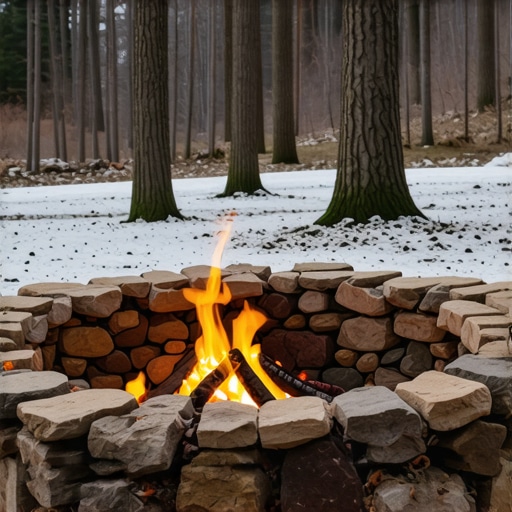
Building a high-quality fire pit on a $400 budget requires prioritizing structural integrity over aesthetic veneers by selecting tumbled concrete blocks and industrial-grade fire brick liners that can withstand thermal expansion without cracking or exploding. Cheap river rocks are dangerous. They contain trapped moisture. When that moisture turns to steam, the rock explodes. Shrapnel is not a good look for your garden design. Stick to concrete masonry units (CMU) or kiln-fired bricks.
| Material Item | Quantity | Estimated Cost | Structural Purpose |
|---|---|---|---|
| Tumbled Wall Blocks | 36-45 Units | $180 – $220 | Structural Wall Integrity |
| 2A Modified Gravel | 0.75 Yards | $40 – $60 | Load Bearing & Drainage |
| Steel Fire Ring | 1 (36-inch) | $60 – $80 | Heat Protection for Stone |
| Polymeric Sand | 1 Bag | $30 – $40 | Joint Stabilization |
The Thermal Reality: Protecting Your Stone and Turf
Heat is an engine of destruction for stone. While the internet tells you to use any old landscape block, the reality is that direct heat exposure will cause thermal shock and spalling in standard concrete if you do not use a steel fire ring or fire-rated mortar. Your lawn care routine also matters here. Radiant heat from a pit can desiccate turf grass within a three-foot radius. If you have high-end Fescue or Kentucky Bluegrass, you need to extend your stone footprint further than you think.
“Proper base preparation accounts for 80% of the long-term success of any hardscape installation, particularly when dealing with high-heat variables.” – ICPI Technical Manual
What is the best stone for a fire pit in 2026?
The best material for a fire pit in 2026 is kiln-fired clay brick or pre-cast concrete wall units designed specifically for high-temperature environments, as these materials offer the durability and compressive strength required to handle repeated freeze-thaw cycles. Avoid limestone. Limestone is porous and soft. It will degrade. Sandstone is even worse. It flakes. For a $400 budget, the tumbled concrete block is your workhorse. It looks decent and stays put. Just ensure you aren’t using a “dry stack” method without some form of heat-resistant adhesive or a mechanical interlock.
The Ground-Up Build: Step-by-Step Installation
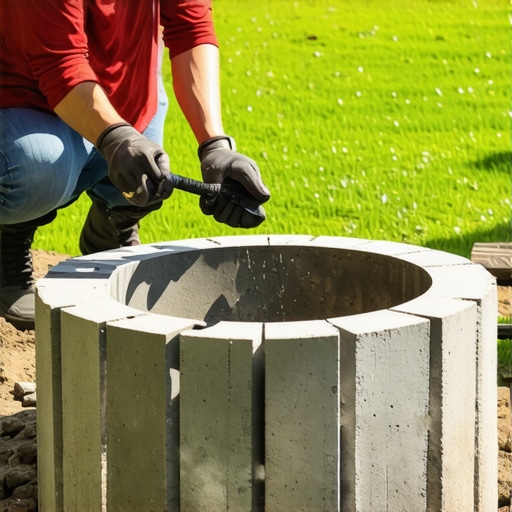
Effective fire pit installation begins with site excavation to a depth that reaches undisturbed sub-soil, followed by the installation of a geotextile fabric to prevent fines migration between the soil and your gravel base. Don’t just dig a hole. Dig a level hole. Use a string level. If you’re off by half an inch at the bottom, you’ll be off by two inches at the top.
- Mark the circle: Use a stake and string. Make the radius 6 inches wider than the pit.
- Excavate: Remove 8 inches of soil. Do not leave loose dirt at the bottom.
- Fabric: Lay down non-woven geotextile. It prevents the gravel from sinking into the mud.
- Gravel: Fill in 2-inch lifts. Compact each lift until it feels like concrete.
- Leveling: The first course of stone must be perfectly level. Spend two hours here if you have to.
- Stacking: Stagger the joints. A vertical joint is a weak point.
- Fire Ring: Insert the steel ring. Leave a 1-inch air gap between the steel and the stone.
Maintenance: The Year One Reality
After the build, your landscaping project enters the settling phase where you must monitor for drainage clogs and ensure that the polymeric sand in the joints remains intact to prevent weed growth and insect infestation. In year one, check your levels after the first big storm. If you did the base right, it won’t move. If it moves, you cheated on the compaction. Ash is also acidic. Don’t let it sit in the pit for months. Rain turns ash into lye, which can eat away at the concrete base of your stones. Scoop it out. Keep the drain holes clear. A fire pit that holds water is just a breeding ground for mosquitoes. It will rot the bottom of your steel ring too. Clean it. Maintain it. Respect the build.
![Build a $300 Modern Pergola for 2026 Shade [DIY]](https://lawnmajesty.com/wp-content/uploads/2026/06/Build-a-300-Modern-Pergola-for-2026-Shade-DIY.jpeg)
![Build a $500 Outdoor Kitchen Frame with Steel Studs [DIY]](https://lawnmajesty.com/wp-content/uploads/2026/05/Build-a-500-Outdoor-Kitchen-Frame-with-Steel-Studs-DIY.jpeg)