![Build a $600 Flagstone Patio on a Sand Base [2026 DIY]](https://lawnmajesty.com/wp-content/uploads/2026/05/Build-a-600-Flagstone-Patio-on-a-Sand-Base-2026-DIY.jpeg)
Build a $600 Flagstone Patio on a Sand Base [2026 DIY]
The Engineering Reality of DIY Flagstone Patios
Most DIY flagstone projects fail because the installer treats soil like a static surface rather than a living, shifting substrate that reacts to hydrostatic pressure and frost heave. Building a $600 flagstone patio requires a deep understanding of soil compaction, base material ratios, and water management to ensure the stone does not shift or crack under environmental stress. Success depends entirely on the preparation of the sub-grade rather than the aesthetic of the stones themselves.
I recently got called out to tear up a $30,000 patio that was sinking because the previous contractor thought they could skip the sub-base compaction. The homeowner was literally watching their investment slide into a drainage swale. When we excavated, I found four inches of uncompacted ‘screenings’ that had turned into a muddy slurry. This is why I tell my crew every morning: the stone is just the skin; the base is the skeleton. If the skeleton is weak, the body collapses. This $600 DIY approach follows the same physics. You aren’t just laying rock; you are building a structural platform that must breathe with the seasons while resisting the weight of foot traffic and furniture.
“A retaining wall or patio doesn’t fail because of the stone; it fails because of the water trapped behind or beneath it.” – Hardscape Engineering Axiom
The Physics of the Base: Beyond Just Dirt
To keep a project under $600, you must be surgical with your material choices. We are looking at a 10×10 area. You need a 4-inch deep excavation. Do not just scrape the grass off. You must remove the organic layer entirely. Organic matter rots. When it rots, it leaves voids. Voids lead to settling. You need a sub-base of 3/4-minus crushed limestone or ‘modified’ gravel. This material has jagged edges that lock together under pressure. Round river stones will never compact; they will roll like ball bearings.
| Material | Quantity (100 sq ft) | Estimated Cost |
|---|---|---|
| 3/4″ Modified Gravel | 1.5 Tons | $120 |
| Concrete Sand (Coarse) | 0.5 Tons | $60 |
| Natural Flagstone (Pallet) | 1.5 Tons | $350 |
| Geotextile Fabric | 1 Roll | $40 |
| Total | — | $570 |
How much modified gravel do I need for a patio base?
Determining gravel volume requires calculating the cubic yardage of your excavation area and multiplying by the compaction factor of 1.2. For a standard 100-square-foot patio with a 4-inch base, you need approximately 1.25 cubic yards or 1.5 tons of modified stone to account for settling during the tamping process.
“Proper compaction for residential hardscapes should reach 98% of the Standard Proctor Density to prevent long-term settling and lateral movement.” – ICPI Tech Spec No. 2
The Installation Protocol: Step-by-Step Execution
A successful sand-base installation involves excavating to a depth of 7 inches, laying geotextile fabric, compacting a 4-inch gravel sub-base, and screeding a 1-inch bed of coarse concrete sand. This layering system ensures drainage while providing a stable, friction-locked surface for the irregular shapes of natural flagstone to rest upon without wobbling.
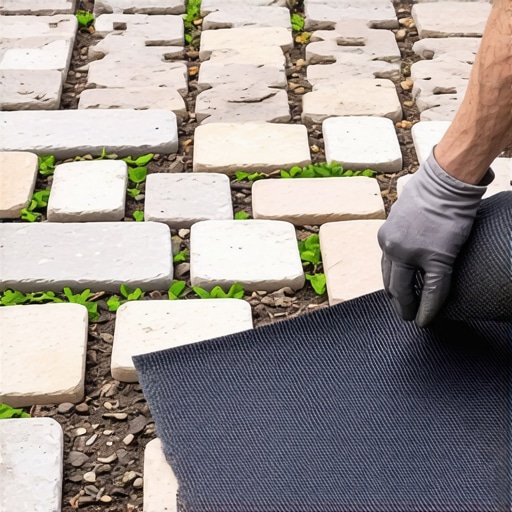
The first step is the ‘Thud Test.’ Once you’ve excavated, rent a gas-powered plate compactor. A hand tamper is a toy. You need the 3,000 PSI of a plate compactor to force those gravel shards together. Run the machine in overlapping patterns. If the machine bounces and the ground rings with a metallic ‘thwack,’ you have achieved density. If it sounds dull, keep going. Next, lay your geotextile fabric. This isn’t ‘weed barrier’ from a big-box store; this is a structural separator that prevents the gravel from sinking into the clay subsoil. Without it, your base will vanish into the earth over three winters.
Is a sand base better than a concrete slab for flagstone?
A sand-set patio is often superior to concrete in freeze-thaw climates because it is flexible and allows for natural expansion and contraction. Unlike rigid concrete slabs that inevitably crack under hydrostatic pressure, a sand base can be easily repaired by lifting individual stones and releveling the base material without expensive demolition.
- Mark the perimeter: Use white marking paint, not string lines that can be tripped over.
- Slope for drainage: Ensure a 2% grade away from the house (1 inch of drop for every 4 feet of length).
- Screed the sand: Use 1-inch PVC pipes as rails to get a perfectly level bed of sand before the stones go down.
- Fit the puzzle: Lay your largest stones first at the corners and high-traffic areas.
- Lock the joints: Use polymeric sand or stone dust to fill the gaps. Don’t use play sand; it’s too fine and will wash away in the first rain.
Maintaining Your Investment
The work doesn’t end when the stones are down. In the first year, the patio will ‘find its seat.’ You will see minor settling. This is normal. Keep a bag of extra stone dust on hand to top off the joints. This prevents weed seeds from finding a home in the gaps. Do not use a power washer on high settings; you will blast the stabilizing sand out from under the stones. A simple garden hose is enough. If you see ants, address them immediately. Ant colonies can move pounds of base material in a single season, creating ‘soft spots’ under your flagstone. This is a scientific build, not a weekend craft project. Respect the physics of the soil, and this $600 build will outlast the house it’s attached to.
![Why Your 2026 Concrete Driveway is Cracking [Fix]](https://lawnmajesty.com/wp-content/uploads/2026/06/Why-Your-2026-Concrete-Driveway-is-Cracking-Fix.jpeg)