
Fix 2026 Clay Soil Compaction with This $40 Aerator
A homeowner called me in a panic after they completely torched their front lawn by applying three times the recommended dose of high-nitrogen fertilizer on top of bone-dry, compacted clay. The grass didn’t just die; it desiccated. When I arrived, the ground was as hard as a sidewalk. You could see the white crust of unused salts sitting on the surface because the soil was too tight to let anything pass. This wasn’t a nutrient problem; it was a physics problem. They had zero pore space. The roots were suffocating in an anoxic environment, and no amount of ‘lawn food’ was going to save a plant that couldn’t breathe. I told them to put the spreader away and pick up a manual core aerator. If your soil has reached a bulk density that prevents water infiltration, you are not growing a lawn; you are managing a concrete slab.
The Critical Failure of Compacted Clay Soil
Clay soil compaction occurs when the microscopic, plate-like particles of clay are pressed together, eliminating the macropores necessary for air and water movement. This results in increased bulk density and decreased oxygen levels, which effectively halts root respiration and leads to turf decline and disease. To fix this, you must physically remove soil cores to break the surface tension and allow for gas exchange at the root zone.
Clay is composed of tiny flat particles. When these particles are hydrated and then subjected to foot traffic or heavy lawn equipment, they stack like sheets of wet paper. This stacking creates a nearly impenetrable barrier. If you find that water beads on the surface of your grass or if you cannot push a screwdriver more than two inches into the ground, your bulk density is too high. High bulk density means your roots are working ten times harder just to move an inch. Eventually, the plant gives up. Most homeowners try to solve this with more water, but that just creates a shallow, muddy mess on top while the roots stay bone-dry and starve. This is where the manual tool becomes a surgical instrument for your yard.
How deep should aeration cores be?
For effective compaction relief in heavy clay, you need to pull cores that are at least 2.5 to 3 inches deep. Anything shallower than two inches fails to penetrate the ‘A’ horizon of the soil profile and does not reach the primary root mass. A $40 manual T-bar aerator is designed to use your body weight to drive hollow tines to this specific depth, ensuring that you are actually bypassing the compacted surface crust. If you use a spike aerator, you are actually increasing compaction by pushing soil aside rather than removing it.
“Soil compaction occurs when soil particles are pressed together, reducing pore space between them. Heavily compacted soils contain few large pores and have a reduced rate of both water infiltration and drainage from the compacted layer.” – Penn State Extension Office
The Engineering of a $40 Manual Core Aerator
A manual core aerator works by using hollow tines to extract plugs of soil, which reduces the mechanical resistance against root growth and improves the cation exchange capacity by introducing oxygen. This $40 investment is more effective than heavy rentals for small residential zones because it allows for targeted remediation of high-traffic areas without the risk of crushing irrigation lines. It is the most cost-effective method for 2026 soil management.
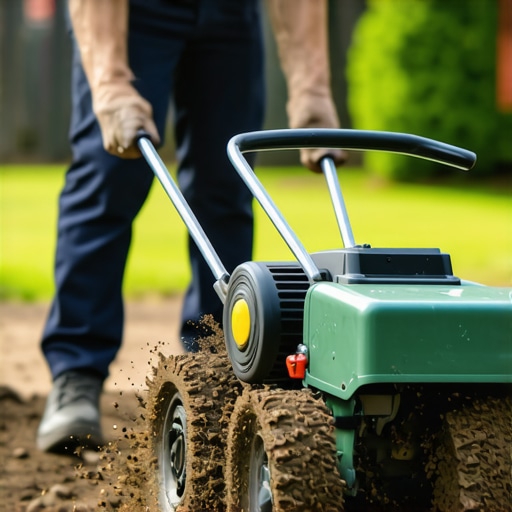
The tool itself is simple: a foot bar, a handle, and two to three hollow metal tubes. Do not confuse this with a spike aerator. Spikes are the enemy. A spike pushes into the ground and compresses the soil around the hole, making the problem worse. A core aerator actually removes a plug (a ‘core’) and spits it out on the surface. This creates a literal void. Nearby soil particles will naturally shift into that void, loosening the surrounding earth. It is a slow, methodical process. You are not just poking holes; you are re-engineering the soil structure one square foot at a time. It requires grit. It requires sweat. But for a $40 tool, the ROI on turf health is unmatched by any chemical application.
| Aeration Method | Cost | Core Depth | Compaction Relief |
| Manual Core Tool | $40 | 2.5 – 3.5 inches | High (Targeted) |
| Spike Shoes | $20 | 0.5 – 1.0 inches | Negative (Increases Compaction) |
| Gas Power Rental | $100+ | 2.0 – 4.0 inches | High (Mass Area) |
| Liquid ‘Aerator’ | $30 | 0.0 inches | Minimal/Temporary |
How much modified gravel do I need for a patio base?
While often discussed in hardscaping, the principle of base compaction is vital; typically, you need a 4-to-6-inch layer of compacted 21A or 3/4-inch minus gravel. In the context of clay soil aeration, understanding that your lawn is currently as compacted as a patio base helps illustrate why your grass is dying. You must break that ‘base’ layer using core extraction to transition from a hardscape-like density back to a horticultural-grade soil structure.
The Step-by-Step Remediation Process
Fixing clay soil requires a forensic approach where you first hydrate the soil to field capacity and then systematically remove cores every 4 to 6 inches across the affected turf area. This process must be followed by top-dressing with organic matter or sand-compost mixes to prevent the holes from simply collapsing back into a compacted state. Consistency in core depth is the only way to ensure uniform drainage improvement.
- Deep soak the lawn 24 to 48 hours before starting; the soil should be moist but not muddy.
- Flag all irrigation heads and shallow utility lines to avoid structural damage.
- Start at the furthest corner and work in a grid pattern, spacing holes 4 to 6 inches apart.
- Apply 2-3 passes in high-traffic areas like walkways or where dogs run.
- Leave the soil cores on the lawn to break down naturally; they contain beneficial microbes.
- Immediately top-dress with a 1/4 inch layer of fine compost to fill the new voids.
- Water lightly to settle the compost into the holes.
“Core aeration is the process of mechanically removing small plugs of thatch and soil from the lawn to improve soil aeration and water infiltration in the root zone.” – Texas A&M AgriLife Extension
The Science of Gas Exchange and Microbial Life
The introduction of oxygen into the soil profile via core aeration triggers a microbial explosion that helps decompose thatch layers and increases nutrient bioavailability. When soil is compacted, it becomes anaerobic, favoring pathogenic fungi and root rot; by using a $40 aerator, you shift the soil ecology back toward aerobic dominance. This is the foundation of integrated pest management and sustainable lawn care.
Microbes are the engine of your soil. They need oxygen to live, just like you. In compacted clay, they die off, and the nitrogen cycle grinds to a halt. When you pull those cores, you are effectively opening the windows of a stuffed room. You will see an almost immediate change in the color of the grass within two weeks, not because you added fertilizer, but because the roots can finally access the nutrients already present in the clay. Clay is actually very nutrient-rich; it just locks those nutrients away behind a wall of high bulk density. Break the wall, and the soil feeds itself. Do not let a ‘mow-and-blow’ contractor tell you that you need a $500 chemical treatment. You need a $40 tool and a Saturday afternoon. It is hard work. Your back will feel it. But your soil will finally breathe again. Skip the fluff and fix the physics first. “
![3 Fertilizer Rules to Stop 2026 Summer Lawn Burn [Tested]](https://lawnmajesty.com/wp-content/uploads/2026/05/3-Fertilizer-Rules-to-Stop-2026-Summer-Lawn-Burn-Tested.jpeg)