
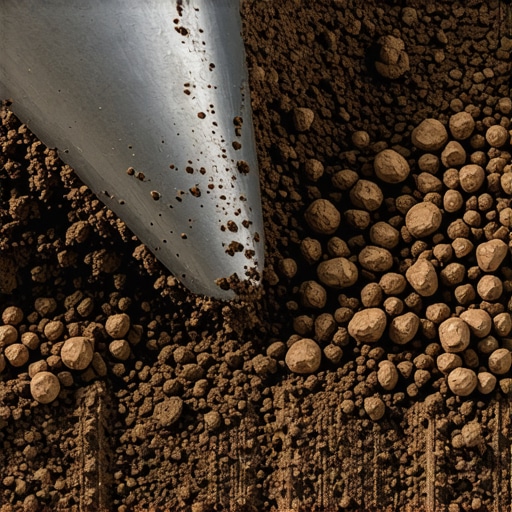
Fix 2026 Clay Soil with This $60 Auger Aeration Hack
Fixing 2026 Clay Soil: The Professional $60 Auger Aeration Hack
I always drill into my new crew members: if you don’t fix the soil grading and structure first, every plant you put in the ground is just expensive compost. Last season, I walked onto a site where a homeowner had spent $12,000 on high-end nursery stock—Japanese Maples, boxwoods, the works. Six months later, the Maples were drowning in their own holes. The culprit? Compacted clay. They had dug ‘teacup’ holes in the clay, effectively creating underground swimming pools with no drainage. The roots rotted in three weeks. Clay isn’t just dirt; it is a structural challenge that requires an engineering mindset to solve. If your yard feels like concrete in August and a swamp in April, you aren’t dealing with a ‘bad lawn.’ You are dealing with platelet compaction and anaerobic soil conditions. Most ‘mow-and-blow’ guys will tell you to just throw more fertilizer at it. That is a lie. Fertilizer on compacted clay just sits on top and runs off into the storm drain. You need to break the cage.
The Forensic Diagnosis of Compacted 2026 Clay
Compacted clay soil prevents gas exchange and water infiltration by eliminating the pore space between microscopic soil particles, leading to a bulk density that exceeds the threshold for root penetration. When clay particles (less than 0.002 mm in size) are pressed together by foot traffic or construction equipment, they align like a stack of wet playing cards. This creates a physical barrier. Water cannot move downward via percolation. Air cannot reach the rhizosphere. The result is a dead zone. You need to measure your soil’s resistance. If you cannot push a screwdriver six inches into the ground after a rain, your bulk density is too high. You are suffocating your lawn. Stop the chemicals. Start the mechanical intervention.
| Soil Property | Heavy Clay (Compacted) | Ideal Sandy Loam | The Auger-Fixed Goal |
|---|---|---|---|
| Bulk Density (g/cm³) | 1.6 – 1.9 | 1.1 – 1.4 | 1.35 |
| Porosity (%) | Less than 30% | 50% | 40%+ |
| Drainage Rate | 0.05 inches/hr | 1.0 – 2.0 inches/hr | 0.5+ inches/hr |
| Root Depth potential | 2-3 inches | 12-18 inches | 10-12 inches |
“Clay soils have high water-holding capacity but low permeability, leading to anaerobic conditions if not physically managed through aggressive aeration and amendment.” – Penn State Agricultural Extension
Why Traditional Core Aeration Fails in Heavy Clay
Standard core aerators only penetrate 2 to 3 inches and often smear the sides of the hole, creating a glazed surface that still resists water. In 2026 clay, a 3-inch plug is a band-aid on a gunshot wound. The compaction layer often extends 8 to 12 inches deep, far below the reach of a rental machine. Furthermore, if the tines are dull, the machine actually increases compaction at the base of the plug. It’s called aerator pan. It is a hidden failure. You need depth. You need to bypass the upper crust entirely to reach the subsoil layers where real drainage happens.
The $60 Auger Aeration Hack: Step-by-Step
This hack involves using a high-torque 1/2-inch corded drill and a 24-inch steel earth auger bit (typically $60 total for the bit) to create deep vertical channels. We call this Vertical Mulching. By drilling 12-18 inches deep every 2 feet in your hardest zones, you create permanent ‘drainage chimneys’ that allow oxygen to hit the deep root zone. It is labor-intensive. It works. Don’t use a cordless drill unless it’s a high-end brushless model; clay will burn the motor out. You want the drill to fight you. Wear gloves. Hold tight.
- Step 1: Flag your irrigation heads and utility lines. Call 811. Don’t skip this.
- Step 2: Wait for a 48-hour window after rain. The soil must be moist but not muddy. Dry clay will snap your wrist.
- Step 3: Drill holes 12-18 inches deep on a 2-foot grid pattern in localized low spots or high-traffic areas.
- Step 4: Backfill the holes immediately. Do not leave them empty or they will just collapse.
- Step 5: Use a mix of 50% calcined clay (like Turface) and 50% high-quality coarse sand or composted rice hulls.
How deep should I aerate clay soil?
To effectively fix clay soil drainage, you must penetrate at least 12 inches to bypass the primary compaction layer created by residential construction. Standard 3-inch aeration is insufficient for heavy clay, as it does not reach the lower soil horizons where moisture is trapped, leading to root rot and fungal pathogens.
“Effective aeration must penetrate the restrictive layer to facilitate gas exchange and downward water movement, otherwise, the surface remains a perched water table.” – ICPI Hardscape Engineering Standards
Does liquid aeration work on heavy clay?
Liquid aeration products, often containing ammonium laureth sulfate, act as surfactants to reduce the surface tension of water, but they cannot fix mechanical compaction in 2026 clay. While they help water soak in initially, they do not create the macropores necessary for long-term soil health or root expansion in high-density substrates.
Chemical Flocculation: Beyond the Auger
Once you have the holes drilled, you need to address the Cation Exchange Capacity (CEC). If your clay is sodic (high in sodium), you must apply Gypsum (calcium sulfate). The calcium ions displace the sodium, causing the tiny clay particles to ‘flocculate’ or clump together into larger aggregates. This creates natural pore space. However, if your soil is already high in calcium, adding more gypsum is a waste of money. Get a $20 soil test from your local University Extension first. Don’t guess. Measure. Most DIYers over-apply lime, which spikes the pH and locks up micronutrients like iron and manganese. Your grass will turn yellow. You will think it needs nitrogen. You will be wrong. It needs a lower pH.
The Long-Term Maintenance Schedule
Fixing clay is not a one-day event; it is a three-year biological transition. After your auger intervention, you must transition to deep, infrequent watering. Water 1 inch, once a week. This forces the roots to ‘chase’ the water down into those new auger channels. If you water every day for 10 minutes, you are keeping the roots in the top 2 inches of soil. That is a recipe for summer kill. In year two, top-dress with 1/4 inch of screened leaf compost. The organic matter will eventually work its way into the clay via earthworm activity, further breaking down the structural bonds. It takes time. Be patient. Clay is a cage, but it’s also rich in minerals. Once you unlock the structure, your lawn will be bulletproof. It won’t happen overnight. Do the work.
![Stop 2026 Lawn Burn: 3 Mowing Height Rules [Tips]](https://lawnmajesty.com/wp-content/uploads/2026/05/Stop-2026-Lawn-Burn-3-Mowing-Height-Rules-Tips.jpeg)