Fix 2026 Standing Water with This $80 French Drain
The Autopsy: Why Your Yard is a Swamp
A standing pool of water is not just an eyesore; it is a structural threat to your foundation and a biological death sentence for your turf. Fixing standing water requires a French drain system consisting of a perforated pipe buried in a trench filled with 57 stone and wrapped in geotextile fabric to redirect hydrostatic pressure away from the low spots of your landscape. This $80 DIY solution targets the specific physics of soil saturation. I recently got called out to tear up a $30,000 patio that was sinking because the previous contractor ignored the subgrade drainage. They thought a few extra inches of bedding sand would compensate for a clay-heavy basin. It did not. The water sat, the soil liquified, and the entire hardscape buckled under its own weight. It was a preventable disaster that cost the homeowner ten times the original quote to remediate. Do not let your yard become a forensic case study in poor civil engineering. Drainage is the first step of any legitimate site plan. If you miss this, you are just throwing money into a hole. You need to understand how water moves through your specific soil profile. Clay soils, often found in inland regions, have microscopic pores that hold water via capillary action, preventing it from draining vertically. When the rain falls faster than the infiltration rate, you get surface pooling. A French drain bypasses this by creating a path of least resistance through aggregate voids. It is basic physics applied to dirt. Stop listening to the hacks who tell you to just add more topsoil. That just hides the problem while the rot continues underneath. Let’s look at the mechanical reality of the French drain. It is a gravity-fed machine. It does not require power, but it does require precision. If you miss your slope by even a quarter-inch over ten feet, you have created a $80 mosquito breeding ground instead of a drain. Every inch of that pipe must be calculated. We are fighting gravity and friction simultaneously. You have to be smarter than the water.
“A French drain must maintain a minimum slope of 1 percent, or 1/8 inch per foot, to ensure gravitational flow and prevent sediment accumulation within the pipe.” – Penn State Agricultural Extension
The Physics of Standing Water and Soil Saturation
Standing water occurs when the soil’s infiltration rate is lower than the precipitation rate, leading to anaerobic conditions that kill beneficial soil microbes and rot root systems. This usually happens in compacted clay or where the water table is artificially high due to poor grading. The $80 French drain solves this by providing a subterranean channel for excess moisture. To build this properly, you must understand the difference between surface runoff and subsurface flow. Surface runoff is the water you see rushing over the grass during a storm. Subsurface flow is the hidden water saturating the root zone. You need to capture both. Most DIYers buy the cheapest pipe they can find and throw it in the ground. That is a mistake. You need 4-inch perforated HDPE pipe. Why 4 inches? Because anything smaller will clog with silt in three seasons. We use 57 stone (crushed limestone or granite approximately 1 inch in size) because it provides the largest void space for water to travel. If you use pea gravel, the voids are too small and the drain will fail. This is not about aesthetics; it is about hydraulic conductivity. When the water enters the trench, it hits the stone. Because the stone has high porosity, the water drops instantly to the bottom of the trench and into the pipe. The pipe then carries it to a daylight exit or a dry well. This process relieves the hydrostatic pressure on your soil. It keeps the ground firm. It keeps your house dry. It is a simple system, but the tolerances are tight. One mistake in the fabric wrap and you are finished. Soil will infiltrate the stone and turn your drain into a concrete-hard plug of mud. This is why we use non-woven geotextile fabric. It allows water through but blocks even the smallest silt particles.
How much modified gravel do I need for a patio base?
While the focus here is on the $80 French drain, many homeowners ask this when planning their drainage. For a standard patio base, you need approximately 1 ton of modified gravel (2A or CR617) for every 50 square feet at a 4-inch depth. Compaction reduces the volume by 20 percent, so always over-order. For the French drain specifically, 5 bags of drainage stone will cover approximately 10 linear feet of trench. Do the math before you dig.
The $80 Materials Inventory
A functional $80 French drain requires 25 feet of perforated corrugated pipe, two rolls of non-woven geotextile fabric, and five to eight bags of 3/4 inch drainage stone. This inventory assumes you own a shovel and a level, focusing exclusively on the raw materials needed for a localized drainage fix. The key is sourcing. Do not buy the “all-in-one” pipes with the sock already on them if you can avoid it; the sock is often too thin and will tear during installation. Buy the heavy-duty fabric separately. You want the stuff that feels like felt, not the plastic-looking weed barrier. The plastic stuff is garbage for drainage. It has zero permeability after a year of soil contact. The non-woven fabric is what the pros use for highway drainage. It lasts 50 years. Also, skip the fancy catch basins for this $80 budget unless you have a specific downspout to tie in. A simple perforated pipe and stone system is more than enough for a soggy spot in the lawn. The goal here is efficiency and function. Every dollar spent must contribute to the movement of water. If it doesn’t move water, it doesn’t belong in the trench.
| Material | Estimated Cost | Purpose |
|---|---|---|
| 4-inch Perforated Pipe (25ft) | $18.00 | Conveyance of water via gravity |
| Non-woven Geotextile Fabric | $22.00 | Silt filtration and stone protection |
| 3/4″ Drainage Stone (8 bags) | $32.00 | Creating void space for water entry |
| PVC End Cap/Outlet | $8.00 | Preventing rodent entry at daylight |
Step-by-Step Installation: Defeating Hydrostatic Pressure
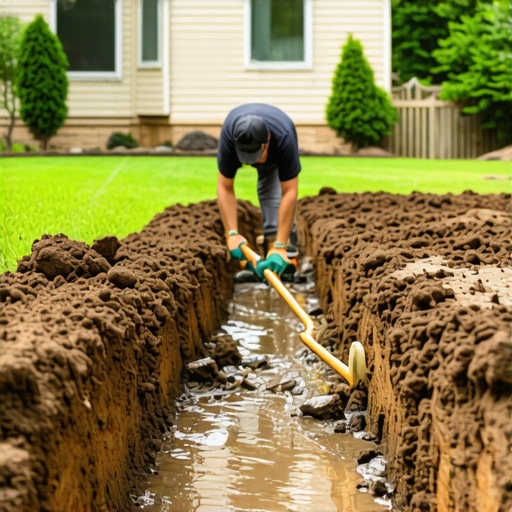
Installing a French drain involves excavating a 12-inch deep trench, lining it with geotextile fabric, laying perforated pipe on a bed of stone, and backfilling with more aggregate. This process ensures that water is captured before it can saturate the soil surface, preventing the “squish” common in poorly graded lawns. First, find your exit point. Water does not run uphill. Use a line level and string to ensure you have a 1 percent slope. Dig the trench. It should be 8 inches wide and 12 inches deep. This is hard work. If you hit a root, cut it clean. Do not leave jagged edges that can puncture the pipe. Once the trench is clean, lay your fabric. Leave enough on the sides to wrap it over the top like a burrito. This is the “taco” method, and it is the only way to ensure longevity. Put 2 inches of stone in the bottom. This acts as a leveling bed. Lay the pipe on top with the holes facing DOWN. Yes, down. Professionals know that water enters the pipe from the bottom as the water table rises in the trench. If you put the holes up, the pipe has to fill up with 4 inches of water before it starts moving anything. Holes down is the industry standard for a reason. Cover the pipe with the remaining stone until you are 2 inches from the surface. Wrap the fabric over the top. This fabric envelope is what keeps the system running for decades. If you skip the wrap, you are building a temporary fix. Use the leftover dirt to top it off or, better yet, use a thin layer of sod. The water will find its way. The stone creates a vacuum of sorts for the moisture. It is beautiful engineering when done correctly.
“Hydrostatic pressure is the force exerted by a fluid at equilibrium at a given point within the fluid, due to the force of gravity.” – Hardscape Engineering Axiom
What is the best pipe for a French drain?
The best pipe for a French drain is 4-inch SDR-35 PVC for permanent residential installations, though HDPE corrugated pipe is the standard for DIY budgets. PVC is easier to clean and resists crushing, but corrugated pipe is flexible and significantly cheaper for the $80 price point. Both will move water effectively if the slope is maintained. Always ensure the perforations are clear before burial.
The Maintenance Schedule for Drainage Longevity
A French drain is a low-maintenance system, but it requires annual inspections of the outlet to ensure no debris or rodent nests are blocking the flow of water. If the outlet is clogged, the entire system backs up, and the hydrostatic pressure returns to your soil, negating the work you did. Every spring, walk to the end of the pipe. Clear away any grass clippings, leaves, or mulch. If you see silt building up, you might need to flush the pipe with a garden hose. But if you did the fabric wrap correctly, silt should not be an issue. Watch the area during the first heavy rain after installation. The water should vanish from the surface almost instantly. If you still see pooling, you may have a secondary drainage issue or a soil compaction layer deeper than your trench. In heavy clay, you might need a series of lateral drains feeding into a main trunk line. This $80 fix is for the localized “hot spot” where water sits for more than 24 hours. If your entire yard is a lake, you are looking at a full-scale civil engineering project involving grading and high-capacity dry wells. But for most homeowners, this simple pipe-and-stone solution is the difference between a usable yard and a mud pit. Don’t be the person who ignores the water. It will win eventually. It will rot your grass. It will crack your concrete. It will find a way into your basement. Spend the $80 now, or spend $8,000 later on foundation repair. The choice is yours. Respect the biology of your yard and the physics of the earth. Get to work.

![Build a $500 Natural Stone Retaining Wall [2026 DIY]](https://lawnmajesty.com/wp-content/uploads/2026/06/Build-a-500-Natural-Stone-Retaining-Wall-2026-DIY.jpeg)