
![Fix a 2026 Yard Slope with This $300 Fieldstone Wall [DIY]](https://lawnmajesty.com/wp-content/uploads/2026/05/Fix-a-2026-Yard-Slope-with-This-300-Fieldstone-Wall-DIY.jpeg)
Fix a 2026 Yard Slope with This $300 Fieldstone Wall [DIY]
Fix a 2026 Yard Slope with This $300 Fieldstone Wall [DIY]
I always drill into my new crew members: if you don’t fix the soil grading first, every plant you put in the ground is just expensive compost. Most homeowners see a slope and think about what flowers will look pretty on it. I see a ticking time bomb of hydrostatic pressure and lateral earth force. I have spent two decades digging out ‘pretty’ gardens that slid into the neighbor’s driveway because someone ignored the physics of soil. If you are looking to stabilize a grade in 2026 without spending five figures on a masonry crew, you need to understand the mechanics of the dry-stack fieldstone wall. It is not just about stacking rocks; it is about managing the 120 pounds per cubic foot that saturated soil exerts against your structure. We are going to build a gravity wall that breathes, drains, and survives the freeze-thaw cycles that shatter concrete. This is a blue-collar approach to civil engineering in your own backyard.
The Physics of Retaining Walls and Soil Grading
Retaining walls succeed or fail based on soil grading and hydrostatic pressure management. A fieldstone wall acts as a gravity-based barrier that must counteract the lateral force of saturated soil, preventing erosion and slope failure in your landscape design and overall lawn care strategy.
When you look at a slope, you are looking at potential energy waiting to become kinetic. Soil has an angle of repose, the steepest angle at which it can be piled without sliding. When your yard exceeds this angle, gravity wants to pull it down. Adding water to that equation increases the weight and decreases the friction between soil particles. This is why walls fail during heavy spring rains. A rigid wall, like one made of mortared cinder blocks, will crack when the earth moves. A dry-stack fieldstone wall is flexible. It shifts with the earth. It allows water to weep through the gaps between stones, relieving the pressure that would otherwise blow out a solid structure. You are building a living filter. The stone is merely the face; the real work happens in the six inches of gravel hidden behind it.
“A retaining wall doesn’t fail because of the stone; it fails because of the water trapped behind it.” – Hardscape Engineering Axiom
Sourcing Fieldstone for a $300 Budget
Fieldstone can be acquired for $300 by sourcing reclaimed stone from local farms, using landscape supply yards for bulk ‘pallet-run’ stone, or utilizing native rock excavated during garden design projects to keep hardscaping costs low and manageable.
The secret to the $300 wall is avoiding the big-box retail stores where they sell ‘decorative’ stones for $5 a piece. Go to a local quarry or a farm. Farmers generally view fieldstone as a nuisance that breaks their plow blades. Many will let you haul it away if you do the labor. For a wall that is 10 feet long and 2 feet high, you need roughly 1.5 to 2 tons of stone. At a professional stone yard, ‘garden-grade’ fieldstone usually runs $120 to $180 per ton. That leaves you $120 for your base material and drainage pipe. We are looking for ‘two-man’ stones for the base and ‘one-man’ stones for the rising courses. Look for flat faces. Round river rocks are the enemy of a stable wall; they roll like ball bearings. You want angular, weathered stone with at least one relatively flat side to serve as the face.
How deep should a fieldstone wall footing be?
For a wall under 3 feet, you need a trench at least 6 to 8 inches deep. This allows for a 4-inch compacted gravel base and one ‘sacrificial’ layer of stone that is buried below the finished grade. This burial, known as embedment, prevents the bottom of the wall from kicking out under the weight of the slope. If you skip this, the first frost heave will tilt your wall toward the lawn.
The Excavation and Base Layer Foundations
Excavation for a hardscaping project requires digging a trench that is twice the width of the wall and filling it with compacted 2A modified gravel to ensure structural integrity and prevent settling or heaving over time.
You start with a string line and a level. Dig your trench. If you hit clay, you dig deeper. Clay holds water and expands like a sponge in winter. You need to replace that clay with 2A modified stone (a mix of crushed limestone and fines). You don’t just dump it in. You add it in 2-inch lifts and hit it with a hand tamper until the tamper literally bounces off the surface. If you can leave a footprint in your base, it is not ready. The base is the most important part of the project. I have seen guys spend three days on the stonework only to have the whole thing sink into the mud because they were too lazy to spend two hours tamping the gravel. Don’t be that guy. Your base needs to be level front-to-back, but you can follow the natural grade side-to-side if the slope is gradual.
| 2A Modified Gravel | $28 – $36 | Moderate | Foundation and base compaction |
| #57 Clean Stone | $32 – $42 | High | Backfill behind the stone face |
| Reclaimed Fieldstone | $0 – $150 | N/A | Structural wall face |
| Non-Woven Fabric | $1.50/ft | High | Separating soil from stone backfill |
The Art of the Dry-Stack: Batter and Hearting
Dry-stacking fieldstone requires a batter of 1 inch for every 6 inches of height, ensuring the wall leans into the slope, while hearting with clean stone fills internal voids for drainage and stability.
Batter is the technical term for the backward lean of the wall. Never build a stone wall perfectly vertical. Gravity will eventually win that fight. For every foot of height, the wall should lean back toward the slope by about 2 inches. As you stack, you must ‘heart’ the wall. This means filling the gaps between the large face stones and the soil behind them with small, angular ‘crush’ or #57 clean stone. Do not use dirt for this. Dirt will wash out. The stone-on-stone contact is what provides the friction to keep the wall standing. Every three feet of length, use a ‘through-stone’—a long rock that spans the entire depth of the wall and reaches into the hillside. This anchors the face to the mass of the earth behind it. Think of it like a deadman anchor in civil engineering.
“Soil is not a static material; it is a fluid that moves in slow motion. Your wall must be the dam that lets the water through but keeps the solids back.” – Agronomy Manual 402
How much modified gravel do I need for a patio base?
While we are discussing walls, the gravel math for any hardscape is the same: Length x Width x Depth (in feet) divided by 27 gives you cubic yards. Multiply yards by 1.5 to get the tonnage. For a wall base, you are looking at roughly 0.5 to 1 ton for every 10 linear feet of wall, depending on trench depth. Over-ordering is better than under-ordering; you will always find a use for extra gravel in a muddy gate area.
Managing Drainage and the French Drain
Drainage is the critical component of landscaping on a slope, requiring a perforated pipe and filter fabric to divert groundwater away from the fieldstone wall to prevent hydrostatic pressure build-up.
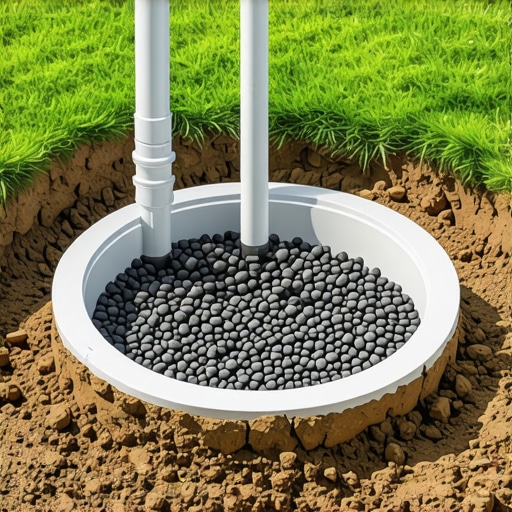
Behind your wall, at the level of the gravel base, you need a 4-inch perforated PVC pipe. Wrap this pipe in a ‘sock’ of non-woven geotextile fabric. This prevents fine silt from clogging the pipe. As water moves down the slope, it hits your #57 stone backfill, drops straight down to the pipe, and is carried out to the ends of the wall or a daylight exit point. Without this, water will pool behind the stones. In winter, that water turns to ice, expands, and pushes your stones out of alignment. I have seen $30,000 patios destroyed in one season because the contractor ‘forgot’ the drainage. A $300 wall needs the same engineering respect as a $30,000 one. You are fighting the same laws of physics.
- Excavate trench to 8 inches depth and 18 inches width.
- Install and compact 4 inches of 2A modified gravel.
- Lay the largest, flattest stones as the base course, slightly below grade.
- Install 4-inch perforated drainage pipe behind the base course.
- Stack stones with a 1:6 batter, ensuring no vertical joints line up (one over two, two over one).
- Fill the cavity behind the stones with clean #57 gravel as you go.
- Top the wall with ‘capstones’ that are heavy and flat to lock the structure in.
Maintenance and the 2026 Outlook
A properly built dry-stack wall is a multi-generational structure. In the first year, you might see some settling. This is normal. You may need to shim a stone here or there using small ‘flatters’ or ‘wedges.’ This is why we don’t use mortar. If a mortared wall settles, it’s a disaster. If a dry-stack wall settles, it’s a five-minute fix. In terms of your broader 2026 lawn care, keep an eye on the area directly above the wall. If you see cracks forming in the turf, it means the soil is still moving and you may need to increase the depth of your gravel backfill or plant deep-rooted native grasses to help stitch the soil together. Avoid planting large trees within five feet of the wall; the root pressure will eventually dismantle your hard work. Stick to low-maintenance perennials or groundcovers that won’t interfere with the lithic structure. This wall is a tool. It turns unusable, eroding slopes into functional, tiered garden spaces. It is the backbone of a professional landscape.

![Fix Cracked Driveways: 3 Cold-Patch Rules [2026 DIY]](https://lawnmajesty.com/wp-content/uploads/2026/06/Fix-Cracked-Driveways-3-Cold-Patch-Rules-2026-DIY.jpeg)