Fix a Sloped 2026 Backyard with 3 Terracing Hacks
The Engineering Reality of Sloped Landscaping
A sloped 2026 backyard requires structural terracing using retaining walls, graded plateaus, and integrated drainage systems to prevent soil erosion and hydrostatic pressure buildup. By breaking a steep grade into manageable tiers, you stabilize the soil profile and create functional hardscape zones. Most contractors see a hill and think about aesthetics; I see a 10,000-pound mass of wet earth pushing against a vertical plane. If you do not respect the physics of soil retention, your backyard will eventually end up in your neighbor’s pool.
The $30,000 Failure: A Hardscape Autopsy
I recently got called out to tear up a $30,000 patio that was sinking because the previous contractor failed to account for hydrostatic pressure. The homeowner thought it was just a few loose pavers. In reality, the entire hillside was migrating downward because the base layer was sitting on uncompacted native clay. The retaining wall had no weep holes and no 3/4-inch clean stone backfill. Every time it rained, the water sat behind that wall, turning the soil into a heavy slurry that pushed the blocks out of alignment. We had to excavate five feet back, install a proper Geogrid reinforcement, and start from the footer. It was a mess that could have been avoided with three inches of DGA and a little common sense. Don’t be that homeowner. Infrastructure comes before the fire pit.
“A retaining wall doesn’t fail because of the stone; it fails because of the water trapped behind it.” – Hardscape Engineering Axiom
Hack 1: The Segmental Retaining Wall (SRW) with Geogrid Reinforcement
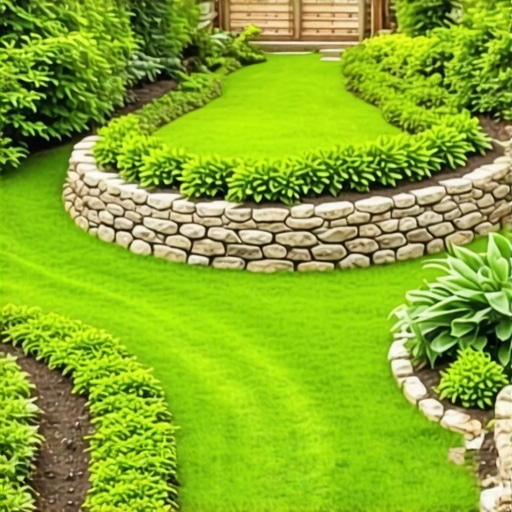
Segmental retaining walls are the workhorses of modern 2026 backyard design because they utilize mortarless interlocking blocks that allow for flexibility and drainage without cracking like poured concrete. These systems rely on mass and friction. For slopes exceeding a 3:1 grade, you must integrate Geogrid—a high-tenacity polyester mesh—into the soil layers. This turns the entire soil mass into a reinforced structure rather than just a pile of dirt behind a thin wall. You need a minimum of 6 inches of compacted 2A modified stone for the footer. Leveling the first course is the most important hour of the entire project. If that base block is off by 1/16th of an inch, your wall will look like a snake by the time you reach the fourth course. Dig deep. Compact harder.
How much modified gravel do I need for a patio base?
To calculate gravel needs, multiply the square footage by the depth (usually 4-6 inches for patios, 12 inches for wall footers) and divide by 27 to get cubic yards; then multiply by 1.5 to account for compaction density. Always order 10% more than you think you need. Running out of base material mid-tamp is a rookie mistake that ruins the momentum of the compaction cycle.
Hack 2: The Engineered Timber Tiering System
For a more organic look that still offers significant structural integrity, pressure-treated 6×6 timbers can be used to create tiered garden beds that manage surface runoff and soil erosion. The key here is the “deadman” anchor. A deadman is a timber placed perpendicular to the wall, extending back into the hillside and anchored with a T-bar. This prevents the wall from bowing outward under the weight of saturated soil. We use 12-inch galvanized spikes or heavy-duty structural screws to knit the courses together. Unlike the cheap 4x4s you see at big-box stores, true 6×6 ground-contact-rated timber will last 20+ years if you wrap the backside in a non-woven geotextile fabric. This fabric prevents soil fines from clogging your drainage stone while allowing water to pass through freely.
Hack 3: Natural Boulder Riprap and Native Planting
Boulders are not just decoration; they are gravity-based stabilizers that use irregular geometry to lock soil in place on extreme slopes where traditional walls are impractical. This hack involves “keying” the boulders into the slope—meaning at least 30% of the stone is buried below grade. Between the stones, we install native plants with deep taproots or fibrous root systems like Little Bluestem or Creeping Juniper. These plants act as biological rebar. While a wall stops soil, a boulder-and-plant matrix integrates with the soil. This is the most cost-effective way to handle a 2026 backyard with multiple grade changes.
“Soil stabilization on steep grades is best achieved through a combination of mechanical hardscaping and deep-rooted vegetative cover to mitigate shear stress.” – Penn State Agricultural Extension
| Material | Durability | Cost Factor | Best Use Case |
|---|---|---|---|
| Segmental Blocks | 50+ Years | High | High-pressure vertical slopes |
| Treated Timber | 15-20 Years | Medium | Terraced garden beds |
| Natural Boulders | Indefinite | Variable | Naturalistic erosion control |
How do you calculate the height of a retaining wall for a slope?
Determine the total vertical rise of the hill and divide it by the desired tier depth to find the number of walls required; never exceed 3 feet in height for a single wall without a structural engineer’s stamp. In many jurisdictions, any wall over 36 or 48 inches requires a permit and professional calculations to ensure it won’t collapse and cause property damage.
The Critical Importance of Drainage and Hydrostatic Management
Water is the enemy of all hardscaping. Every terrace must have a French drain consisting of a perforated 4-inch SDR-35 pipe buried in 3/4-inch clean stone. This pipe must be sloped at a 2% grade to a daylight exit point. Without this, water builds up behind your hacks and creates a hydraulic jack effect. I have seen 800-pound boulders moved three inches by ice lenses forming in poorly drained soil. If your landscaper doesn’t talk about “weep holes” or “daylighting pipes,” fire them. They are just a mower with a shovel. You need an engineer with a level.
Terracing Installation Checklist
- Mark all utilities via 811 before any excavation begins.
- Excavate the base trench to a depth of at least 12 inches.
- Compact the subgrade until a hand-tamper bounces off the surface.
- Install a non-woven geotextile to separate soil from drainage stone.
- Level the first course of stone or timber with surgical precision.
- Backfill with clean 3/4-inch stone, not native soil.
- Install deadman anchors every 6-8 feet for timber walls.
- Cap the wall with adhesive to prevent water infiltration from the top.
Precision matters. Do not skip the compaction. Do not use dirt as backfill. If you follow these three hacks, your backyard will stay exactly where you put it. If you cut corners, I will be the guy you call in three years to fix the $30,000 hole in your yard. It costs twice as much to fix a wall as it does to build it right the first time. Buy the right gravel. Rent the heavy plate compactor. Do the work once.
![Best 2026 Groundcover for Steep Slopes [No-Mow]](https://lawnmajesty.com/wp-content/uploads/2026/07/Best-2026-Groundcover-for-Steep-Slopes-No-Mow.jpeg)