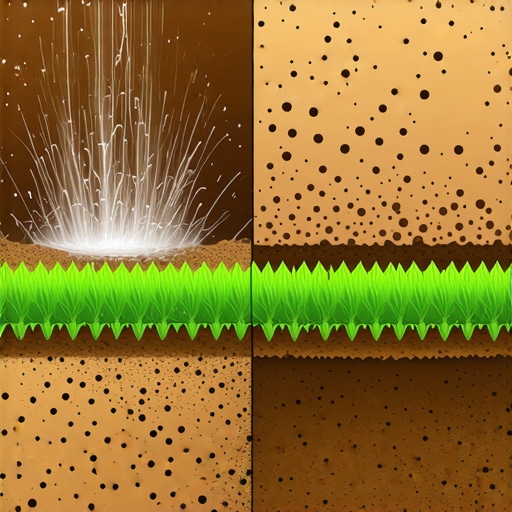
Why Liquid Aeration Beats Core Aeration for Heavy Clay Soil
The Suffocation of Heavy Clay: A Forensic Breakdown
Liquid aeration solves the fundamental structural failure of heavy clay soil by using chemical surfactants and organic acids to break down ionic bonds between clay particles, creating deep-reaching pore space that traditional core aeration cannot achieve. While mechanical plugs only penetrate 2-3 inches, liquid treatments affect the entire soil profile, improving drainage, root depth, and microbial activity. This chemical approach eliminates the risk of ‘smearing’ the sides of aeration holes, a common failure in mechanical methods that actually increases compaction in the long run.
I have seen more lawns destroyed by ‘standard’ practices than by neglect. A homeowner once called me in a total panic after they decided to ‘fix’ their yellowing turf by dumping 50 pounds of high-nitrogen synthetic fertilizer onto bone-dry, compacted clay in the middle of a July heatwave. They didn’t understand that their soil was essentially a brick. The fertilizer sat on the surface, couldn’t penetrate the hydrophobic layer, and the resulting salt accumulation torched the grass roots within 48 hours. It looked like a blowtorch had been taken to the yard. That is the cost of ignoring soil physics. If your soil can’t breathe, your grass is just a slow-moving expensive compost pile.
The Mechanical Failure: Why Core Aeration Struggles in Clay
Mechanical core aeration is the industry standard for a reason, but in heavy clay, it is often a half-measure. When a hollow tine penetrates wet clay, it often creates a ‘smear layer’ along the walls of the hole. This glazing effect effectively seals the hole, preventing lateral oxygen movement. Furthermore, you are only affecting about 5% of the total surface area. The remaining 95% remains a compacted mess. It is a temporary fix for a systemic structural problem.
“Soil compaction occurs when soil particles are pressed together, reducing pore space between them. Heavily compacted soils contain few large pores and have a reduced rate of both water infiltration and drainage from the compacted layer.” – Penn State Extension
The Science of Liquid Decoupling
Liquid aeration products, often containing ammonium lauryl sulfate or highly concentrated humic acids, work on a molecular level. Clay particles are shaped like microscopic plates; they carry a negative charge and stack tightly together, excluding water and air. Liquid aerators act as ‘wetting agents’ that break the surface tension and allow water to carry the treatment deep into the subsoil. This facilitates a process called flocculation, where individual clay particles clump together into larger ‘peds,’ creating permanent channels for air and moisture. It is a biological and chemical shift, not just a physical puncture.
| Feature | Mechanical Core Aeration | Liquid Soil Aeration |
|---|---|---|
| Depth of Effect | 2-4 Inches | Up to 12 Inches (via water movement) |
| Surface Disruption | Messy soil plugs everywhere | Zero disruption; clean finish |
| Compaction Risk | High (tine pressure can compact base) | Zero (chemical reaction) |
| Application Ease | Heavy machinery required | Standard sprayer |
| Long-term Structure | Temporary relief | Permanent soil flocculation |
How much liquid aerator do I need per thousand square feet?
For most professional-grade liquid aeration concentrates, you will typically need 4 to 9 ounces per 1,000 square feet, diluted in at least 1-2 gallons of water. The goal is not just to wet the surface but to use the water as a carrier to reach the root zone. I always tell my crew: if the ground isn’t moist before you start, you are wasting the client’s money. You need a pre-saturated soil profile to ensure the chemistry moves deep enough to make a difference. Heavy clay requires the higher end of that dosage range.
Is liquid aeration safe for pets and children?
Most liquid aeration formulas are derived from biodegradable surfactants and organic humates, making them safe for pets and children once the application has dried or been watered into the soil. Unlike synthetic pesticides, these are soil conditioners. However, you must read the MSDS (Material Safety Data Sheet) for the specific brand. If it contains high concentrations of potassium hydroxide or concentrated acids, keep the dogs off the lawn until the next morning. Safety isn’t an option; it is the baseline for professional landscaping.
The Hardscape Connection: Managing Hydrostatic Pressure
In hardscaping, the condition of the soil surrounding a patio or retaining wall is just as critical as the base under it. Compacted clay holds water like a bathtub. When that clay is adjacent to a wall, it creates immense hydrostatic pressure as it expands. By using liquid aeration on the turf surrounding your hardscape installs, you improve the lateral drainage of the entire site. This reduces the load on your French drains and prevents the freeze-thaw heaving that ruins $50,000 backyard builds. Soil science and civil engineering are two sides of the same coin.
“A retaining wall doesn’t fail because of the stone; it fails because of the water trapped behind it.” – Hardscape Engineering Axiom
- Step 1: Test soil pH. High acidity often accompanies compaction.
- Step 2: Apply the liquid aerator during active growth periods (Spring/Fall).
- Step 3: Water heavily (at least 0.5 inches) immediately after application.
- Step 4: Follow up with a humic acid treatment to feed soil microbes.
Clay doesn’t breathe on its own. It needs chemistry. Stop pulling plugs and start changing the soil’s DNA. If you don’t fix the compaction at the pore level, you are just painting a dying lawn green. Stick to the science, use the right surfactants, and stop listening to the guys who think a motorized rake is a cure-all. It isn’t.
![Fix Your 2026 Brown Bermuda Grass [3 Steps]](https://lawnmajesty.com/wp-content/uploads/2026/06/Fix-Your-2026-Brown-Bermuda-Grass-3-Steps.jpeg)