How to Prune Overgrown Hydrangeas Without Killing Blooms
Understanding Hydrangea Species and Bloom Cycles
Hydrangea species identification is the critical first step because pruning macrophylla or serrata varieties at the wrong time will remove old wood buds, whereas paniculata and arborescens bloom on new wood and require different timing to ensure flower production. If you fail to distinguish between these, you are essentially gambling with next year’s canopy. I always drill into my new crew members: if you don’t fix the soil grading first, every plant you put in the ground is just expensive compost. The same applies to pruning. You cannot just walk up to a shrub with a pair of shears and start hacking. You have to understand the vascular system of the specific cultivar. Last year, I saw a homeowner take a gas hedge trimmer to a 15-year-old Bigleaf hydrangea in November. They didn’t see a single flower for two seasons. That is a failure of education. Horticulture is not a hobby; it is applied biology. You are managing apical dominance and hormonal flow within the plant tissue. When you make a cut, you are signaling the plant to redirect its energy. If you cut the terminal bud of a species that blooms on old wood in the winter, you have removed the only cells capable of producing a flower that year. It is that simple. Don’t skip the identification phase. Inspect the stems. Are they peeling? Are they woody? Are the buds located at the tips or along the entire length of the branch? These are the questions that determine your success.
The Tools of the Trade: Beyond the Hand Pruner
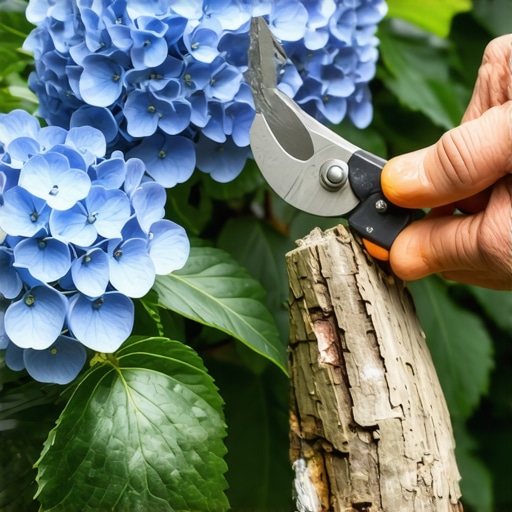
Using the correct pruning tools like bypass pruners, loppers, and folding saws ensures clean cuts that prevent pathogen entry and promote callus formation on the hydrangea stems. Dull blades crush the vascular cambium. A crushed stem is a dead stem. I mandate that my crew sharpens their Felco blades every morning. If a blade is dull, it creates a jagged edge that holds moisture. Moisture invites fungus. Specifically, we are looking for a clean, 45-degree slant about 1/4 inch above a viable node. This angle allows water to shed off the cut surface rather than pooling on the exposed pith. For overgrown specimens, you will likely need a folding saw for the 2-inch thick base wood. Do not try to force a pair of hand pruners through a thick branch. You will spring the tool and ruin the plant. We use bypass pruners because the blades cross like scissors. Anvil pruners, which crush the stem against a flat metal base, have no place in a professional landscape kit. They are for deadwood only. When dealing with overgrown hydrangeas, you are often dealing with years of neglected, congested growth. This requires a tiered approach to tool selection.
| Tool Type | Branch Diameter | Primary Use Case |
|---|---|---|
| Bypass Pruners | Up to 0.75 inch | Removing spent blooms and thin lateral stems. | Loppers (Gear-driven) | 0.75 to 1.5 inches | Cutting back thick old wood at the base. | Folding Saw | Over 1.5 inches | Removing dead or diseased structural trunks. | Sharpening Stone | N/A | Maintaining surgical precision on all blades. |
“Pruning is the most important maintenance practice for hydrangeas, but it is also the most misunderstood. Improper timing is the primary reason these shrubs fail to bloom in residential landscapes.” – University of Georgia Extension
The Hard Math of Pruning: The 1/3 Rule
The one-third rule of pruning dictates that you should never remove more than 33% of the total biomass of a hydrangea in a single season to prevent root shock and excessive vegetative growth at the expense of flowers. This is an engineering standard. If you have an 8-foot tall ‘Nikko Blue’ that is blocking a window, you cannot chop it down to 2 feet in one day. The root system is sized to support an 8-foot plant. Removing too much foliage causes a massive hormonal surge. The plant panics. It throws out dozens of weak, succulent water sprouts that will never be strong enough to hold a heavy flower head. Instead, you take out the oldest, woodiest third of the plant at ground level. This opens up the center for airflow. It reduces the height while maintaining the health of the remaining stalks. Year two, you take the next third. By year three, you have a completely rejuvenated plant. It takes patience. Hacks don’t have patience. They want the check today. We want the plant healthy ten years from now. This strategy also helps manage the plant’s hydraulic pressure. A massive reduction in leaf surface area leads to high internal pressure, which can cause physiological issues in the remaining tissue.
When should I prune my overgrown hydrangea?
The optimal pruning time depends entirely on whether your hydrangea variety blooms on old wood (mid-summer, immediately after flowering) or new wood (late winter or early spring before the first flush of growth). For species like Hydrangea macrophylla, waiting until winter means you are cutting off next year’s flower buds. For Hydrangea paniculata, pruning in the spring actually stimulates larger blooms. Always check the wood before you cut. If it feels hollow and brittle, it is dead. If it has green tissue under the bark, it is alive and carrying potential energy for the season.
Will my hydrangea bloom if I cut it to the ground?
Most hydrangea cultivars will not bloom the following year if cut to the ground, with the exception of Hydrangea arborescens (like ‘Annabelle’) which can handle renewal pruning to the soil level in late winter. For most other types, such as the popular mophead varieties, cutting to the ground removes the terminal buds required for flower production. You will get plenty of green leaves, but zero flowers. This mistake is often made by landscapers who treat every shrub like a boxwood. It is a fundamental lack of botanical knowledge that costs the homeowner their seasonal color.
Step-by-Step Restoration Strategy
A professional restoration pruning plan involves a systematic removal of deadwood, thinning of crossing branches, and the strategic reduction of height to improve shrub longevity and flower quality. We follow a strict checklist on every job site. No exceptions.
- Identify the species to confirm bloom wood (Old vs. New).
- Remove all dead, damaged, or diseased wood (The 3 D’s) first.
- Cut out crossing branches that rub against each other to prevent bark cankers.
- Remove 1/3 of the oldest stems at the soil line to stimulate basal growth.
- Thin out the center of the plant to increase light penetration and air circulation.
- Reduce the height of remaining stems by cutting back to a strong pair of buds.
- Clean tools with isopropyl alcohol between plants to prevent disease spread.
By thinning the center, you are reducing the risk of powdery mildew and Cercospora leaf spot. These fungi thrive in stagnant, humid air. An overgrown hydrangea is a breeding ground for pathogens. You need to be able to see through the plant. If the interior is a tangled mess of dead twigs and old leaves, the plant is suffocating. We also look at the root flare. Often, over-mulching or ‘mulch volcanoes’ have buried the base of the stems. We clear that away. The stems need to breathe at the soil line just like a tree does. If the bark is constantly wet from mulch, it will rot. It is that simple.
“When pruning, always make cuts that favor the plant’s natural form and growth habit. Avoid shearing, which creates a dense outer shell of foliage that shades out the interior of the plant.” – American Horticultural Society
Soil Chemistry and Hydration: The Post-Pruning Recovery
After structural pruning, the hydrangea recovery process requires balanced soil pH and consistent irrigation levels to support the development of new floral primordia. Pruning is a stressor. To mitigate this, we test the soil. Most hydrangeas prefer a pH between 5.5 and 6.5. If the soil is too alkaline, the plant cannot take up iron, leading to interveinal chlorosis. The leaves turn yellow while the veins stay green. This weakens the plant’s ability to photosynthesize and recover from your cuts. We also check the aluminum availability. If you want blue flowers, you need acidic soil and available aluminum. If the soil is too dry, the plant cannot transport the nutrients to the site of the pruning cuts. You need deep, infrequent watering. Exactly 1 inch per week. We use drip irrigation or a soaker hose. Do not use overhead sprinklers. Wetting the leaves is an invitation for disease. You want the water at the roots. The roots are the engine; the leaves are the exhaust. Keep the engine hydrated and the exhaust will take care of itself. We also avoid high-nitrogen fertilizers immediately after a heavy prune. Too much nitrogen will result in massive leaf growth but weak stems that flop over once the heavy flower heads develop. Use a balanced, slow-release fertilizer with a slightly higher phosphorus number to encourage root development and bud setting.
Climate Realities: Hardiness Zones and Frost Damage
In regions with harsh winters or late spring frosts, protecting the dormant buds of your hydrangeas is as important as the pruning technique itself. If you live in USDA Zone 5 or 6, a late April frost can wipe out an entire year of blooms on a Macrophylla. Even if you pruned perfectly in July, the weather can still win. We recommend using burlap wraps for sensitive varieties in the winter. Do not use plastic; it traps moisture and can cook the buds on a sunny day. The goal is to buffer the temperature fluctuations. In the fall, we also make sure the plants go into dormancy well-hydrated. A dehydrated plant is much more susceptible to winter kill. The moisture in the soil acts as an insulator for the root ball. In the spring, do not be in a hurry to prune out ‘dead’ looking wood. Often, the terminal buds are dead but the lateral buds lower down the stem are still viable. Wait until you see green growth before you make your final structural cuts for the season. This ensures you aren’t removing living tissue that could still produce flowers.
![Stop 2026 Boxwood Blight with These 3 Pruning Rules [Zone 7]](https://lawnmajesty.com/wp-content/uploads/2026/05/Stop-2026-Boxwood-Blight-with-These-3-Pruning-Rules-Zone-7.jpeg)