
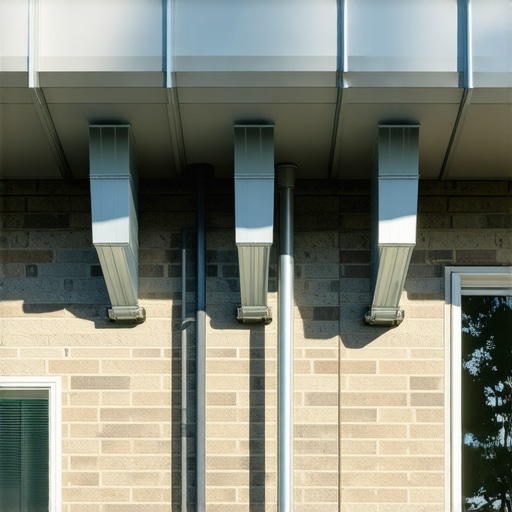
Stop 2026 Foundation Damage: 3 Downspout Rules
The Forensic Autopsy of a Sinking Footer
The first sign of disaster isn’t usually a massive crack; it is a subtle, metallic smell in the basement and a white, powdery crust known as efflorescence creeping up your cinder blocks. This is the visual signature of hydrostatic pressure—the weight of water-logged soil pressing against your home with enough force to eventually buckle concrete. I recently got called out to tear up a $30,000 patio that was sinking because the previous contractor made a fatal error: they buried corrugated downspout lines that collapsed under the weight of the base-layer compaction. The patio stayed flat for six months, but once the spring rains hit, the water had nowhere to go but the foundation footer. The soil turned into a slurry, the patio settled two inches, and the homeowner’s basement started weeping. It was a total loss. To avoid a similar financial catastrophe by 2026, you must understand the physics of water movement and the engineering required to move it away from your structure. Drainage is not an afterthought; it is the primary defense of your real estate investment.
Rule 1: The Ten-Foot Minimum Extension Standard
To effectively prevent foundation damage, roof runoff must be discharged at least 10 feet away from the foundation wall into a properly graded landscape area. If you discharge water within 3 feet of your home, you are effectively saturating the ‘backfill’ zone—the loose soil that was put back into place after your house was built. This loose soil acts like a sponge, holding water against the foundation.
“A retaining wall doesn’t fail because of the stone; it fails because of the water trapped behind it.” – Hardscape Engineering Axiom
This same principle applies to your basement walls. When the soil around your footer reaches 100% saturation, the pressure can exceed 500 pounds per square foot. You must extend your downspouts. Use a 2% minimum slope for your drainage lines. This means for every 10 feet of horizontal run, the pipe must drop at least 2.4 inches. Don’t eyeball it. Use a laser level or a transit. If you don’t have the pitch, the water will sit in the pipe, collect silt, and eventually freeze, causing the pipe to burst underground. This is why soil grading is the most critical component of landscaping.
How to Calculate Proper Drainage Slope
To find the necessary pitch for your downspout extensions, measure the distance from the foundation to the discharge point and multiply by 0.02. This calculation ensures that gravity overcomes the friction of the pipe walls and keeps debris moving toward the exit. In heavy clay soils, you might even increase this to 3% to account for potential soil shifting over time.
Rule 2: Abandon Corrugated Tubing for Rigid PVC
For permanent, professional-grade drainage, you must use Schedule 40 or SDR-35 rigid PVC pipe instead of the cheap, black corrugated plastic sold at big-box stores. Corrugated pipe is the enemy of longevity. Its internal ridges catch shingle grit, leaves, and pine needles, creating a sludge that will eventually clog the line. Furthermore, it is impossible to effectively snake a corrugated line without tearing the thin plastic walls. Rigid PVC has a smooth interior (high Manning’s n-value), which allows water to flow at higher velocities, naturally flushing out debris. [IMAGE_PLACEHOLDER]
“Surface water management systems must be designed to withstand local frost depth and soil loading to prevent structural failure of the conduit.” – Penn State Agricultural Extension
When we install these systems, we bed the PVC in a layer of 2B modified gravel. This provides a stable base and prevents the pipe from shifting during the freeze-thaw cycles that plague most northern climates. One heavy frost can heave a poorly installed pipe, reversing the pitch and sending water back toward your house. Rigid pipe resists these forces. It is more expensive. It is harder to install. It is worth every penny. Don’t skip this.
How much modified gravel do I need for a drainage trench?
A standard drainage trench should be 12 inches wide and at least 18 inches deep. For every 50 linear feet of trench, you will need approximately 1.5 to 2 tons of 2B clean crushed stone to provide adequate bedding and backfill around the pipe.
| Feature | Corrugated Plastic (HDPE) | Rigid PVC (SDR-35 / Sch 40) |
|---|---|---|
| Durability | Low – easily crushed | High – structural grade |
| Interior Flow | Turbulent (catches debris) | Laminar (self-cleaning) |
| Lifespan | 5-10 years | 50+ years |
| Maintenance | Disposable/Non-cleanable | Snakable/Jet-able |
| Cost | $1.00 – $1.50 per foot | $3.00 – $5.00 per foot |
Rule 3: Engineered Termination Points
The end of your downspout line is just as important as the beginning; you must use a pop-up emitter or a daylight exit with a flared end section to prevent erosion. Simply ending a pipe in the middle of the lawn will create a swampy mess that kills your turf and attracts mosquitoes. A pop-up emitter allows water to rise and spread evenly over the grass once the pipe fills with pressure. However, you must drill a small weep hole at the lowest point of the elbow underground. This allows the standing water to drain into a small bed of gravel, preventing the pipe from holding water that would freeze in winter. If you are dealing with a high-volume area, consider a dry well—a buried structural chamber filled with stone that allows water to slowly infiltrate the subsoil. This is particularly important if your local municipal code restricts runoff onto neighbor properties. In many jurisdictions, ‘The Common Enemy Rule’ for water is being replaced by ‘Reasonable Use’ doctrines, meaning if your new downspout floods the guy next door, you’re liable for the damage. Engineering the exit point protects your lawn, your neighbor’s property, and your wallet.
Downspout Maintenance Checklist
- Check gutters for shingle grit every spring and fall.
- Inspect pop-up emitters for mechanical obstruction (grass growth).
- Clear debris from gutter outlets to prevent ‘overflowing’ which bypasses the system.
- Ensure the soil around the foundation hasn’t settled, creating a ‘negative grade’.
- Flush underground lines with a high-pressure hose once a year to clear silt.
The Biological Reality of Saturated Soil
In my 20 years of landscaping, I have seen more trees killed by improper drainage than by drought. When you fail to manage your downspouts, you aren’t just hurting your foundation; you are drowning your landscape. Root flares need oxygen. When soil stays saturated due to roof runoff, the pore spaces in the soil fill with water, suffocating the roots. This leads to root rot (Phytophthora) and eventually, the death of expensive ornamental trees. Your garden design should incorporate bioswales or rain gardens if you have a low-lying property. These are engineered depressions filled with specific native plants and deep-reaching root systems that can handle ‘wet feet’ while filtering pollutants from the water. Proper landscaping is a marriage of civil engineering and biology. If you ignore the engineering, the biology will fail. Every single time. Fix your downspouts now, or prepare to pay a foundation repair crew five times the cost later. It is that simple.
![Build a $100 2026 Pea Gravel Fire Pit [Weekend DIY]](https://lawnmajesty.com/wp-content/uploads/2026/05/Build-a-100-2026-Pea-Gravel-Fire-Pit-Weekend-DIY.jpeg)


![Building a 2026 Simple Stone Bench [DIY]](https://lawnmajesty.com/wp-content/uploads/2026/09/Building-a-2026-Simple-Stone-Bench-DIY.jpeg)