Stop 2026 Backyard Flooding with This Swale Trick
Why Your Backyard Becomes a Lake Every Spring
To stop 2026 backyard flooding, you must construct a scientifically graded bioswale that utilizes a minimum 2% longitudinal slope and permeable check dams to manage hydraulic load. This trick involves using engineered soil media and specific stone sizing to transform a passive ditch into an active infiltration system that prevents hydrostatic pressure build-up. It is not about digging a hole; it is about civil engineering on a residential scale.
The $30,000 Hardscape Autopsy
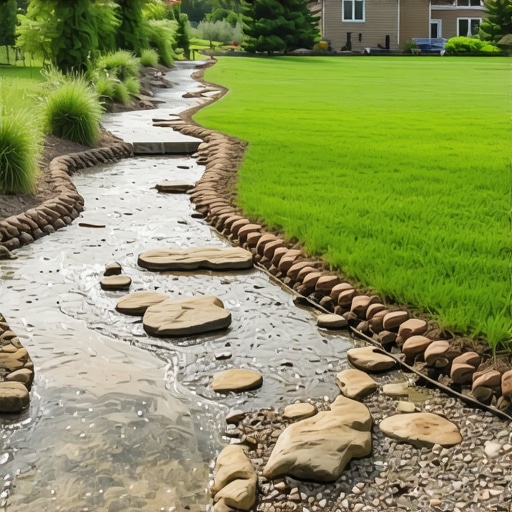
I recently got called out to tear up a $30,000 patio that was sinking because the previous contractor ignored the basic physics of water movement. The pavers were heaving, and the homeowners had two inches of standing water against their foundation every time the rain topped a half-inch. When we excavated, we found the culprit: a total lack of sub-base drainage. The installer had used a standard sand set over poorly compacted clay. Water had no exit strategy. It sat under those pavers, saturated the subgrade, and turned the entire structural base into a slurry. We had to rip out every stone, regrade the entire property, and install a French drain system integrated into a decorative dry creek swale. It was an expensive lesson in why you never fight gravity. Gravity always wins. You have to give water a path of least resistance, or it will find one through your basement walls. I told my crew that day: we aren’t just laying stone; we are managing a local watershed. If you don’t account for the 100-year storm event in your grading plan, you are just building a very expensive temporary fix.
“A retaining wall doesn’t fail because of the stone; it fails because of the water trapped behind it.” – Hardscape Engineering Axiom
The Engineering of the Perfect Swale
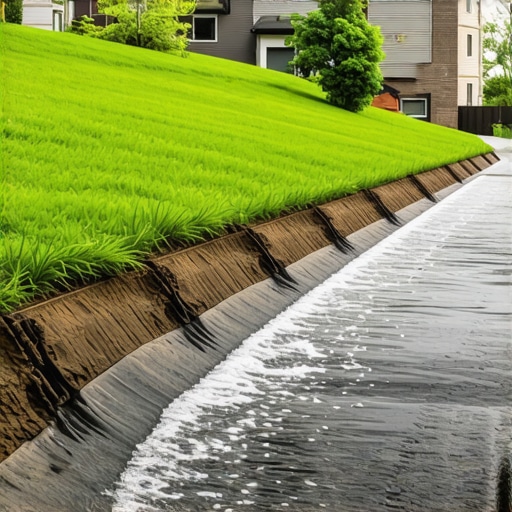
A swale is more than a depression in the dirt. It is a calculated piece of stormwater infrastructure. Most homeowners think they can just shovel out a trench and call it a day. That is how you end up with a mosquito-breeding swamp. To do this right, you need to understand hydraulic conductivity. You are aiming for a wide, shallow channel that moves water slowly enough to prevent erosion but fast enough to prevent stagnation. We use a transit level for every inch of the run. A 2% slope is the sweet spot. That is a two-foot drop for every 100 feet of length. Anything less and the water stalls. Anything more and you risk scouring the soil and ripping out your plantings. You also need to consider the cross-section. A parabolic shape is superior to a V-shape because it distributes the water volume more evenly and is easier to maintain with a mower or trimmer. Don’t skip the soil compaction check. You want the bottom of the swale to be firm enough to resist erosion but porous enough to allow for some deep-rooted infiltration.
The Check Dam Trick: The Secret to High-Volume Management
Here is the trick that separates the pros from the hacks: Internal Check Dams. If your yard has a significant pitch, water will gain too much velocity. Fast water is destructive water. By placing small, low-profile dams made of 3-to-5-inch river cobble every 10 to 15 feet within your swale, you create a series of mini-retention cells. This slows the water down, allowing sediment to drop out and giving the ground more time to absorb the moisture. This reduces the total volume of water reaching your outlet or the municipal storm sewer. It turns a potential flood into a controlled irrigation event. We use non-woven geotextile fabric under the stones to prevent them from sinking into the subsoil over time. This keeps the dams structural and functional for decades rather than just a single season.
| Material Type | Function | Optimal Placement |
|---|---|---|
| ASTM D448 No. 57 Stone | Structural drainage and void space | Sub-base of French drains and swale cores |
| Non-Woven Geotextile | Separates soil from aggregate | Between native soil and gravel layers |
| Native Switchgrass | Bio-filtration and root stabilization | Along the side slopes of the swale |
| River Cobble (3-5 inch) | Energy dissipation (Check dams) | Across the flow path at 10-foot intervals |
How deep should a drainage swale be?
A residential drainage swale should typically have a depth of 6 to 12 inches at its center point relative to the surrounding grade. This depth ensures enough capacity for heavy rain events while remaining shallow enough to prevent a tripping hazard or a visual eyesore. The side slopes should be at least a 3:1 ratio (three feet of width for every one foot of depth) to ensure stability and ease of maintenance. If you go deeper without widening the top, the walls will eventually slump and fill the channel with sediment, rendering the swale useless.
What is the best pitch for a backyard swale?
The ideal pitch for a backyard swale is between 1% and 3%. A 2% grade is generally considered the gold standard in landscape engineering. This provides enough gravitational pull to keep water moving toward the discharge point without creating high-velocity flows that lead to channelization and soil loss. If your property is extremely flat, you may need to install an underdrain (a perforated pipe in a gravel bed) beneath the swale to help move the water along when gravity alone isn’t enough.
“Soil saturation reduces the shear strength of the ground, leading to slope failure and structural settling.” – USDA Natural Resources Conservation Service
The Bio-Mechanical Approach: Why Plants Matter
Do not just throw down some cheap Kentucky Bluegrass and hope for the best. Lawns have terrible infiltration rates once the top inch of soil is saturated. For a swale to work in 2026 and beyond, you need deep-rooted native perennials. Plants like Carex (Sedges) or Panicum virgatum (Switchgrass) have root systems that can reach several feet into the earth. These roots act like biological drills, creating macropores in the soil that allow water to bypass the compacted surface layer. This is called bio-retention. Plus, these plants thrive in the wet-dry cycles of a swale. They won’t rot during a wet week and won’t die during a July drought. Avoid using mulch in the bottom of your swale; it will just float away and clog your outlet. Use shredded hardwood mulch on the upper banks only, or better yet, use a groundcover that can knit the soil together.
The Post-Installation Checklist
- Check the slope with a laser level or transit before adding stone or seed.
- Ensure the discharge point (the end of the swale) is clear of debris and leads to a safe legal area.
- Monitor the swale during the first three major rain events to identify any “dead zones” where water is pooling.
- Remove leaf litter every autumn to prevent the channel from clogging and turning into compost.
- Verify that no utility lines (811) are within the excavation zone.
Fixing the grade is the only way to protect your investment. If you are planning a garden design or a new lawn care routine, start with the dirt. Every plant you put in the ground is just expensive compost if it sits in an undrained bog. Real landscaping is about the invisible work—the layers of gravel, the percent of the grade, and the biology of the soil. Get the water right, and the rest of the yard will follow. Ignore the water, and you will be calling me in three years to tear it all out. [IMAGE_PLACEHOLDER]

![Building a 2026 Modern Wood Fence [Budget DIY]](https://lawnmajesty.com/wp-content/uploads/2026/09/Building-a-2026-Modern-Wood-Fence-Budget-DIY.jpeg)