Stop 2026 Garden Fungi with Air Flow Pruning Techniques DIY
The smell of a fungal outbreak is unmistakable to a professional. It is the scent of rotting organic matter and stagnant, humid air trapped where it does not belong. When I walk onto a property in the mid-summer heat and see white powdery film on the Ninebark or shriveled, brown-edged leaves on the hydrangeas, I don’t reach for a spray bottle of fungicide first. I reach for my bypass pruners. Most homeowners are essentially running a biological experiment in their backyard, creating high-humidity incubators by overcrowding plants and ignoring the interior architecture of their shrubs. In 2026, as weather patterns shift toward more intense, localized humidity spikes, the margin for error in garden maintenance has vanished. If you do not manage the air, the fungi will manage the plants. This is not about aesthetics; it is about the structural integrity of your landscape and preventing a total systemic collapse of your garden’s health.
The Stagnant Canopy: Why Your Garden Is a Fungal Petri Dish
Garden fungi thrive in 2026 due to excessive humidity, stagnant air pockets, and high spore density within unmanaged canopies. Airflow pruning mitigates this by strategically removing interior branches to increase wind penetration and UV exposure, effectively drying leaf surfaces before pathogens like Powdery Mildew can colonize tissue. I always drill into my new crew members: if you don’t fix the soil grading and the airflow first, every plant you put in the ground is just expensive compost. I’ve seen $50,000 planting plans decimated in a single season because the designer forgot that air needs to move through a shrub, not just around it. When you have branches crossing and rubbing, you create wounds. Those wounds are open doors for spores. When you have a dense mat of leaves, you create a micro-climate where the relative humidity stays near 100% even when the sun is out. That is a death sentence for roses, lilacs, and dogwoods.
“Increased air circulation within the plant canopy reduces the relative humidity and allows for more rapid drying of foliage after rain or irrigation, which is the primary defense against foliar pathogens.” – Penn State Extension Horticultural Manual
The Physics of Micro-Climates and Spore Germination
Fungal spores require specific surface moisture durations to germinate and penetrate the plant’s waxy cuticle. By altering the micro-climate through airflow pruning, you reduce the boundary layer of humid air around leaves, preventing the 12-to-24-hour damp period necessary for fungal infection to take hold in 2026 garden environments. Most people think plants breathe like we do, but they are far more dependent on the immediate atmosphere around each leaf. If the air is still, a layer of moisture sits on the leaf. Fungi like Sphaerotheca pannosa (powdery mildew) or Botrytis cinerea (gray mold) use this moisture to launch their attack. You need turbulent air—not just a light breeze—to break that boundary layer. This requires thinning the plant from the inside out. You are looking for the ‘bird-flight’ rule: a small bird should be able to fly through your shrub without hitting a wing on a branch.
How much space do plants need for air circulation?
Spacing depends on the mature spread of the species, but a general rule is to maintain at least 12 to 18 inches of daylight between the outermost reach of adjacent plants. This allows for laminar airflow to transition into turbulent air, which effectively ‘scrubs’ the leaves of excess moisture. In high-density garden designs, this is often ignored for immediate ‘full’ looks, which leads to massive failures within three years. Avoid the temptation to plant for today; plant for the size the specimen will be in five years. If you’ve already made the mistake of overplanting, airflow pruning is your only mechanical remedy to prevent a total loss.
| Fungal Pathogen | Common Host Plants | Pruning Strategy | Target Humidity Redux |
|---|---|---|---|
| Powdery Mildew | Roses, Lilacs, Peonies | Thinning 25% of interior wood | 30% reduction |
| Leaf Spot (Septoria) | Dogwoods, Tomatoes | Removing lower 15% of branches | 45% reduction |
| Botrytis (Gray Mold) | Geraniums, Strawberries | Deadheading and thinning center | 50% reduction |
| Root Rot (Phytophthora) | Azaleas, Boxwoods | Base thinning for soil evaporation | 25% soil moisture redux |
The Action Plan: Mechanical Remediation Steps
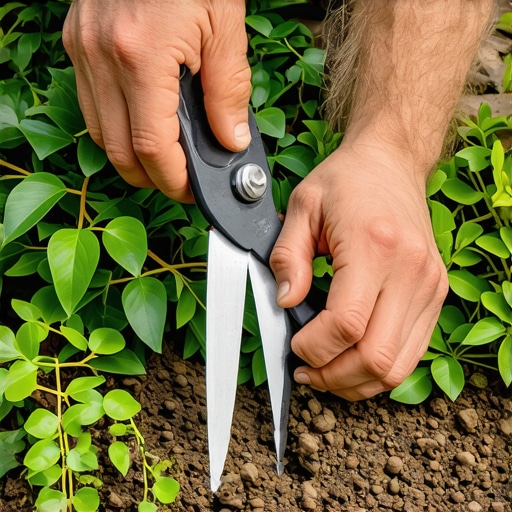
To execute airflow pruning effectively, you must understand the difference between a thinning cut and a heading cut. A heading cut—chopping the ends of branches—actually makes the problem worse by stimulating flush growth at the tips, which creates an even denser outer shell. You want thinning cuts. Follow this step-by-step process: First, remove the ‘Three Ds’: dead, damaged, and diseased wood. Second, identify crossing branches that rub together; remove the less dominant one. Third, identify ‘water sprouts’—those thin, vertical shoots that suck energy and block the interior. Finally, remove about 15-20% of the interior lateral branches to open the ‘heart’ of the plant. This allows the sun to hit the interior stems and the wind to pass through the center. Do not skip this. If the sun can’t reach the interior, the plant will eventually self-shade and the interior wood will die anyway, providing a dry fuel source for wood-rotting fungi.
What are the best tools for air flow pruning?
You need a high-quality pair of bypass pruners (not anvil style, which crushes the stem) and a folding pruning saw for anything over one inch in diameter. Keep your tools sharp and, most importantly, sanitized. Use a 70% isopropyl alcohol solution between every single plant. If you prune a diseased shrub and move to a healthy one without cleaning your blades, you are literally injecting the fungus into the next plant. It is the equivalent of a surgeon using a dirty scalpel. I’ve seen entire rows of Leyland Cypresses die because a ‘mow-and-blow’ contractor moved down the line with contaminated shears. It is professional negligence, plain and simple.
“A retaining wall doesn’t fail because of the stone; it fails because of the water trapped behind it, and a plant canopy fails because of the moisture trapped within it.” – Hardscape and Agronomy Engineering Axiom
- Inspect your garden at 6:00 AM. If leaves are still wet at 11:00 AM, you have an airflow problem.
- Monitor the soil pH. Fungi thrive in acidic, poorly drained soils. Aim for a 6.5 pH for general garden health.
- Avoid overhead irrigation. Water the soil, not the leaves. If you must use sprinklers, run them at 4:00 AM so the sun dries the foliage quickly.
- Mulch correctly. Avoid ‘mulch volcanoes’ against the trunk. This traps moisture against the bark and invites collar rot.
Maintenance and the 2026 Climate Reality
The 2026 growing season is proving that we can no longer garden by the ‘set it and forget it’ mentality. We are seeing higher night-time temperatures, which prevents plants from ‘exhaling’ properly through transpiration, leading to increased internal stress. When a plant is stressed, its chemical defenses drop, and fungi move in. Airflow pruning is a proactive biological intervention. It forces the plant to allocate resources to its strongest limbs while ensuring the environmental conditions do not favor the enemy. While the internet tells you to water every day, turf grass and shrubs actually need deep, infrequent watering—exactly 1 inch per week—to force roots to chase the water down. Surface misting just keeps the humidity high and the roots shallow. It will rot your garden from the bottom up. Stop doing it. Real landscaping is about managing the invisible forces—air, water pressure, and microbial loads. Get your pruners out and give your plants room to breathe. They will thank you with survival.