Stop 2026 Lawn Grub Attacks with Organic Milky Spore Secret
The Forensic Autopsy of a Dying Turf System
You walk onto your lawn in late August and it feels like walking on a soaked sponge, despite not having rained for three days. You reach down, grab a handful of turf, and it lifts up like a loose piece of cheap carpet. No resistance. No root tension. Just a brown, dying mat of organic matter and a swarm of C-shaped, creamy-white larvae wriggling in the top two inches of soil. This is the structural failure of a lawn. It is not a ‘watering issue’ or a ‘nutrient deficiency.’ It is an active excavation by Popillia japonica—the Japanese Beetle. If you see this now, your 2026 season is already in jeopardy. I recently saw a homeowner in a panic after they completely torched their front lawn by applying three times the recommended dose of a synthetic ’24-hour grub killer.’ They didn’t just kill the grubs; they altered the soil pH so drastically and killed so many beneficial microbes that the ground became sterile. The grubs that survived the chemical burn simply moved deeper into the profile, only to return with a vengeance three weeks later. They missed the biological window. Stop 2026 lawn grub attacks by shifting from chemical warfare to biological engineering. [image_placeholder_1]
What is the Milky Spore Secret for Long-Term Control?
To effectively stop 2026 lawn grub attacks, you must introduce Bacillus popilliae, commonly known as Milky Spore, into your soil matrix during the peak larval feeding window. This specialized bacterium targets the midgut of the grub, multiplying by the billions until the host expires and releases a fresh wave of spores back into the soil, creating a self-perpetuating cycle of larval suppression that can last 15 to 20 years. This is not a quick fix; it is a long-term infrastructure project for your yard.
“A retaining wall doesn’t fail because of the stone; it fails because of the water trapped behind it. Similarly, a lawn doesn’t fail because of the beetle; it fails because the soil ecosystem lacks the biological checks to maintain root integrity.” – Hardscape Engineering Axiom
How do I know if I have grubs?
Perform a ‘tug test’ in areas showing localized wilting. If the turf pulls up with zero root attachment, excavate a one-square-foot section to a depth of three inches. If you count more than six to ten grubs in that single square foot, you have reached the economic threshold for treatment. Anything less might be managed by a healthy turf’s natural recovery, but 10+ grubs per square foot will result in total crown death of your grass plants.
The Biological Mechanism: How Milky Spore Works
Milky Spore is not a poison. It is a pathogen. When a grub feeds on the roots of your grass, it incidentally ingests the spores residing in the soil. Once inside the grub’s gut, the spores germinate and begin to multiply. This turns the grub’s internal fluids a milky white color—hence the name. The grub dies, and as its body decomposes, it releases billions of new spores. This process is called ‘cycling.’ If you apply it correctly now, you are building a biological minefield that will be at peak efficacy by 2026. It requires patience. It requires the right soil temperature. It won’t work in frozen ground. The soil must be at least 65 degrees Fahrenheit for the grubs to be active near the surface and for the bacteria to colonize effectively.
When is the best time to apply milky spore?
The optimal application window is from late July through September. This is when the eggs have hatched and the young larvae are feeding voraciously near the surface. Applying in the spring is less effective because the mature third-instar larvae are tougher and preparing to pupate. You want to catch them when they are small and hungry.
Grub Control Comparison: Biological vs. Synthetic
| Feature | Organic Milky Spore | Synthetic (Imidacloprid) | Synthetic (Carbaryl) |
|---|---|---|---|
| Longevity | 15-20 Years | 3-4 Months | 2-3 Weeks |
| Impact on Bees | Zero / Safe | High Risk | Moderate Risk |
| Application Logic | Biological Colonization | Systemic Neurotoxin | Contact Killer |
| Soil Health | Improves Microbiome | Can Disrupt Microbes | Toxic to Earthworms |
| Target | Japanese Beetle Larvae | Broad Spectrum | Broad Spectrum |
Synthetic options like Imidacloprid are systemic, meaning the plant absorbs the toxin. When the grub eats the root, it dies. However, these chemicals often leach into groundwater or affect non-target species like honeybees. Milky Spore is a sniper rifle; synthetics are a grenade. In high-end garden design, we prioritize the sniper approach to protect the surrounding perennials and pollinators.
Step-by-Step Implementation for 2026 Protection
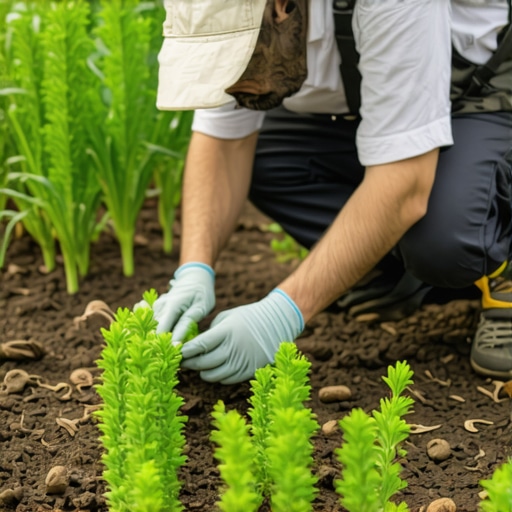
Success with Milky Spore is about placement and persistence. You cannot simply throw it out like grass seed and hope for the best. It requires a grid-based delivery system to ensure the bacteria colonize the entire lawn area. Don’t skip the watering step. It’s vital.
- Measure your square footage: Calculate the exact area of turf. Do not include hardscaping or mulch beds.
- The Grid Method: Apply one teaspoon of Milky Spore powder every four feet in a grid pattern. Do not use a spreader for the concentrated powder; it is too fine.
- Light Irrigation: Use a fine mist to water the powder into the soil for 15 minutes. Heavy rain will wash it away; you want it to sink into the root zone.
- Mowing Suspension: Do not mow the lawn for 24 hours after application to avoid sucking the powder back up into the mower bag.
- Verification: Monitor for beetle activity the following July. You should see a marked decrease in the number of emerging adults.
“Effective grub control requires understanding the vertical migration of larvae based on soil temperature and moisture content. Chemical solutions are temporary, but biological integration offers a permanent shift in pest dynamics.” – Agronomy Manual for Sustainable Turf
The Hardscape Connection: Why Grubs Ruin Patios
As a foreman, I’ve seen grubs cause more than just brown grass. When you have a massive grub infestation near the edge of a paver patio or a retaining wall, you attract secondary predators. Skunks, raccoons, and moles will literally excavate your hardscaping to get to the ‘protein bars’ underneath. I’ve seen $15,000 walkways undermined by moles chasing grubs, leading to base-layer settling and cracked joints. By stopping the grubs with Milky Spore, you are protecting the structural integrity of your hardscaping by removing the food source for tunneling pests. It’s all connected. The soil is the foundation for everything. If you don’t fix the biological balance, your engineering will eventually fail. [image_placeholder_2]
Common Pitfalls in Organic Lawn Care
The biggest mistake people make is impatience. They apply Milky Spore and then two weeks later, seeing a few grubs, they dump a bag of ‘Kill-All’ pesticide on top. This is a disaster. The pesticide kills the grubs, which stops the ‘cycling’ of the Milky Spore. You are essentially killing your own investment. If you want the ‘Secret’ to work for 2026 and beyond, you have to trust the biology. Let the grubs get sick. Let them die naturally in the soil. That is how the spore count rises to a level that provides total protection. Also, avoid ‘Mulch Volcanoes’ around your trees while you’re at it—it has nothing to do with grubs, but it’s another hack move that rots the root flare and kills your canopy. Focus on the soil, and the lawn will follow.