Stop 2026 Patio Settling with This $20 Gravel Hack
Stop 2026 Patio Settling with This $20 Gravel Hack
I recently got called out to tear up a $30,000 patio that was sinking because the previous contractor used stone dust as a bedding layer and ignored the hydrostatic pressure building up in the clay subgrade. The homeowners were devastated. Their expensive Turkish travertine was cracking like an eggshell because the ‘pro’ they hired didn’t understand the fundamental physics of drainage. I spent three days excavating 18 inches of sludge that used to be a base. It was a forensic autopsy of a failed project. The fix was simple, and it could have been prevented for about twenty bucks in extra material costs if it had been done right the first time. This is not just about aesthetics; it is about civil engineering on a residential scale.
Why Your Paver Patio Is Sinking
Patio settling occurs primarily due to poor subgrade preparation, inadequate compaction, and water saturation in the base layers. When water stays trapped under your pavers, it softens the soil, causing the heavy stone to migrate downward. Using open-graded aggregates and non-woven geotextile fabric ensures your hardscape remains level for decades.
The root cause of 90 percent of patio failures in North America is ‘fines’ migration. Most contractors use a modified stone base (CR6 or 21A) that contains a mix of 3/4-inch stone down to stone dust. While this packs tightly, the dust or ‘fines’ are susceptible to water. If the soil beneath is heavy clay, the water sits there. In winter, that water freezes and expands, pushing your pavers up. In spring, it thaws, leaving a void. This is the frost heave cycle. To stop this, you need to understand the relationship between the soil and the aggregate. We use a 4-ounce non-woven geotextile fabric as a separation layer. This fabric costs roughly $20 for a small project’s worth of coverage, but it acts as a permanent barrier between the raw dirt and your structural gravel. Without it, the gravel simply sinks into the mud over time.
“A retaining wall doesn’t fail because of the stone; it fails because of the water trapped behind it.” – Hardscape Engineering Axiom
The $20 Open-Graded Gravel Solution
The secret to preventing patio settling is switching from modified stone to a #57 clean stone base wrapped in geotextile fabric. This ‘open-graded’ system allows water to flow through the base and into the soil naturally, preventing the saturation that leads to sinking and shifting. It is the gold standard for 2026 hardscaping.
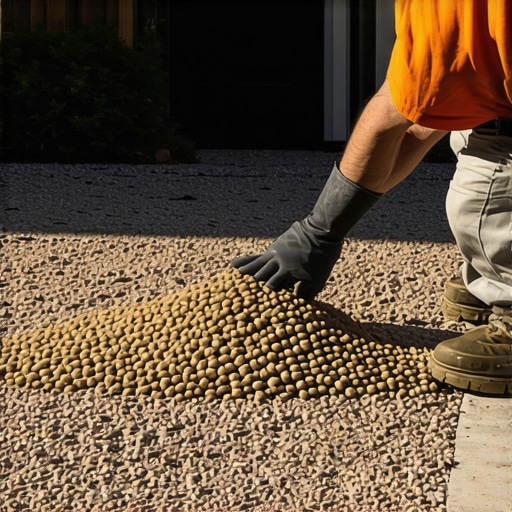
When we talk about #57 stone, we are talking about 3/4-inch angular crushed rock with no dust. Because there are no fines, there is roughly 40 percent void space between the stones. This creates a built-in reservoir for rainwater. Instead of the water sitting under your pavers and turning the base into soup, it drains vertically and horizontally. This is crucial for garden design and long-term landscaping stability. If you are in a region with heavy freeze-thaw cycles, this is not an option; it is a requirement. The ‘hack’ is simple: go to the quarry and ask for #57 clean or #8 washed stone instead of the standard crusher run. The price difference per ton is negligible, often less than $20 for a standard pallet of pavers, but the structural integrity is tripled.
How much modified gravel do I need for a patio base?
To calculate your gravel needs, multiply the square footage of your patio by the depth of the base (usually 6 inches for walkways, 10-12 inches for patios), then divide by 27 to get cubic yards. A standard 10×10 patio with a 6-inch base requires roughly 2 cubic yards of material. Always add 10 percent for compaction loss if using modified stone.
| Material Type | Drainage Rating | Compaction Stability | Primary Risk Factor |
|---|---|---|---|
| Stone Dust / Screenings | Very Poor | High (until wet) | Water retention and liquefaction |
| Modified Stone (CR6) | Moderate | Excellent | Fines migration and frost heave |
| #57 Clean Stone | Excellent | High (Angular Lock) | Requires geotextile wrap |
| ASTM No. 8 Washed | Superior | High | High cost per ton |
Why is my paver patio settling after 2 years?
Settling after 24 months usually indicates that the subgrade was not properly compacted or that the bedding sand is washing out into the base. If your contractor used a standard 1-inch layer of concrete sand over a base that wasn’t fully vibrated with a plate compactor, the sand will eventually fill the microscopic gaps in the gravel, causing the surface to dip. You must ensure the base is compacted in 2-inch lifts, not all at once.
“Soil compaction is the most critical variable in any civil engineering project; failing to achieve 98% Proctor density results in inevitable structural subsidence.” – Agronomy and Soils Manual (Volume 4)
The 2026 Hardscape Stability Checklist
- Excavate to a minimum depth of 8 to 12 inches depending on soil type.
- Verify 811 utility markings before any digging occurs.
- Install a 4-ounce non-woven geotextile fabric across the entire subgrade.
- Layer #57 angular crushed stone in 3-inch lifts, compacting each lift.
- Use a 1-inch bedding layer of #8 washed stone or coarse sand.
- Install edge restraints with 10-inch steel spikes every 12 inches.
- Apply high-quality polymeric sand to the joints to lock the system.
Proper landscaping requires more than a shovel and a dream. It requires an understanding of the local soil profile. If you are working in heavy red clay, you cannot treat it like sandy loam. Clay holds moisture like a sponge. In these environments, I always recommend a perforated French drain pipe at the lowest point of the excavation to lead water away from the patio foundation. This is the difference between a patio that lasts 5 years and one that lasts 50. Don’t let a ‘mow-and-blow’ guy tell you that stone dust is fine because it’s ‘easy to level.’ Easy for him means expensive for you in three years. Do it right. Use clean stone. Wrap it in fabric. Protect your investment.