The $50 Tool That Makes Weeding Twice as Fast
The Stirrup Hoe: Why This $50 Tool Wins the Weeding War
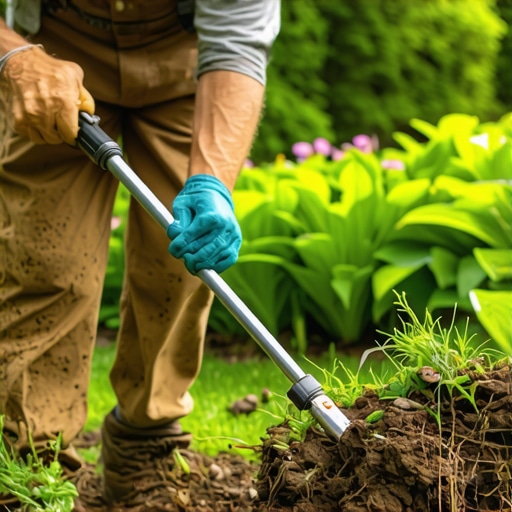
The stirrup hoe, often called a hula hoe or scuffle hoe, is a professional-grade manual tool that doubles weeding speed by utilizing an oscillating blade to sever weed roots 1 to 2 inches below the soil surface. This tool eliminates the need for hand-pulling while preventing the soil inversion that typically brings dormant weed seeds to the surface for germination.
I always drill into my new crew members: if you don’t fix the soil grading first, every plant you put in the ground is just expensive compost. I remember an apprentice who spent eight hours hand-pulling dandelions in a 4,000-square-foot bed. By the time he finished, the first half of the bed was already seeing new sprouts. He was doing it wrong. He was disturbing the soil structure, breaking the capillary action, and inviting a new generation of weeds to take hold. I handed him a professional stirrup hoe with a 60-inch ash handle and told him to stop fighting the dirt and start engineering it. Professionals don’t pull; we cut. We treat the garden bed like a biological machine where every disturbance has a consequence.
“Maintaining a weed-free environment requires a multi-faceted approach where the goal is to prevent weed seeds from receiving the light necessary for germination.” – Cornell University Agricultural Extension
The Biology of the Weed Seed Bank
To understand why this $50 tool is superior, you have to understand the weed seed bank. Your soil is currently holding thousands of dormant seeds per square foot. When you pull a weed by hand, you create a localized soil disturbance. This disturbance introduces oxygen and light to the top 2 inches of soil, which serves as the primary germination zone. The stirrup hoe works on a different principle. Its blade oscillates back and forth, slicing through the root collar of the weed. It leaves the root in the ground to decompose—adding organic matter—while keeping the soil structure intact. This is tactical lawn care. You aren’t just cleaning up; you are managing the soil’s microscopic environment.
How do you kill weeds without damaging the soil?
To kill weeds without damaging the soil, you must use a tool that utilizes a scuffle motion to sever the weed at the meristematic tissue level. This prevents soil compaction and keeps the mycorrhizal fungi networks intact, which are essential for the health of your ornamental plants and turf grass. Avoiding broad-spectrum herbicides prevents chemical runoff and protects the soil pH levels, which should typically sit between 6.0 and 7.0 for optimal nutrient uptake in most landscaping environments.
The Engineering of the Tool: Leverage and Blade Angle
Most homeowners buy cheap tools from big-box stores that have 22-gauge steel and hollow plastic handles. They break within one season. A professional-grade stirrup hoe, costing roughly $50, features high-carbon steel blades that can be sharpened with a mill file. The oscillating head is designed to work on both the push and pull stroke. This 50% increase in efficiency comes from the physics of the blade angle. It maintains a 20-degree pitch relative to the ground, ensuring it doesn’t dive too deep into the subsoil. [image_placeholder]
| Tool Type | Action Mechanism | Soil Disturbance | Efficiency Rating |
|---|---|---|---|
| Hand Pulling | Vertical Extraction | High | Low |
| Standard Hoe | Chopping/Impact | Medium | Medium |
| Stirrup Hoe | Horizontal Slicing | Low | High |
| Chemical Spray | Systemic Toxicity | Zero (Structural) | Medium-High |
What is the most effective manual weeding tool for large areas?
The most effective manual weeding tool for large areas is the long-handle scuffle hoe because it allows the operator to maintain a neutral spinal position while covering a 4-inch to 7-inch swath of soil per stroke. By leveraging kinetic energy through the handle, a professional can clear 500 square feet of garden bed in under 15 minutes, provided the weeds are in the cotyledon stage or early vegetative growth. Hardscaping professionals also use these tools to clear edges before applying polymeric sand or laying pavers.
“Effective weed management in professional landscapes relies on the ‘Scuffle’ method, which severs the plant from its root system at the soil’s surface without disturbing deeper soil layers.” – University of California Integrated Pest Management
The Professional Weeding Checklist
- Monitor soil moisture; weeding is most effective when the soil moisture tension is low.
- Check blade sharpness; a dull blade tears the plant rather than slicing the vascular tissue.
- Maintain a rhythmic push-pull motion; do not chop at the ground.
- Apply a 3-inch layer of arborist wood chips immediately after weeding to suppress further growth.
- Inspect for perennial weeds like nutsedge or thistle which may require deep taproot extraction.
Soil Physics and Hydrostatic Pressure
Weeding isn’t just about aesthetics; it’s about water management. Weeds compete for transpiration. In a dense garden design, weeds can rob your primary specimens of up to 40% of available groundwater. Furthermore, in areas with heavy clay soil, weed roots can create unintended drainage channels that affect the hydrostatic pressure against retaining walls or foundation footings. By using a stirrup hoe, you keep the soil surface flat and uniform. This promotes sheet flow drainage rather than localized pooling. It’s a small detail, but engineering-grade hardscaping relies on these micro-adjustments to ensure longevity. Don’t be a hack. Use the right tool and respect the dirt. One inch of depth. Two strokes. Done. Keep your edges clean and your blade sharp. That is the difference between a yard and a professional landscape.
![Stop Killing 2026 Peonies: 3 Drainage Secrets [Zone 6]](https://lawnmajesty.com/wp-content/uploads/2026/05/Stop-Killing-2026-Peonies-3-Drainage-Secrets-Zone-6.jpeg)