![Why Your 2026 Deck Stain is Peeling [Preparation]](https://lawnmajesty.com/wp-content/uploads/2026/06/Why-Your-2026-Deck-Stain-is-Peeling-Preparation.jpeg)
Why Your 2026 Deck Stain is Peeling [Preparation]
The Anatomy of a Flaking Disaster: Why Most Decks Fail by July
Deck stain peels primarily because of poor mechanical bonding caused by mill glaze, excessive internal moisture (above 15%), or chemical residue from improper cleaning. When the wood’s cellular structure is closed or saturated, the resins in the stain cannot penetrate the fibers, leading to a surface-only film that cracks under UV exposure and hydraulic pressure from within the wood.
The Forensic Autopsy: A $40,000 Lesson in Hubris
I recently got called out to tear up a $30,000 deck and outdoor kitchen assembly that was barely 14 months old. The homeowner was livid because the premium oil-based finish was coming off in sheets like a bad sunburn. The contractor blamed the product. I didn’t. I pulled out my Delmhorst moisture meter and my 10x jeweler’s loupe. The meter pinned at 22% moisture—it was basically a sponge. Beneath the loupe, I could see the ‘mill glaze,’ a shiny, crushed layer of wood cells created by high-speed planer blades during manufacturing. The contractor had stained right over it. He didn’t prep; he just painted on a failure. It was a structural rejection. The wood didn’t want the stain because the wood was already full of water and sealed shut by mechanical friction. We had to strip it to the raw grain and start over. It was an expensive, avoidable nightmare.
“Wood that is not allowed to reach an equilibrium moisture content or is not mechanically abraded to remove mill glaze will inherently reject long-chain polymer resins found in modern stains.” – USDA Forest Products Laboratory: Wood Handbook
The Science of Substrate Saturation
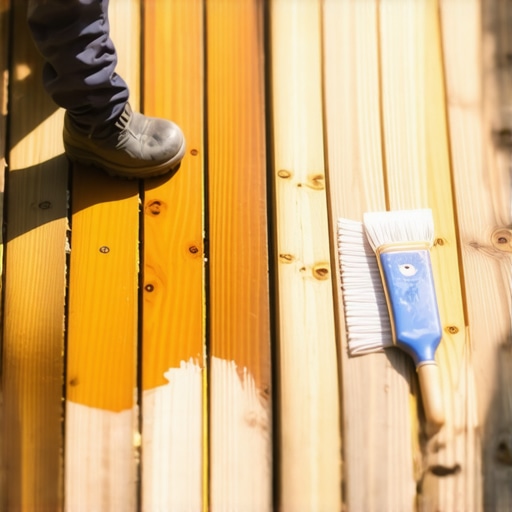
To understand why your deck is peeling, you have to look at the wood as a series of vertical straws or ‘lumens.’ These straw-like cells are held together by lignin, the natural glue of the tree. When you apply a cleaner or a stain, you are attempting to trigger a capillary action. If those straws are already full of water, the stain sits on top. If the wood has been weathered for too long, the UV rays have already shredded the lignin, leaving a layer of ‘dead’ silver fibers. Staining dead fibers is like gluing a house to sand. It won’t hold. [image_placeholder_1]
How long should pressure treated wood dry before staining?
Pressure treated lumber usually requires a drying period of 3 to 6 months depending on local humidity and sun exposure before it reaches the necessary 12% moisture threshold. You cannot rely on a ‘bead test’ alone; a digital moisture meter is the only professional way to verify that the internal cellular structure is ready to receive a coating without trapping hydrostatic pressure.
The Chemical Warfare of Prep
Most homeowners and ‘mow-and-blow’ hacks reach for the bleach (sodium hypochlorite) the second they see gray wood. Stop. Bleach is a salt. It destroys the lignin and leaves a salt residue that attracts moisture deep into the grain. I use sodium percarbonate—an oxygen-based cleaner. It lifts the dirt and kills the mold without ‘fuzzing’ the wood fibers. After cleaning, you must use a citric or oxalic acid brightener. This isn’t for aesthetics; it’s for chemistry. It lowers the pH of the wood, opens the pores, and neutralizes the caustic cleaners. It’s the difference between a finish that lasts five years and one that peels in five months.
| Prep Stage | Material/Tool | Technical Objective | Target Value |
|---|---|---|---|
| Cleaning | Sodium Percarbonate | Lignin preservation & dirt lift | pH 8.0-9.0 |
| Neutralizing | Oxalic Acid | Cellular opening & pH balance | pH 6.0-7.0 |
| Abrasion | 80-Grit Orbital | Mill glaze removal | Visible grain depth |
| Testing | Moisture Meter | Internal dryness verification | <12% MC |
The Mechanical Bond: Why Sanding is Non-Negotiable
If your wood is ‘smooth’ to the touch, it is likely too smooth for stain. For a deck to hold a finish, especially a film-forming or semi-transparent one, you need to create ‘tooth.’ I tell my crew: if you aren’t using 60 to 80 grit, you’re just polishing the problem. Anything finer than 100 grit will burnish the wood, closing the pores you just spent hours trying to open. We use floor maintainers with specialized ‘sand-screens’ to ensure an even profile across the entire surface. Don’t skip the edges. The end-grain is where 80% of moisture enters the board. Seal it or watch the board rot from the inside out.
“Failure of the coating system is often attributed to the presence of extractives or the physical state of the wood surface, particularly the degradation of the cellular structure due to over-exposure prior to treatment.” – International Wood Products Journal Standards
Can I stain a deck after it rains?
No, you must wait at least 48 hours of clear, dry weather after a rain event before applying any stain. Staining a damp deck traps moisture under the finish, which will eventually turn into water vapor when the sun hits it, blowing the stain right off the wood in small bubbles or flakes.
The Professional Checklist for 2026 Success
- Visual Inspection: Look for ‘fuzzing’ or silvering. If it’s gray, the lignin is dead.
- The Scrap Test: Take a flathead screwdriver and press into the wood. If it’s soft, you have rot, not a staining issue.
- Moisture Verification: Check 10 different boards. Do not stain if any board reads above 15%.
- Chemical Neutralization: Always follow a cleaner with a brightener to reset the pH.
- The Weather Window: You need a 72-hour window where the temperature is between 50°F and 85°F. No direct noon sun.
Maintenance: The ‘One and Done’ Myth
Landscaping isn’t just about the plants; it’s about the engineering of the entire outdoor environment. A deck is a horizontal surface in a vertical world of rain. It takes more abuse than your roof. You don’t ‘fix’ a deck and walk away. You monitor it. If the water stops beading, it’s time for a maintenance coat—not a full strip. If you wait until it’s peeling, you’ve already lost the battle. The preparation is the project. The staining is just the victory lap.
![Repairing 2026 Deck Boards with Wood Hardener [Pro Tip]](https://lawnmajesty.com/wp-content/uploads/2026/07/Repairing-2026-Deck-Boards-with-Wood-Hardener-Pro-Tip.jpeg)