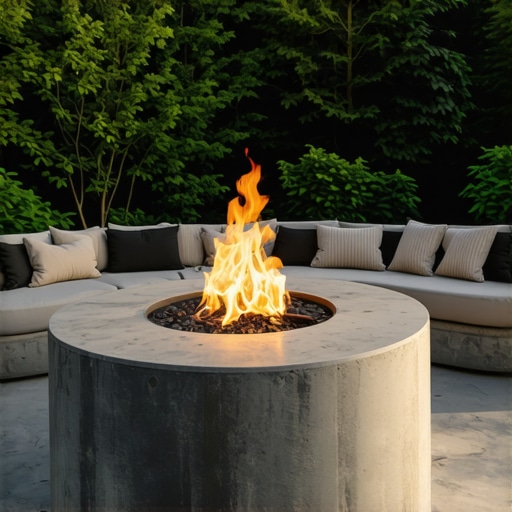
Build a $400 2026 Stone Fire Pit Area for Patios
The Science of the $400 Hardscape Foundation
Building a $400 stone fire pit requires a rigorous focus on sub-grade compaction and aggregate selection to prevent frost heave. By utilizing crushed #2A limestone and polymeric sand, homeowners can create a structurally sound hardscape that resists lateral displacement and settling over multiple seasons.
I recently got called out to tear up a $30,000 patio that was sinking because the previous contractor failed to account for hydrostatic pressure and used a base of clean pea gravel instead of modified stone. The stones were literally swimming in the mud after two years. It was a $30,000 autopsy. When you are working on a $400 budget for a fire pit area, you do not have the luxury of over-engineering the surface, so you must perfectly engineer the base. If you ignore the 4-inch minimum of compacted aggregate, your fire pit will become a collection of loose teeth in a year. Hardscaping is not about the stone you see; it is about the structural integrity of the dirt you hide. Every project starts with excavation. You are not just digging a hole; you are removing organic matter that will rot and cause voids. Turf grass and topsoil hold moisture. Moisture leads to expansion. Expansion leads to failure. Don’t skip the transit level. Even a $400 project needs a 1% slope for drainage.
“A retaining wall doesn’t fail because of the stone; it fails because of the water trapped behind it.” – Hardscape Engineering Axiom
The Material Breakdown for a 2026 Budget Install
The budget for a 2026 fire pit relies on sourcing tumbled concrete pavers or trapezoidal retaining wall blocks from local masonry yards rather than big-box retailers. By allocating $150 for stone, $100 for aggregate, and $150 for a heavy-gauge steel fire ring, you prioritize safety and longevity over aesthetic fluff.
| Material Item | Quantity Required | Estimated Cost | Purpose |
|---|---|---|---|
| #2A Modified Stone | 1.5 Tons | $65.00 | Structural Base |
| Concrete Wall Blocks | 36-48 Blocks | $160.00 | Vertical Structure |
| Steel Fire Ring | 36-inch Diameter | $120.00 | Thermal Protection |
| Polymeric Sand | 1 Bag | $35.00 | Joint Stabilization |
| Lava Rock | 2 Bags | $20.00 | Drainage/Heat Shield |
To keep costs low, you must avoid “decorative” stones. Focus on functional mass. A standard 12-foot diameter circle for a fire pit area requires roughly 113 square feet of space. If you are doing this for $400, you aren’t paving the whole circle. You are building the pit and a 2-foot ring of gravel. It works. It’s safe. It’s clean.
How much modified gravel do I need for a patio base?
For a standard 10×10 fire pit area with a 4-inch base, you will need approximately 1.5 to 2 tons of #2A modified stone to ensure proper load-bearing capacity. This aggregate size provides the necessary interlock between the 3/4-inch crushed limestone and the stone dust, creating a nearly impenetrable sub-base when compacted with a plate tamper.
The Critical Installation Process
Installing a stone fire pit involves a step-down excavation method where the center of the pit is dug deeper than the surrounding pavers to create a sump for drainage. This prevents water from pooling in the bottom of the pit, which can lead to rusted rings or, in the case of natural stone, explosive steam expansion during a fire.
- Mark a 12-foot diameter circle and excavate 6 inches deep for the surround and 10 inches for the pit.
- Compact the sub-grade using a manual or mechanical tamper until the soil is firm.
- Add 4 inches of #2A modified stone in 2-inch lifts, wetting and compacting each layer.
- Set the first course of blocks 1 inch below the finished grade to lock the structure into the ground.
- Install the steel fire ring to shield the concrete blocks from direct thermal shock.
The tamper should literally bounce off the compacted base. If it sinks, you aren’t done. Don’t skip this. I see homeowners try to level their stone with 3 inches of sand. Sand is not a structural material; it is a leveling medium. Anything more than 1 inch of sand will lead to shifting. It will fail. Use the 4-inch stone base rule or don’t start the project.
“Compaction is the single most important variable in hardscape longevity, as it eliminates air voids that allow water to settle and freeze.” – ICPI Installation Standards
What is the best stone for a budget fire pit?
The most cost-effective stone for a durable fire pit is tumbled concrete wall block, as it offers uniform dimensions and high compressive strength. Unlike river rock or limestone, which can contain trapped moisture and explode under high heat, kiln-fired masonry units or those used with a steel liner are the safest options for budget-conscious homeowners.
Thermal Dynamics and Safety Rules
Managing thermal shock in a DIY fire pit is critical to prevent the calcination of concrete, which occurs when the chemical bond in the block breaks down due to excessive heat. A steel fire ring insert creates a mandatory 1-inch air gap between the flame and the stone, significantly extending the life of the $400 structure.
Many people think they can just pile up some rocks and call it a day. That’s how you end up with a face full of shale shards. Natural stones like river rock have high water content. When that water turns to steam inside the stone, the stone explodes. Use a liner. It’s not a suggestion. It’s physics. Furthermore, keep your pit at least 15 feet away from any overhangs or structures. Check your local municipal codes regarding 811 Dig Safe requirements before you break ground. One severed gas line will turn your $400 project into a $10,000 nightmare. Soil grading around the pit is also non-negotiable. You want water to move away from the pit, not toward it. If you build your pit in a low spot, you’re just building a very expensive puddle holder. It will rot.
The Long-Term Maintenance Schedule
Maintaining a gravel-base fire pit involves an annual application of pre-emergent herbicide and the replenishment of joint sand to prevent weed encroachment and organic build-up. By removing ash after every three fires, you prevent the alkaline ash from mixing with rainwater and corroding the steel liner or the stone base.
Hardscaping isn’t a “set it and forget it” deal. The environment is always trying to reclaim the space. Nitrogen from grass clippings will settle in your gravel and start a compost cycle. Keep it clean. Use a leaf blower on the area weekly. If you see the stones settling, it means your base wasn’t compacted or your drainage is failing. Fix it early. A $400 pit can last 15 years if you respect the engineering. If you treat it like a pile of rocks, it will look like one by next spring.
![Why Your 2026 Deck is Turning Black [3 Fixes]](https://lawnmajesty.com/wp-content/uploads/2026/06/Why-Your-2026-Deck-is-Turning-Black-3-Fixes.jpeg)