Why Your Lawn Needs a Core Aeration Every Single Autumn
The Forensic Autopsy of a Dying Lawn
You look at your lawn in late August and see a thinning, yellowing mess. You think it needs more fertilizer. You think it needs more water. You are wrong. A homeowner called me last year in a panic after they completely torched their front lawn by applying three rounds of high-nitrogen fertilizer to a lawn that wasn’t ‘eating.’ The soil was so compacted that the nitrogen just sat in the upper half-inch, turning the root zone into a chemical kiln. By the time I arrived, the turf was literally crispy. The culprit wasn’t a lack of nutrients; it was a lack of pore space. This is the reality of soil compaction. When your soil reaches a certain bulk density, the biology stops. The roots suffocate. Without autumn aeration, you are just throwing money onto a parking lot. It will die. Don’t skip the science.
The Silent Killer: Soil Compaction and the Thatch Barrier
Soil compaction occurs when soil particles are pressed together, reducing the pore space necessary for air and water movement. Core aeration mechanically removes small plugs of soil to alleviate this pressure, allowing oxygen, water, and nutrients to penetrate the root zone during the critical autumn growth phase. It is non-negotiable for clay-heavy soils.
Think of your soil as a series of microscopic highways. Over a summer of foot traffic, lawn mowers, and heavy rains, those highways get shut down. In technical terms, we are talking about increasing the bulk density of the soil. When soil is compacted, it loses its macropores. These are the larger spaces that allow for gas exchange. Roots need to breathe out carbon dioxide and breathe in oxygen. When they can’t, they stop growing. This leads to a shallow root system that can’t survive a freeze or a drought. Then there is the thatch. Thatch is a layer of organic matter—lignins and stems—that hasn’t decomposed. A thin layer is fine, but anything over half an inch acts like a waterproof tarp. It prevents your expensive Kentucky Bluegrass or Tall Fescue from actually getting the water you’re paying for. Core aeration is the only way to punch through that tarp. It’s physical surgery for your yard.
“Core aeration is the most effective way to reduce soil compaction and improve the gas exchange between the soil and the atmosphere.” – Penn State Center for Turfgrass Science
How much depth is required for a successful core aeration?
To be effective, a core aerator must pull a plug that is at least 2.5 to 3 inches deep. If the machine is just scratching the surface or using spikes, it is actually increasing compaction around the hole. You need to physically remove the soil volume to create meaningful expansion space.
The Science of the Pore: Why Roots Need Oxygen
Every autumn, your grass enters a period of intense root development as it prepares for winter dormancy. Core aeration facilitates this by increasing the cation exchange capacity and allowing aerobic microbes to break down organic matter. Without this gas exchange, the turf cannot store the carbohydrates needed for spring green-up. This is biological engineering, not just yard work.
Most ‘mow-and-blow’ guys will tell you that a liquid aerator is just as good. They are lying. Liquid aerators are often just surfactants—fancy soaps—that help water penetrate the surface. They do nothing to change the physical structure of a compacted clay soil. To fix a physical problem, you need a physical solution. You need a gas-powered, walk-behind or stand-on aerator that uses hollow tines. When those tines pull a plug, the surrounding soil has room to expand. This expansion is what lowers the bulk density. This is the only way to encourage the deep root growth required to survive the next summer. If the roots don’t go down, the grass won’t stay up. It is that simple. We use a 3/4-inch diameter tine because it provides the best balance between soil removal and turf recovery. Small holes fill in too fast. Big holes create a tripping hazard. Precision matters.
| Aeration Method | Physical Soil Removal | Compaction Relief | Thatch Breakdown | Effective Depth |
|---|---|---|---|---|
| Core Aeration | High | Maximum | High | 3.0″ |
| Liquid Aeration | None | Negligible | Low | 0.5″ |
| Spike Aeration | None | Negative (Increases) | None | 1.0″ |
The Autumn Timing: Why September and October Matter
The window for aeration is narrow. You need the soil to be moist but not saturated. You need the air temperatures to be cooling but the soil to remain warm. In the transition zone, this is the ‘Goldilocks’ period. If you aerate in the spring, you are opening up the soil just in time for weed seeds like crabgrass to germinate. You are literally planting your own enemies. By aerating in the autumn, you are timing the intervention with the grass’s natural desire to spread its roots. This is also the perfect time for overseeding. The holes created by the aerator act as perfect nursery pods for new seed. We call this ‘seed-to-soil’ contact. Throwing seed on top of compacted ground is a waste of a paycheck. The birds will eat it, or the sun will bake it. Get it in the holes. That is where the moisture is. That is where the life is.
What is the best time of year to aerate a lawn in the transition zone?
The ideal window is late August through mid-October. This allows for at least four weeks of active growth before the first hard frost. Aerating during this period ensures that newly planted seeds can establish a root flare and store enough nitrogen for the winter. Soil temperatures should be between 50 and 65 degrees Fahrenheit.
“Compaction is the primary cause of turfgrass decline in high-traffic areas; mechanical cultivation is required to restore soil porosity.” – Texas A&M AgriLife Extension
The Maintenance Schedule: Post-Aeration Recovery
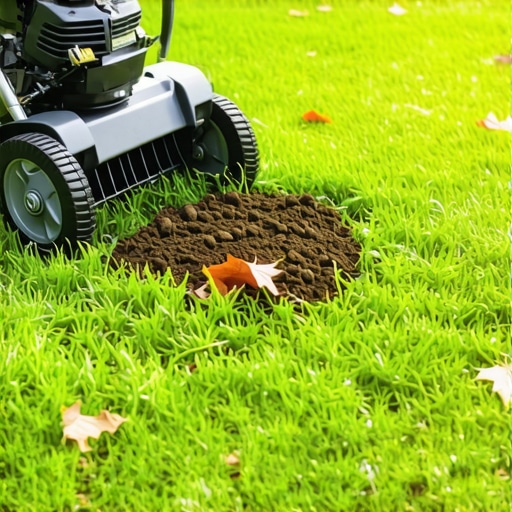
Once the cores are on the surface, leave them there. They contain the beneficial microbes your lawn needs. As they break down over the next two weeks, they act as a top-dressing, filtering back into the holes and the thatch layer to speed up decomposition. This is the ‘biological loop’ that high-end landscaping firms strive for. Here is your post-aeration checklist:
- Flag your irrigation heads: A 200-pound aerator will snap a plastic sprinkler head like a toothpick.
- Water 24 hours prior: You want the tines to penetrate deep. Bone-dry soil is like concrete.
- Apply a starter fertilizer: Focus on Phosphorus (the middle number) to encourage root development rather than top growth.
- Keep it moist: If you overseeded, you must water lightly twice a day for 14 days. Don’t let the seeds dry out.
- Mow high: Set your deck to at least 3.5 inches to shade the new seedlings.
Landscaping isn’t a decoration; it’s a living system. If you treat your soil like dirt, your lawn will look like trash. If you treat it like an engineering project, it will perform like one. Get the cores out of the ground this autumn. Your roots will thank you in July.
![Stop Overwatering Your Fescue Lawn [2026 Summer Fix]](https://lawnmajesty.com/wp-content/uploads/2026/10/Stop-Overwatering-Your-Fescue-Lawn-2026-Summer-Fix.jpeg)