Why Your New Grass is Dying in the Shade
The Autopsy of a Failing Shaded Lawn
You walk out to the back corner of your yard and see it—not the dense carpet you paid for, but a thinning, yellowing mess that feels more like a wet sponge than turf. It is a slow death. Most homeowners assume more water or more fertilizer will fix the problem, but in the shade, those are often the very things that accelerate the rot. I have spent 20 years digging through failed yards, and the diagnosis is almost always the same: a total misunderstanding of photosynthetic limits and soil gas exchange. If you don’t respect the biology of the plant, you are just throwing money into a woodchipper.
A homeowner called me in a panic last June after they completely torched their front lawn by applying a heavy-duty, high-nitrogen ‘weed-and-feed’ product to their shaded fescue. They thought they were being proactive. Instead, they triggered a chemical nightmare. Because the grass was in 80% shade, its metabolic rate was already crawling. It couldn’t process the massive nitrogen spike. The salt index in the fertilizer pulled moisture out of the roots, the plant tried to grow faster than it could produce energy, and the whole patch turned into straw in 48 hours. That wasn’t a product failure; it was a logic failure. Shaded grass is not just ‘grass with less light’; it is a different biological machine entirely.
Why Your Shaded Grass Is Failing to Thrive
Grass dies in shade because the light compensation point is not met, meaning the plant consumes more energy through cellular respiration than it creates via photosynthesis, leading to carbohydrate depletion, root atrophy, and total structural collapse. When you starve a plant of light, you are effectively suffocating its engine. The blades become thin, the cell walls weaken, and the plant becomes a magnet for fungal pathogens like powdery mildew and Rhizoctonia solani (brown patch).
“In shaded environments, the rate of photosynthesis is significantly reduced, leading to a decrease in carbohydrate reserves and a critical reduction in root-to-shoot ratios.” – Penn State Center for Turfgrass Science
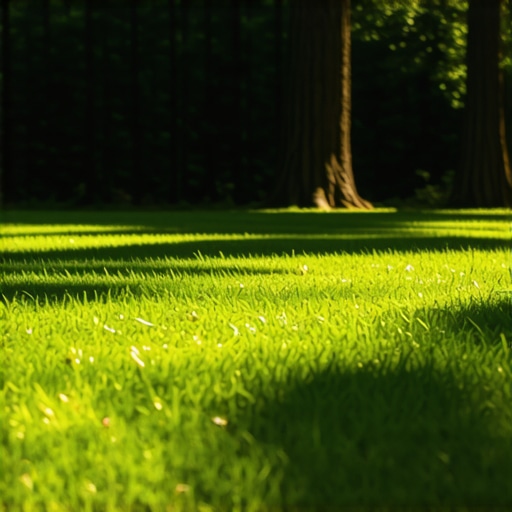
In a sun-drenched lawn, grass can handle high-traffic and heavy feeding. In the shade, every footstep is a trauma. The lack of UV light also means the soil surface stays damp for longer, creating a micro-climate that is perfect for mold but deadly for root respiration. Without the sun to drive evaporation, the soil pores stay filled with water, pushing out the oxygen the roots need to breathe. This is why your shaded grass often feels ‘mushy’ before it disappears entirely.
How much sunlight does ‘shade-tolerant’ grass actually need?
To maintain a functional root system, so-called ‘shade-tolerant’ varieties like Fine Fescue or St. Augustine still require a minimum of 4 to 6 hours of filtered sunlight or 2 to 3 hours of direct, unobstructed sun. ‘Shade-tolerant’ is a relative term in landscaping; it does not mean the grass can grow in a closet. If your canopy coverage is 90% or higher, no amount of lawn care magic will keep a turfgrass stand alive. You are fighting the laws of thermodynamics at that point.
| Turf Variety | Minimum Sun Requirement | Shade Tolerance Level | Best Soil pH Range |
|---|---|---|---|
| Fine Fescue | 4 Hours | Excellent | 5.5 – 6.5 |
| St. Augustine | 4-5 Hours | High | 6.0 – 7.5 |
| Tall Fescue | 6 Hours | Moderate | 6.0 – 7.0 |
| Kentucky Bluegrass | 8+ Hours | Poor | 6.5 – 7.2 |
What is the best fertilizer for grass in the shade?
For shaded areas, you must use a low-nitrogen, high-potassium fertilizer (such as a 10-0-20 ratio) to prioritize cellular wall strength and osmotic regulation rather than rapid blade elongation. High nitrogen in the shade is a death sentence. It forces the plant to put all its limited energy into growing tall, thin, ‘leggy’ blades that have no structural integrity. You want a fertilizer that focuses on the root crown and the ability of the plant to manage water stress. Look for products with slow-release polymer-coated urea to avoid the salt spikes that lead to root burn.
The Forensic Remediation Plan
If you want to stop the cycle of buying sod every spring only to watch it die by July, you have to change the hardscaping of the environment itself. You cannot treat a shaded lawn like a sunny one. It requires a specific, horticultural engineering approach. Follow this checklist to stabilize the site:
- Raise the Mower Deck: Cut shaded grass at 4 inches or higher. More blade surface area equals more ‘solar panels’ for the plant to collect what little light is available.
- Core Aeration: Perform deep-core aeration twice a year to combat soil compaction and improve oxygen diffusion to the root zone.
- Selective Pruning: Thin the tree canopy (crown thinning) to allow ‘dappled light’ to reach the ground. Removing even 15% of the lower limbs can increase PAR (Photosynthetically Active Radiation) significantly.
- Reduce Irrigation: Water shaded areas 50% less than sunny areas. If the soil stays saturated, the roots will rot from anaerobic stress.
- Soil Testing: Shaded soils are often more acidic due to leaf litter. Maintain a pH of 6.5 to ensure nutrient bioavailability.
“A retaining wall doesn’t fail because of the stone; it fails because of the water trapped behind it, and similarly, a lawn doesn’t fail because of the shade; it fails because of the humidity and lack of drainage that the shade creates.” – Hardscape Engineering Axiom
When you are dealing with garden design under heavy tree cover, you also have to account for root competition. Large oaks and maples have massive lateral root systems that will out-compete your grass for every drop of water and every milligram of potassium in the soil. In these cases, landscaping with turf is often the wrong choice. I tell my clients: if the grass has failed three years in a row, stop fighting. Use a modified gravel base for a small patio or switch to shade-loving perennials like Hostas or Hellebores that are biologically equipped for low-light environments.
Don’t be the homeowner who keeps pouring money into a failing system. Check your light levels. Measure your soil pH. If you have less than 4 hours of sun, your grass is going to die. It is that simple. Respect the biology or get used to the dirt.
![Fix Patchy Fescue: 3 Spring Seeding Rules [2026 Fix]](https://lawnmajesty.com/wp-content/uploads/2026/06/Fix-Patchy-Fescue-3-Spring-Seeding-Rules-2026-Fix.jpeg)