
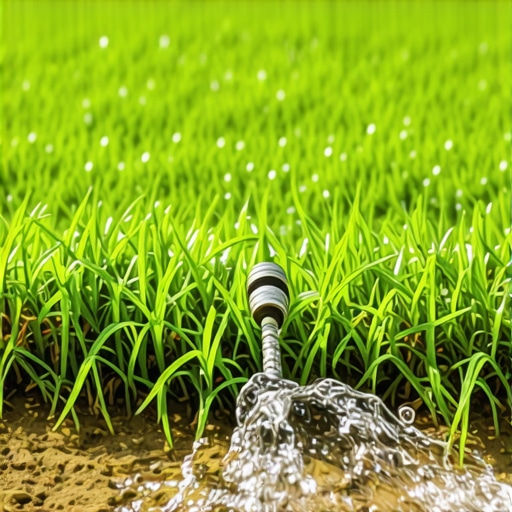
3 Reasons Your Morning Watering is Actually Killing Your Lawn
I see it every single day. A homeowner pulls up in a luxury SUV, looks at their yellowing, patchy turf, and tells me they water every morning at 6:00 AM like clockwork. They think they are being diligent. They think they are nurturing a living ecosystem. In reality, they are running a slow-motion execution. I call this the ‘Hydration Paradox.’ By providing frequent, light sips of water, you are essentially training your grass to be weak, vulnerable, and prone to systemic collapse. I recently walked a property in a high-end zip code where the owner had spent five figures on a custom irrigation system, yet his fescue looked like it had been through a bleach cycle. He had torched the entire front lawn by applying three inches of water a week in daily ten-minute intervals. The soil was a swamp of anaerobic bacteria, and the grass blades were covered in fungal lesions. It was a chemical nightmare that started with good intentions and ended with a $15,000 sod replacement bill. If you do not understand the physics of soil moisture and the biology of fungal pathogens, you are just an expensive hobbyist playing with a hose.
The Physiological Failure of Shallow Root Architecture
Morning watering on a daily schedule forces shallow root systems that cannot survive environmental stressors like heat or foot traffic. When the top half-inch of soil is constantly saturated, the plant has no biological incentive to drive its roots deep into the soil profile to find moisture, leading to structural instability and nutrient deficiencies. Grass is a survivor. It is programmed to seek water. When you provide that water on a silver platter every single morning, the root system stays in the upper ‘A horizon’ of the soil. This is the hottest part of the ground. When a 95-degree day hits, that top inch of soil cooks. Because the roots are shallow, they have no access to the cooler, moist subsoil. They bake. They die. It is that simple. You need roots that are six to eight inches deep to survive a real summer. You will never get that with a daily 10-minute morning spray. You are creating a dependent, weak organism that will fail the moment the mercury rises.
| Watering Strategy | Root Depth (Inches) | Disease Resistance | Drought Tolerance |
|---|---|---|---|
| Daily Morning (10 mins) | 1-2 | Very Low | Non-Existent |
| Deep/Infrequent (2x Weekly) | 6-8 | High | Excellent |
| Night Watering | 2-4 | Critical Risk | Moderate |
“A lawn does not die from lack of water as often as it dies from the inability to access it due to poor root development and soil compaction.” – Agronomy Field Manual v.4
How much water does a lawn actually need per week?
For most cool-season grasses like Kentucky Bluegrass or Tall Fescue, the target is exactly one inch of water per week, delivered in one or two heavy applications. This forces the gravitational water to migrate deep into the soil pores, encouraging the roots to chase it downward through capillary action.
Fungal Pathogens and the Leaf Blade Microclimate
Excessive morning moisture creates a high-humidity microclimate within the thatch layer that acts as an incubator for pathogens like Rhizoctonia solani or Brown Patch. When leaf blades stay wet for extended periods during high-temperature windows, the plant cuticle softens, allowing fungal spores to penetrate and digest the cellular structure. Fungi love a specific set of conditions: heat, moisture, and stillness. By watering every morning, you are providing the moisture. If the air is humid, that grass stays wet until noon. That is a six-hour window where the fungus is active and eating your investment. Professional turf managers look at the ‘leaf wetness duration.’ We want to keep that duration as short as possible. Watering heavily but infrequently allows the leaf blades to dry out completely between sessions, breaking the lifecycle of the fungi. If your lawn has brown circles with a ‘smoke ring’ edge, you aren’t looking at drought. You are looking at a fungus you invited to dinner by over-watering.
“Pathogen pressure in turfgrass is directly correlated to the duration of leaf surface moisture; reducing irrigation frequency is the primary cultural control for Brown Patch.” – Penn State Agricultural Extension
Soil Anaerobia and the Displacement of Oxygen
Over-frequent irrigation cycles displace essential soil oxygen, creating anaerobic conditions that suffocate the root system and kill off beneficial aerobic microbes. This process leads to nitrogen leaching and the buildup of toxic gases like hydrogen sulfide within the root zone, effectively poisoning the plant from the bottom up. Roots don’t just drink water; they breathe. In a healthy soil structure, roughly 50% of the space between soil particles should be air. When you water every single morning, those pore spaces stay filled with water. The roots suffocate. Without oxygen, the plant cannot perform respiration. It stops taking up nutrients. This is why over-watered lawns often look yellow (chlorotic). The homeowner thinks it needs more fertilizer, so they dump nitrogen on it, which the plant can’t use because the roots are drowning. It is a vicious cycle of mismanagement. You are literally drowning your grass in a sea of your own good intentions.
Is it better to water at night or in the morning?
If you must choose, early morning (4:00 AM to 6:00 AM) is better than night, but the frequency is what matters most. Watering at night is a death sentence because the grass stays wet for 10-12 hours, which is the optimal growth window for Pythium blight and other devastating diseases.
- Check the Thatch: Use a soil probe to ensure your thatch layer is less than 0.5 inches thick; heavy thatch blocks water from reaching the soil.
- The Tuna Can Test: Place three flat-bottomed cans around your yard. Run your zones. See how long it actually takes to hit 0.5 inches of water.
- Monitor the Soil: If you can’t push a screwdriver six inches into the ground, your soil is compacted and needs core aeration, not more water.
- Check the Weather: Stop the automatic timers. If it rained an inch yesterday, you don’t need to water today.
- Audit the Heads: Ensure your rotors aren’t spraying the siding of your house or the sidewalk. That is wasted PSI and wasted money.
The solution is not more water. The solution is better engineering. Get a soil test. Check your pH levels. If your pH is off, the plant can’t drink even if the water is there. Stop acting like a ‘mow-and-blow’ hack and start treating your land like the biological system it is. Deep watering. Infrequent cycles. Oxygen in the soil. That is how you build a lawn that lasts. It is not about the green you see on top. It is about the brown you manage underneath. If you don’t fix the soil grading and the compaction first, every drop of water you put in the ground is just expensive compost in the making. Do the work. Measure the moisture. Stop killing your lawn with kindness.
![Why Your 2026 Fescue is Still Yellow After Fertilizing [Soil Fix]](https://lawnmajesty.com/wp-content/uploads/2026/05/Why-Your-2026-Fescue-is-Still-Yellow-After-Fertilizing-Soil-Fix.jpeg)