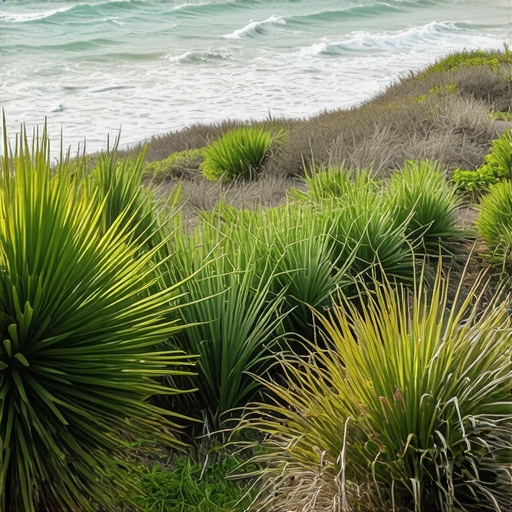
5 2026 Best Plants for Salty Coastal Yards
Engineering Coastal Resilience: The 5 Best Plants for Salty Yards in 2026
I always drill into my new crew members: if you don’t fix the soil grading and chemistry first, every plant you put in the ground is just expensive compost. I remember a job in Cape May where a homeowner spent four figures on high-end nursery stock, only to watch it shrivel in three weeks. They didn’t account for the salt spray or the 8.5 pH level of the sandy loam. We had to excavate two feet of dead material, install a dedicated drainage system, and restart with species actually built for the Atlantic. Coastal landscaping is not a hobby; it is a battle against sodium chloride and hydrostatic pressure. You cannot fight the ocean. You can only build a landscape that survives it.
The Coastal Reality: Why Most Landscapes Fail at the High-Tide Line
To successfully grow plants in salty coastal yards, you must manage physiological drought caused by sodium accumulation in the soil. High salinity prevents root osmosis, requiring the selection of halophytic species with thick waxy cuticles and efficient salt-excretion mechanisms like Muhly Grass or Yaupon Holly. When salt concentrations are high, water moves out of the roots and back into the soil. The plant starves for moisture even in a rainstorm. It is a biological lockout.
“Coastal soils often exhibit high pH and low organic matter, making the selection of plants with high sodium-ion exclusion rates critical for long-term survival.” – University of Florida IFAS Extension
The Ground-Up Build: Measuring Your Site Before You Plant
Before you buy a single 3-gallon pot, you need data. You need a soil test that specifically measures the Electrical Conductivity (EC) to determine the soluble salt concentration. Anything above 4 dS/m (decisiemens per meter) is going to kill standard turf grass and common ornamentals. You also need to check your perk rate. Dig a hole 12 inches deep, fill it with water, and see how long it takes to drain. In coastal zones, you either have pure sand that drains too fast to hold nutrients, or heavy muck that stays anaerobic. Aim for a perk rate of 2 inches per hour. [image-placeholder]
How do I protect my plants from salt spray?
To protect plants from coastal salt spray, homeowners should install physical windbreaks or privacy screens and utilize overhead irrigation rinsing after storm events. Rinsing foliage with fresh water removes sodium deposits from the stomata, preventing leaf scorch and ensuring the plant can continue photosynthesis during high-heat periods in the summer months.
| Plant Species | Salt Tolerance | USDA Zone | Primary Function |
|---|---|---|---|
| Pink Muhly Grass | High | 6-11 | Erosion Control |
| Yaupon Holly | High | 7-10 | Privacy Screening |
| Saw Palmetto | Extreme | 8-11 | Structural Foundation |
| Saltgrass | Extreme | 4-10 | Turf Replacement |
| Sea Grape | High | 10-11 | Wind Buffer |
The 5 Best Plants for Salty Coastal Yards in 2026
1. Muhlenbergia capillaris (Pink Muhly Grass)
This is the workhorse of the 2026 coastal garden. It is a bunching grass that reaches 3 feet in height and width. Its root system is fibrous and aggressive, making it perfect for stabilizing dunes or sloped yards. It handles aerosol salt spray with zero leaf burn. The fall bloom provides a mass of fine-textured pink inflorescence. It needs zero fertilizer. In fact, if you over-fertilize it with high nitrogen, it flops. Keep it lean. Give it 1 inch of water a week until established, then leave it alone.
2. Ilex vomitoria ‘Schillings Dwarf’ (Dwarf Yaupon Holly)
Forget Boxwoods in a coastal environment. Boxwoods hate salt and will yellow and die within a season. The Yaupon Holly is the native alternative. It has a small, leathery leaf with a thick cuticle that sheds salt ions. It is an evergreen that stays tight and compact. We use these for formal hedges where the client wants a clean line. It handles a pH range from 5.0 to 8.0 without flinching. It is iron-clad. Don’t plant it too deep; the root flare must be visible at the surface.
3. Serenoa repens (Saw Palmetto)
If you want a plant that will be here in 100 years, this is it. Saw Palmetto is practically indestructible. It is slow-growing but offers incredible structural density. Its fan-shaped fronds are designed to catch and shed wind, reducing the mechanical stress on the plant during gale-force winds. It provides critical habitat and thrives in nutrient-poor sandy soils. We often use these as the backbone of a privacy screen. They require zero pruning once the dead fronds are cleared annually.
4. Distichlis spicata (Saltgrass)
In 2026, we are seeing a shift away from traditional Fescue or St. Augustine in coastal zones. Saltgrass is a true halophyte. It doesn’t just tolerate salt; it thrives in it. It is a sod-forming perennial that can handle periodic flooding by brackish water. If your yard sits low and gets swamped during king tides, this is your only viable turf option. It stays green when other grasses go dormant from salt stress. It is the definition of coastal engineering in a blade of grass.
5. Coccoloba uvifera (Sea Grape)
For those in warmer zones like Florida or the Gulf Coast, Sea Grape is the ultimate wind buffer. Its large, circular, leathery leaves are 8 to 10 inches wide. These leaves act as a sail, catching salt spray and protecting the more sensitive plants behind them. It can be trained as a large shrub or a multi-trunked tree. It produces edible fruit, but its real value is in its ability to withstand 100 mph winds without snapping. It is a civil engineering tool in plant form.
What are the best salt-tolerant shrubs for a coastal garden?
The best salt-tolerant shrubs for coastal gardens include Dwarf Yaupon Holly, Oleander, and Rugosa Rose. These species have evolved with thick, waxy leaf coatings and specialized cells that store or excrete excess salt, allowing them to thrive in high-sodium environments where traditional garden shrubs would suffer from severe dehydration.
Hardscaping in the Salt Zone: Preventing Corrosion
Hardscaping near the ocean is a different beast. You cannot use standard carbon steel rebar in your concrete; it will rust, expand, and crack the slab from the inside out. Use epoxy-coated rebar or fiberglass reinforcement. When building retaining walls, drainage is the only thing that matters. Use a 12-inch thick layer of #57 clean stone behind the wall and a 4-inch perforated drain tile. Hydrostatic pressure from a heavy rain combined with a high tide will push a wall over if that water has nowhere to go.
“A retaining wall doesn’t fail because of the stone; it fails because of the water trapped behind it.” – Hardscape Engineering Axiom
- Use Type S mortar for any stone work; it has higher lateral strength.
- Seal all pavers with a high-grade silane/siloxane sealer to prevent salt pitting.
- Ensure a 2% grade away from the home foundation to prevent standing water.
- Always call 811 before trenching for irrigation or drainage pipes.
The maintenance schedule for a coastal yard is relentless. You need to check your mulch layers every spring. Use heavy, double-ground hardwood mulch or river rock. Pine straw is too light; the coastal winds will blow it into the next county. Keep your irrigation heads adjusted. If your sprinklers are hitting your Yaupon Hollies with well-water that has high iron and sulfur, you’ll end up with rust-colored foliage. Direct the water to the roots, not the leaves. Coastal gardening is about precision. If you skip a step, the ocean will find it.