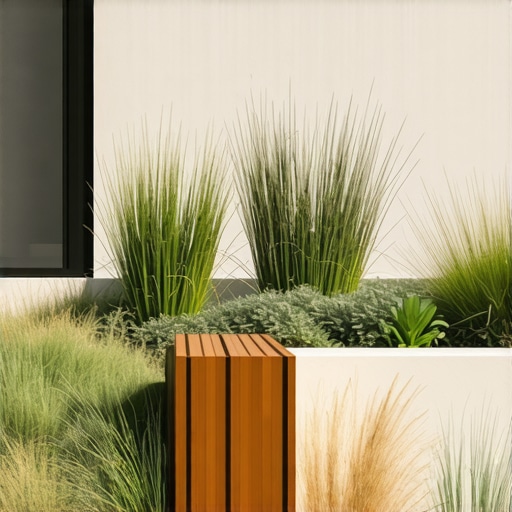
The Best Ornamental Grasses for Modern Minimalist Yards
Minimalist garden design is not about what you add, but what you have the guts to leave out. In my twenty years of running a hardscape and landscape firm, I have seen too many homeowners try to achieve a modern look by throwing random plants into a bed with white gravel. It never works. True minimalist landscaping is an exercise in structural biology. You are using living organisms to define space, create movement, and provide architectural lines. Ornamental grasses are the backbone of this aesthetic, but you cannot just shove them in the ground and hope for the best. You need to understand the engineering of the soil and the physiological needs of the species to ensure those clean lines don’t turn into a messy, dying graveyard of expensive nursery stock.
The Critical Importance of Soil Grading and Planting Depth
The success of a minimalist landscape depends on proper soil grading and root flare visibility to prevent rot and ensure the structural integrity of the ornamental grasses. Most contractors ignore the fact that even a 1% slope variation can lead to water pooling, which will suffocate the root systems of drought-tolerant grasses like Panicum or Festuca. I always drill into my new crew members: if you don’t fix the soil grading first, every plant you put in the ground is just expensive compost. We once spent three weeks on a site just correcting the subgrade before a single 3-gallon pot touched the dirt. If the water doesn’t move away from the crown of the grass, the meristematic tissue will succumb to fungal pathogens before the first season is over. This is non-negotiable. We use laser levels to ensure the grade moves water at exactly 2% toward the designated drainage basins. Precision is the difference between a landscape that lasts twenty years and one that fails in twenty months.
“A retaining wall doesn’t fail because of the stone; it fails because of the water trapped behind it.” – Hardscape Engineering Axiom
How much modified gravel do I need for a patio base?
While the focus is on plants, minimalist yards often include hardscape elements. For a standard patio base, you need a minimum of 6 inches of compacted 21A or 3/4-inch modified gravel to ensure stability. This base must be compacted in 2-inch lifts using a plate compactor with at least 4,000 lbs of centrifugal force. Without this engineering, your clean, minimalist pavers will shift, ruining the aesthetic lines that the ornamental grasses are meant to complement.
Selecting Grasses for Architectural Clarity
Modern minimalist yards utilize structural ornamental grasses such as Calamagrostis x acutiflora ‘Karl Foerster’ and Panicum virgatum ‘Northwind’ to create verticality and rhythmic repetition. These specific cultivars are chosen for their upright growth habit, which does not flop over even in high winds or heavy rain. The goal is to create a living wall or a series of rhythmic columns that emphasize the geometry of the house. We focus on the C4 photosynthetic pathway species for warmer regions because they maintain their structural rigidity during the heat of July, whereas C3 grasses might go dormant or lose their color intensity.
| Grass Species | Height (Feet) | Light Requirement | Soil pH Preference | Growth Habit |
|---|---|---|---|---|
| Calamagrostis ‘Karl Foerster’ | 4-5 | Full Sun | 6.0 – 8.0 | Strictly Upright |
| Panicum ‘Northwind’ | 5-6 | Full Sun | 5.5 – 7.5 | Vertical Columnar |
| Festuca glauca ‘Elijah Blue’ | 0.5-1 | Full Sun | 6.5 – 7.5 | Mounded |
| Carex pensylvanica | 0.5-1 | Part Shade | 5.0 – 7.0 | Spreading Groundcover |
When selecting plants, we avoid big-box stores. Their stock is often root-bound, meaning the roots have begun to encircle the pot. This leads to root girdling, where the plant eventually strangles itself as it grows. We only source from wholesale nurseries that can guarantee the provenance of the cultivars. A minimalist yard requires uniformity. If one grass in a row of ten is stunted because of poor nursery stock, the entire design is compromised. We look for white, fleshy roots and clear, healthy crowns before any plant is accepted on my job site.
Do ornamental grasses need fertilizer?
High-quality ornamental grasses require minimal nitrogen fertilization because excessive NPK ratios lead to weak, succulent growth that causes the stalks to flop. Instead of chemical fertilizers, we focus on soil microbiology by incorporating high-quality leaf mold or composted pine bark at the time of planting to encourage mycorrhizal fungi development. This allows the plants to access phosphorus and micronutrients naturally, resulting in stronger cell walls and better structural uprightness.
The Engineering of the Planting Bed
In minimalist design, the transition between the hardscape and the softscape must be sharp. We use 1/8-inch steel edging or heavy-duty aluminum restraints to maintain a crisp line between the mulch or gravel and the planting beds. This prevents the grasses from encroaching on the walkways and keeps the mulch from migrating into the hardscape. The mulch itself should be a dark, triple-shredded hardwood, applied at exactly 2 inches. Do not build mulch volcanoes around the base of your grasses. This traps moisture against the stem and encourages pests. It is a rookie mistake that I won’t tolerate on my crews. Every plant must have its root flare exposed to the air.
“Soil compaction is the silent killer of urban landscapes; without macropores for gas exchange, root respiration ceases.” – Agronomy Manual Section 4.2
- Step 1: Test soil pH and nutrient levels (Target 6.5 pH for most grasses).
- Step 2: Excavate bed to 8 inches and incorporate 2 inches of organic matter.
- Step 3: Set plants at a height 1/2 inch above the surrounding grade.
- Step 4: Install 0.5 GPH drip irrigation emitters at the base of each plant.
- Step 5: Apply pre-emergent herbicide to prevent weed competition in the first year.
The Settling In Period and Winter Maintenance
In the first year, your grasses are building the root architecture necessary to support their top-heavy growth. You need to provide deep, infrequent watering. We aim for 1 inch of water per week, delivered via drip irrigation to the root zone. This forces the roots to chase the water down into the subsoil, creating a more drought-resilient plant. In a minimalist yard, you should leave the dried stalks standing through the winter. The golden-tan color and the structural form provide visual interest during the bleakest months. We cut them back to about 4 inches in late February, just before the new green shoots emerge from the crown. If you cut too early, you risk moisture entering the hollow stems and rotting the crown during a late freeze. If you cut too late, you damage the new growth. Timing is everything. It will rot if you don’t follow this schedule. Don’t skip the spring cleanup. A minimalist yard looks like a mess if last year’s dead foliage is tangling with the new season’s growth.