
Why Your Sprinkler System is Wasting $100 Every Month
The Hydraulic Autopsy: Why Your Irrigation System is Bleeding Cash
A wasted water bill is typically caused by leaking valves, broken sprinkler heads, and poorly programmed controllers that ignore seasonal evapotranspiration rates. By failing to calibrate nozzle precipitation rates, homeowners often apply water faster than the soil infiltration capacity, resulting in expensive runoff and turf disease. I recently saw the aftermath of this firsthand. A homeowner called me in a panic after they completely torched their front lawn by applying a heavy dose of high-nitrogen fertilizer and then running their antiquated sprinkler system for two hours straight to ‘soak it in.’ They didn’t just burn the grass; they created a localized flood that leached the chemicals into the storm drain and left the soil a salty, anaerobic mess. The grass didn’t die of thirst; it died of suffocation. When I walked the property, the ground felt like a wet sponge, a classic sign of hydrostatic saturation. They had been wasting at least a hundred dollars a month on water that was actively killing their investment. Most homeowners treat their irrigation controller like a ‘set it and forget it’ kitchen appliance. That is a massive mistake. Landscaping is applied biology, and water is the primary solvent. If you don’t control the flow, you don’t control the health of your garden design.
“Irrigation efficiency is not just about the hardware; it is about matching the application rate to the soil’s infiltration capacity to prevent nutrient leaching.” – Texas A&M AgriLife Extension
The Friction Loss Factor: Why PSI Matters for Your Wallet
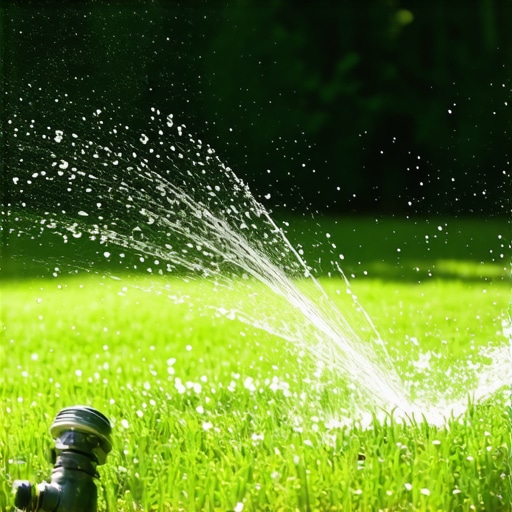
Friction loss in irrigation pipes occurs when high-velocity water creates turbulence, leading to uneven pressure at the heads. When operating pressure exceeds the manufacturer’s rating, it causes misting, where water particles are so fine they evaporate before hitting the turfgrass root zone. You can see this on a windy day. If your sprinklers look like they are producing a fog bank, you are throwing money away. A standard spray head is designed to operate at 30 PSI. If your home pressure is 70 PSI, those heads are ‘atomizing’ the water. This results in 20 to 30 percent water loss before a single drop touches a blade of grass. We solve this by installing pressure-regulated heads or a master regulator at the valve manifold. It is basic civil engineering. High pressure also wears out the internal diaphragms of your valves. A weeping valve, one that never fully closes, can leak thousands of gallons a month. You might not even see it if the water is escaping into a French drain or sandy soil. It is a silent killer of your maintenance budget.
How much water does my lawn actually need?
Most turfgrass species require exactly one inch of water per week, including rainfall, to maintain metabolic function. Providing this in one or two deep sessions encourages deep root growth, whereas daily light watering creates shallow roots that fail during a heatwave. You must measure this using the ‘catch-can’ method. Place six flat-bottomed cans across a zone, run it for 15 minutes, and measure the depth. If you have a half-inch, you know that zone needs 30 minutes a week. Stop guessing. If you have heavy clay soil, you cannot apply that half-inch all at once. The infiltration rate of clay is roughly 0.1 inches per hour. Anything faster than that is just water running down the gutter. You need to use the Cycle and Soak method: run the zone for 5 minutes, let it soak for an hour, and repeat. This is how you build a resilient lawn without the $400 utility bill.
| Nozzle Type | Application Rate (In/Hr) | Efficiency Rating | Best Use Case |
|---|---|---|---|
| Fixed Spray | 1.5 – 2.0 | Low | Small, narrow turf areas |
| Rotary Nozzle | 0.4 – 0.6 | High | Large lawns, slopes, clay |
| Drip Irrigation | 0.5 – 2.0 (GPH) | Extreme | Flower beds, shrub rows |
Why is my sprinkler head leaking after the zone turns off?
Low-head drainage occurs when the lowest sprinkler in a zone continues to seep water after the cycle ends, caused by the residual water in the pipes draining out. This can be fixed by installing check valves (CVs) in the heads, which hold the water in the lateral lines up to a certain feet of head pressure. Without check valves, every time the system turns off, the entire volume of the pipe empties through that bottom head. When the system turns back on, the pipes have to refill, causing air hammers that can shatter PVC fittings. It is a cycle of waste and mechanical stress. Check the seals. Check the nozzles. Don’t let a $2 part cost you a $100 bill.
The Soil Microbiology Link: Water as a Pathogen Vector
Soil microbiology thrives in a balance of 45 percent minerals, 5 percent organic matter, 25 percent air, and 25 percent water. When you over-irrigate, you flip that ratio, drowning the aerobic bacteria and mycorrhizal fungi that your plants depend on for nutrient uptake. This leads to root rot and fungal pathogens like Brown Patch or Pythium Blight. I see ‘mow-and-blow’ hacks tell homeowners to water every night at 6 PM. That is the worst advice possible. Watering at night keeps the leaf blade wet for 12 hours, creating a petri dish for disease. Water at 4 AM. This allows the grass to hydrate before the sun hits, and then the rising sun dries the leaf blade quickly. It is simple horticultural logic. If your lawn care professional doesn’t talk about oxygen exchange in the soil, find a new one.
“Excessive water in the root zone displaces oxygen, leading to anaerobic conditions that promote Pythium and other fungal pathogens.” – Penn State Department of Plant Science
The 10-Point Irrigation Audit Checklist
- Inspect the Controller: Ensure seasonal adjustments are active. 100% output in October is a crime.
- Check for Misting: If you see a fog, your PSI is too high. Install regulators.
- Straighten Tilted Heads: Heads must be perfectly vertical to ensure head-to-head coverage.
- Clear Clogged Nozzles: Small bits of grit disrupt the spray pattern, creating dry spots.
- Test Valve Diaphragms: Listen for humming or leaking at the manifold.
- Observe Surface Runoff: If water hits the sidewalk before 5 minutes are up, shorten your cycles.
- Audit Rain Sensors: Ensure they actually shut the system off during a downpour.
- Verify Nozzle Matching: Don’t mix rotary nozzles and spray heads on the same zone.
- Inspect the Backflow Preventer: Look for leaks or discharge that indicates a pressure surge.
- Monitor the Meter: Turn everything off and check your water meter. If it is spinning, you have a leak.
Stop looking at your yard as a static picture. It is a living, breathing system of hardscaping, garden design, and lawn care. Every gallon of water you waste is a gallon that isn’t helping your plants grow. It is stripping the soil of nutrients and bloating your monthly expenses. Fix the physics of your system, and the biology of your lawn will follow. [image_placeholder_1] It takes effort, but your wallet and your soil will thank you. Don’t be the homeowner who pays for a flood and wonders why their grass is dying.




![Stop 2026 Nitrogen Burn on Yellow Fescue [3-Step Fix]](https://lawnmajesty.com/wp-content/uploads/2026/05/Stop-2026-Nitrogen-Burn-on-Yellow-Fescue-3-Step-Fix.jpeg)