Build a $450 2026 Paver Walkway Using Local Gravel
The Hardscape Autopsy: Why Most Walkways Fail by Year Three
Building a $450 2026 paver walkway requires a shift from cosmetic thinking to structural engineering. To succeed on this budget, you must source local quarry aggregates and prioritize base compaction over expensive ornamental stone. Most failures occur because the contractor ignored hydrostatic pressure or used round stone that never locks into place. I recently got called out to tear up a $30,000 patio that was sinking because the previous contractor used a 2 inch base of unwashed river stone. It was a structural nightmare. The stone shifted under the weight of a single person, and within two winters, the entire surface looked like a topographical map of the Andes. We had to excavate 18 inches of sludge and start over. Don’t let your $450 project become a $4,000 remediation. The secret isn’t the paver; it is the crushed rock underneath it.
The Science of Sourcing Local Gravel for Walkways
To keep a walkway project under $450 in 2026, you must leverage quarry-direct pricing for crusher run or 3/4-inch modified stone. This material provides the necessary structural interlock to prevent lateral shifting while maintaining enough void space for water to migrate away from the paver surface. Do not buy bagged stone from big-box retailers. It will bankrupt your budget. Go to the local quarry and ask for ‘3/4 minus’ or ‘dense-graded aggregate’ (DGA). This is a mix of crushed stone and fines that, when compacted, reaches 95 percent proctor density. This density is what supports the load, not the soil. If your soil is heavy clay, you need this base more than ever to prevent the frost-heave cycles from ejecting your pavers like a slow-motion volcano.
“A retaining wall or paver system doesn’t fail because of the stone; it fails because of the water trapped behind or beneath it.” – Hardscape Engineering Axiom
How much modified gravel do I need for a patio base?
Calculating the volume of gravel for a $450 walkway involves multiplying the length by the width by the depth (converted to feet) and then dividing by 27 to get cubic yards. For a standard 20-foot by 3-foot walkway with a 4-inch base, you need roughly 0.75 cubic yards. Always factor in a 20 percent compaction loss. When you run a plate compactor over crushed stone, the air is forced out and the volume shrinks. If you don’t account for this, you will run short. In 2026, many local quarries will have a minimum delivery fee, so if you have a truck, haul it yourself to keep the budget tight. Every dollar saved on delivery goes into the quality of the paver.
| Material Type | Typical Cost (per ton) | Best Use Case | Compaction Rating |
|---|---|---|---|
| Crusher Run (3/4 minus) | $25 – $35 | Primary Structural Base | Excellent |
| Pea Gravel (Round) | $40 – $55 | Decorative Only | Zero (Poor) |
| Screening / Stone Dust | $22 – $30 | Leveling Layer (Thin) | Good |
| ASTM C33 Sand | $30 – $45 | Setting Bed | N/A |
Excavation and Soil Grading: The 80/20 Rule
The excavation depth for a permanent hardscape installation must account for the paver thickness, the 1-inch sand setting bed, and a minimum 4-inch compacted gravel base. In 2026, labor is your biggest cost, so if you are doing this DIY, your sweat equity is the only way to stay under $450. You must dig down at least 7 to 8 inches. Use a line level to ensure the subgrade has a 2 percent slope away from any foundations. This prevents water from pooling and saturating the sub-base, which leads to base failure. If you see water standing in your trench, you haven’t finished grading. Fix the dirt before you buy the stone. If you don’t fix the soil grading first, every plant or paver you put in the ground is just expensive compost.
Can I use local gravel instead of sand for pavers?
Using local screenings or fine gravel as a leveling layer is acceptable if the material is angular and under 1/4 inch in size. However, for a $450 budget, a coarse concrete sand (ASTM C33) is often cheaper and provides a better setting bed for the pavers to bite into. Avoid ‘play sand’ or ‘mason sand’ as they are too fine and will wash out from under the pavers during heavy rain. You want the grit. The grit creates friction. Friction creates stability. Without it, your walkway will drift like a raft on a lake. Use 1-inch PVC pipes as screed rails to ensure the sand layer is perfectly flat before you lay the first stone.
“Base compaction is the single most critical variable in the longevity of a segmental pavement system.” – ICPI Technical Manual
The Installation: Laying the Units and Joint Stabilization
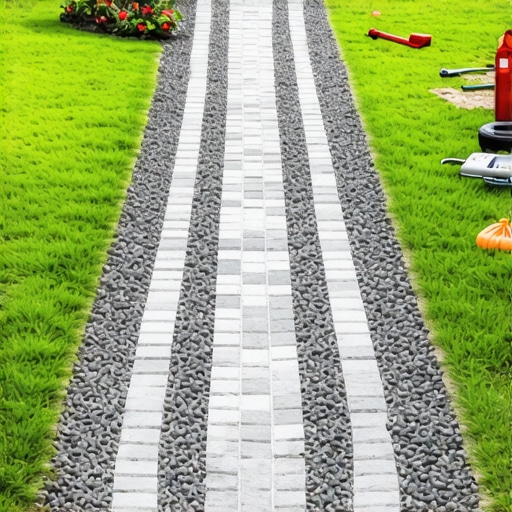
For a $450 walkway, look for standard 4×8 brick pavers or concrete cobbles at a local masonry supply house. These are often the most cost-effective per square foot. When laying the units, do not drop them into place. Set them straight down to avoid disturbing the sand bed. Once the pavers are in, you must use polymeric sand or high-quality fines for the joints. This prevents weed growth and, more importantly, locks the pavers together through interlock. If the joints are empty, the pavers are just individual rocks. When the joints are full and compacted, the walkway becomes a monolithic slab that can handle the weight of a garden tractor without flinching.
- Call 811 before you dig to mark utility lines.
- Excavate to a depth of 8 inches for maximum stability.
- Compact the subgrade soil with a power tamper.
- Install a non-woven geotextile fabric to separate soil from gravel.
- Add gravel in 2-inch ‘lifts’ and compact each layer separately.
- Use a 1-inch sand bed, screeded perfectly flat.
- Set pavers and sweep in joint sand until the gaps are saturated.
Drainage and Long-Term Maintenance
A properly engineered walkway must manage hydrostatic pressure by allowing water to move through the base or off the surface. In 2026, we are seeing more extreme weather events, so the 2 percent slope mentioned earlier is non-negotiable. If you live in an area with heavy clay, consider a French drain parallel to the walkway to catch runoff. Check your walkway every spring. If you see a dip, it means the base was under-compacted or water is undermining the edge. Pull the pavers, add more base, and re-compact. It is a 20-minute fix if you catch it early. If you wait, the whole run will fail. Maintenance is a choice between a rake now or a backhoe later. Don’t skip the edges. Use a professional-grade edge restraint pinned with 10-inch spikes every 12 inches. Plastic edging from a big-box store will fail. Use heavy-duty PVC or aluminum restraints. It will cost more, but it keeps the walkway from spreading.
![Build a $1000 2026 Flagstone Patio [DIY Step-by-Step]](https://lawnmajesty.com/wp-content/uploads/2026/05/Build-a-1000-2026-Flagstone-Patio-DIY-Step-by-Step.jpeg)