
![Repair 2026 Cracked Concrete Walkways for $40 [Fast]](https://lawnmajesty.com/wp-content/uploads/2026/05/Repair-2026-Cracked-Concrete-Walkways-for-40-Fast.jpeg)
Repair 2026 Cracked Concrete Walkways for $40 [Fast]
The Anatomy of a Failing Slab
To repair 2026 cracked concrete walkways for $40 fast, you must utilize polymer-modified cementitious repair mortars and flexible polyurethane sealants to bridge structural gaps and prevent moisture ingress. This method addresses thermal expansion joints and prevents further freeze-thaw degradation without the need for total demolition or expensive equipment rentals. Concrete is not a static object; it is a rigid material resting on a dynamic, breathing substrate of soil and moisture.
I recently got called out to tear up a $30,000 patio that was sinking because the previous contractor failed to address the hydrostatic pressure and sub-base compaction. The homeowner thought a few bags of quick-set would fix the visible cracks, but the underlying issue was a 4 inch layer of uncompacted organic topsoil trapped beneath the slab. As that soil decomposed, it created voids. When the winter freeze hit, the water in those voids expanded by 9 percent, lifting the slab and snapping it like a dry cracker. You cannot fight physics with a thin layer of mortar. You have to understand why the concrete failed before you spend a dime on the fix. Most DIY repairs fail because the operator ignores the bond-breaker or fails to remove the laitance from the crack walls.
“A retaining wall doesn’t fail because of the stone; it fails because of the water trapped behind it.” – Hardscape Engineering Axiom
Why Your Concrete is Actually Cracking
Concrete cracks are symptoms of soil movement, thermal expansion, or sub-base failure. A hairline crack is usually the result of plastic shrinkage during the initial cure, whereas a crack wider than 1/8 inch indicates structural movement. If one side of the crack is higher than the other, you have a differential settlement issue. This is often caused by localized saturation of the subgrade, frequently from a misdirected downspout or poor yard grading. In heavy clay soils, the soil swells when wet and shrinks when dry, creating a constant rhythmic stress on the walkway. Without proper control joints every 5 to 6 feet, the concrete will choose its own path of least resistance. It will break.
| Material Item | Purpose | Estimated Cost |
|---|---|---|
| Polymer-Modified Repair Mortar | Structural filling of deep cracks | $18.00 |
| Backer Rod (1/2 inch) | Prevents three-point bonding | $7.00 |
| Wire Brush & Chisel | Mechanical cleaning and profiling | $9.00 |
| Concrete Bonding Agent | Ensures adhesion to old concrete | $6.00 |
The $40 Fast-Fix Protocol
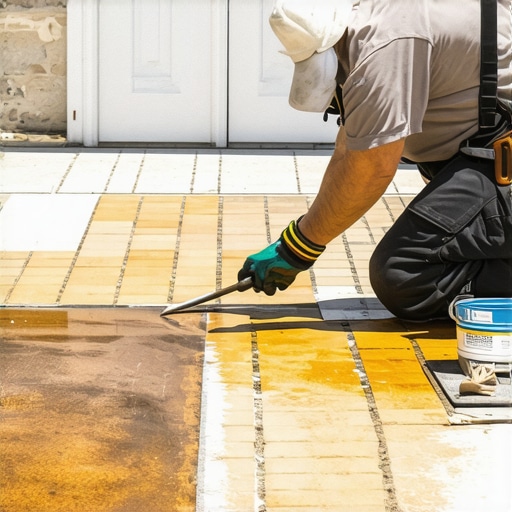
Follow this checklist to ensure your repair lasts more than one season. Skip a step, and the patch will pop out during the first hard frost. It is that simple.
- Clean the crack using a wire brush to remove all loose aggregate and vegetation.
- Use a cold chisel to widen the base of the crack, creating an inverted “V” shape for mechanical locking.
- Flush the area with high-pressure water to remove dust.
- Install a foam backer rod if the crack is deeper than 1/2 inch to ensure the sealant only sticks to the sides.
- Apply the polymer-modified mortar or self-leveling sealant.
- Protect the area from foot traffic for at least 24 hours.
How long do concrete crack repairs last?
A professional-grade repair using polymer-modified materials typically lasts 5 to 10 years depending on the severity of the soil movement. The key to longevity is preventing water from reaching the sub-base. Once you seal the crack, you must address the surrounding drainage. If your lawn care routine involves heavy irrigation near the walkway edge, you are actively undermining your repair. Deep, infrequent watering of the turf is better for the grass and safer for your hardscaping. Keep the water moving away from the slab.
Can I use caulk for walkway cracks?
Standard household caulk will fail within months because it lacks the elongation properties required for concrete movement. You must use a polyurethane-based masonry sealant that meets ASTM C920 standards. This material is designed to stretch and compress as the concrete moves through seasonal temperature swings. If you use a rigid filler in a moving crack, the filler will simply crack again or pull away from the edges. High-end hardscaping requires materials that respect the laws of thermodynamics.
“Proper jointing in concrete is not an aesthetic choice; it is a controlled failure point required to manage the inevitable shrinkage of the slab.” – Portland Cement Association Manual
The Science of the Bond
When you apply new material to old concrete, you are dealing with two different chemical states. Old concrete is carbonated and dry. New repair mortar is alkaline and wet. Without a bonding agent, the old concrete will suck the moisture out of the repair mix before it can hydrate, resulting in a weak, chalky patch. Spend the extra $6 on a liquid bonding adhesive. Paint it on the interior walls of the crack. Let it get tacky. Then apply your filler. This creates a chemical bridge that prevents delamination. Don’t skip this. It is the difference between a 10-year fix and a 10-day failure.
Maintenance is the final step. After the repair has cured for 28 days, apply a silane-siloxane penetrating sealer to the entire walkway. This doesn’t just protect the patch; it makes the entire surface hydrophobic. Water will bead up and roll off rather than soaking into the pores of the concrete. This prevents the internal pressure that leads to scaling and spalling. A $40 repair is a great start, but a $20 bucket of sealer is the insurance policy that keeps you from doing it again in 2027.

![Why Your 2026 Concrete Driveway is Cracking [Fix]](https://lawnmajesty.com/wp-content/uploads/2026/06/Why-Your-2026-Concrete-Driveway-is-Cracking-Fix.jpeg)