How to Fix Large Brown Patches in Your Tall Fescue Lawn
The Post-Mortem of a Dying Lawn
Identifying large brown patches in a tall fescue lawn requires more than a glance; it requires a forensic analysis of the turf’s biological failure. To fix these areas, you must identify if the cause is Rhizoctonia solani, soil compaction, or localized dry spots by examining the leaf margin and the crown of the grass plant. Most homeowners mistake fungal dormancy for death, leading to over-watering that fuels the very pathogen killing their yard.
A homeowner called me in a panic last August after they completely torched their front lawn by applying a high-nitrogen quick-release fertilizer during a record-breaking heatwave. They thought they were feeding the grass. In reality, they were spiking the osmotic pressure in the soil to the point where the roots couldn’t pull moisture, effectively dehydrating the plant at a cellular level while the nitrogen stimulated tender new growth that fungal spores found irresistible. We didn’t just have brown spots; we had a chemical massacre. This is the cost of ignoring the math of agronomy. If you don’t understand the relationship between ambient temperature and nitrogen uptake, you shouldn’t be handling a spreader. It took three weeks of heavy core aeration and specialized wetting agents just to get the soil chemistry back to a baseline where it wouldn’t kill new seed on contact. Cheap 10-10-10 fertilizers from a big-box store are for the amateur. Professionals understand that turf health is a game of slow-release cycles and microbial activity.
“Tall fescue is most susceptible to brown patch when night temperatures exceed 65°F and leaf surfaces remain wet for more than 10 hours.” – Penn State Center for Turfgrass Science
Diagnosing the Primary Pathogen: Rhizoctonia Solani
Rhizoctonia solani, commonly known as brown patch, manifests as circular or irregular tan patches ranging from a few inches to several feet in diameter. Unlike drought stress, brown patch leaves a smoke ring of dark, grayish mycelium around the edges of the patch in the early morning hours. This fungus thrives in high humidity and high nitrogen environments, particularly in the transition zone where tall fescue is standard. If you see lesions on the leaf blades that look like tan hourglasses with dark brown borders, you are dealing with a fungal infection, not a water deficit. Do not reach for the hose. Increasing moisture at this stage is like throwing gasoline on a fire. You must treat with a group 11 fungicide like azoxystrobin or a group 3 like propiconazole, but only after you have addressed the cultural failures that allowed the fungus to take hold in the first place.
How much modified gravel do I need for a patio base?
While often asked during lawn renovations, a standard 4-inch deep modified gravel base for any hardscape structure requires roughly 1 ton of material per 50 square feet. This ensures the hydrostatic pressure does not shift the surrounding turf or cause drainage issues that lead to fungal pools in your fescue.
| Condition | Primary Symptom | Technical Solution | Recovery Time | |
|---|---|---|---|---|
| Brown Patch (Fungal) | Tan lesions with dark borders | Systemic Fungicide (Azoxystrobin) | 14-21 Days | |
| Grub Damage | Turf lifts like a carpet | Dylox (Trichlorfon) application | 10 Days | |
| Nitrogen Burn | Uniform yellowing/browning | Heavy irrigation/Gypsum | 4-6 Weeks | |
| Soil Compaction | Hard soil, thin turf | Core Aeration (2.5-inch depth) | Full Season |
The Remediation Protocol: Mechanical and Chemical Steps
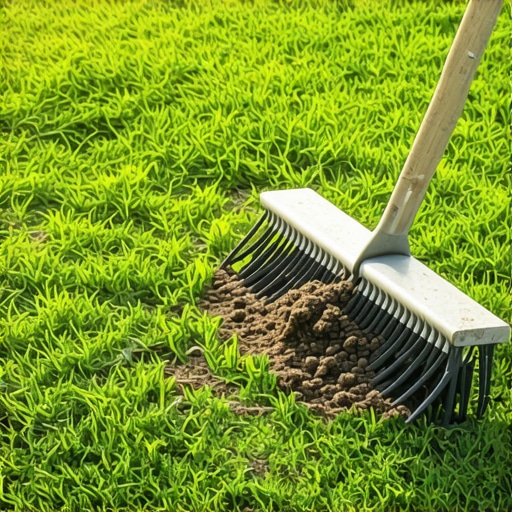
Fixing fescue is not about a single spray; it is a mechanical process of re-establishing soil porosity and microbial balance. Tall fescue is a bunch-type grass, meaning it does not have rhizomes or stolons to fill in gaps. If a patch is dead, it stays dead until you put new seed in the ground. The first step is core aeration. You need to pull at least 20 to 40 plugs per square foot to a depth of 2.5 to 3 inches. This breaks the surface tension and allows oxygen to reach the root zone. Once the soil is opened, you must perform a top-dressing with a high-quality compost or sand-soil mix depending on your native texture. In heavy clay, compost provides the organic matter needed to flocculate the soil particles. After top-dressing, you apply NTEP-rated tall fescue seed at a rate of 5 to 7 lbs per 1,000 square feet. Use a starter fertilizer with a high phosphorus count (the middle number on the bag) to encourage root elongation rather than top-growth.
“Soil compaction is the silent killer of turf; without pore space for oxygen, roots undergo anaerobic stress and succumb to opportunistic pathogens.” – NCSU Extension Agronomy Manual
How to calculate the right amount of fungicide?
To calculate fungicide rates, measure the total square footage of the affected area and apply the manufacturer’s high-label rate, typically 0.5 to 1.5 ounces per 1,000 square feet. Ensure you use a flat fan nozzle to provide uniform coverage of the leaf blade where the fungal spores reside.
Long-Term Maintenance and Prevention
Preventing the return of brown patches requires a shift in how you view irrigation and nutrition. While the internet tells you to water every day, turf grass actually needs deep, infrequent watering—exactly 1 inch per week—to force roots to chase the water down into the cooler soil profile. Watering for 15 minutes every morning keeps the thatch layer perpetually damp, creating a laboratory for fungal growth. Instead, run your zones for 45-60 minutes once or twice a week at 4:00 AM. This allows the sun to dry the blades quickly while the roots drink deep. Furthermore, stop the high-nitrogen habit in late spring. Fescue is a cool-season grass; forcing it to grow when it wants to be semi-dormant in the summer heat is a recipe for disaster. [IMAGE_PLACEHOLDER] Use a slow-release polymer-coated urea in the fall to build up the carbohydrate reserves in the crown. This ensures the plant enters the next season with the structural integrity to resist pathogens.
- Step 1: Conduct a soil test to check for pH levels below 6.0 or above 7.0.
- Step 2: Mechanically remove dead thatch with a power rake if it exceeds 0.5 inches.
- Step 3: Apply a preventative fungicide rotation starting when night temps hit 60 degrees.
- Step 4: Mow at 4 inches. Higher heights shade the soil and reduce weed pressure.
- Step 5: Calibrate your spreader. Over-application is worse than under-application.
Stop looking for a miracle in a bottle. Lawns are biological systems. If you treat your soil like dirt, it will act like dirt. Treat it like a living ecosystem, and the fescue will respond. Don’t skip the aeration. It is the single most important mechanical intervention you can perform. If your tamper or aerator isn’t bouncing off a compacted base, you aren’t doing it right. Keep your blades sharp. A dull blade tears the grass, leaving an open wound that fungal spores enter with ease. Sharpen them twice a season. No excuses.
![Why Your 2026 Fescue Needs Lime [Soil pH Guide]](https://lawnmajesty.com/wp-content/uploads/2026/05/Why-Your-2026-Fescue-Needs-Lime-Soil-pH-Guide.jpeg)
![5 2026 Drought-Proof Grass Alternatives [Tested]](https://lawnmajesty.com/wp-content/uploads/2026/06/5-2026-Drought-Proof-Grass-Alternatives-Tested.jpeg)