5 Plants That Thrive in Sandy Soil with Minimal Water
Designing for Drainage: Why Sandy Soil is a Strategic Advantage
Designing a landscape for sandy soil requires shifting from a moisture-retention mindset to a high-drainage strategy using xeric plants like Lavender, Russian Sage, and Blanket Flower. While many contractors view sand as a deficiency, seasoned professionals see it as an engineering asset that prevents root rot and simplifies site grading. I always drill into my new crew members: if you don’t fix the soil grading first, every plant you put in the ground is just expensive compost. I remember a job in a coastal neighborhood where the client had spent five figures on ‘premium’ topsoil and sod, only for the entire yard to turn into a leaching field that starved the plants of nitrogen. We had to excavate, re-introduce the native sandy substrate, and select species evolved for low Cation Exchange Capacity (CEC). Sand doesn’t hold nutrients well, but it offers oxygen levels that heavy clays can never match. Success in these environments isn’t about fighting the sand; it is about respecting the hydraulic conductivity of the site. You are building a system, not just a garden.
The Science of High-Porosity Substrates
In sandy environments, macropores dominate the soil structure. This means water moves vertically at rates exceeding 20 inches per hour. While this prevents the ‘bathtub effect’ seen in clay, it creates a nutrient vacuum. You have to understand the chemistry.
“Sandy soils, with their low surface area and lack of organic matter, have very low Cation Exchange Capacity, making them prone to leaching mobile nutrients like nitrate and potassium.” – USDA Soil Survey Manual
This is why your big-box store 10-10-10 fertilizer is useless here; it washes away before the roots even wake up. We use slow-release, polymer-coated prills and focus on species that have adapted thick cuticles and deep taproots to find the water table three feet down.
Top 5 Plants for Sandy, Arid Landscapes
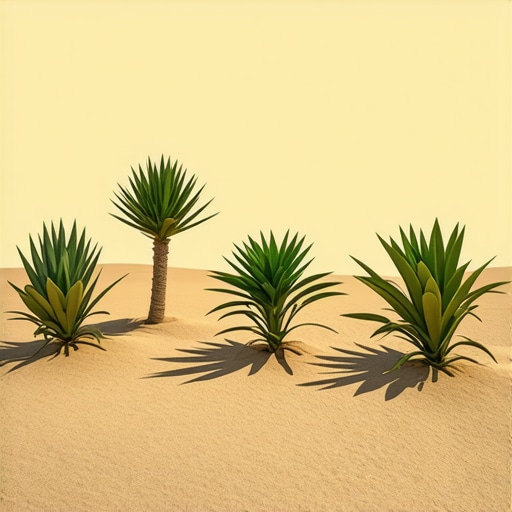
The best plants for sandy soil landscaping are those that exhibit xeromorphic traits such as silver foliage, needle-like leaves, or deep taproots to survive in USDA Hardiness Zones 5-9. These plants avoid the physiological wilt associated with high-evapotranspiration rates found in open, sandy sites. Let’s break down the workhorses of the xeric garden.
| Plant Species | Root Type | Water Needs | Technical Benefit |
|---|---|---|---|
| Lavandula (Lavender) | Fibrous/Deep | Ultra-Low | Prevents fungal crown rot via drainage |
| Perovskia (Russian Sage) | Rhizomatous | Low | Tolerates high alkalinity and salt spray |
| Gaillardia (Blanket Flower) | Taproot | Moderate-Low | Thrives in low-nutrient, high-heat zones |
| Opuntia (Prickly Pear) | Shallow/Spread | Negligible | Superior water storage in mucilage cells |
| Festuca glauca (Blue Fescue) | Clumping | Low | Stabilizes surface sand to prevent erosion |
1. Lavender (Lavandula angustifolia)
Lavender is the litmus test for sandy soil. If you plant this in heavy clay, it will rot within one season. In sand, it thrives because the roots stay oxygenated. Use the ‘Munstead’ or ‘Hidcote’ cultivars for the best results. Don’t over-amend the hole. If you put too much peat moss in a sandy hole, you create a sponge that will eventually ferment the root flare. Keep it lean.
2. Russian Sage (Perovskia atriplicifolia)
This is a structural powerhouse. It’s not actually a sage, but it acts like one. It loves a pH of 7.0 to 8.0, which is common in many sandy coastal regions. It reaches heights of 4 feet, providing the necessary verticality for hardscape borders without requiring supplemental irrigation once the root system hits the 24-inch depth mark. It is tough as nails.
3. Blanket Flower (Gaillardia)
Gaillardia is a short-lived perennial that makes up for its lifespan by seeding aggressively. Its taproot is designed to find moisture in the sub-soil. In the landscaping world, we call this ‘Information Gain’—it tells you where the microsites in your yard are. If it’s thriving, your drainage is perfect.
4. Prickly Pear Cactus (Opuntia)
Stop thinking of cactus as desert-only. Opuntia is native to many sandy regions across North America. It handles the freeze-thaw cycle by dehydrating its pads in winter. It requires zero inches of supplemental water after year one. If you have a south-facing slope with 90% sand, this is your anchor plant. It stops erosion cold.
5. Blue Fescue (Festuca glauca)
For ground cover that doesn’t demand a mower, Blue Fescue is the professional’s choice. It forms tight mounds. We use it to create ‘living mulch’ between larger shrubs. It helps hold the top two inches of sand in place during heavy rain events, preventing the ‘scouring’ effect that exposes the root flares of your more expensive nursery stock.
How often should you water new plants in sandy soil?
During the establishment phase, you must water every 48 hours for the first three weeks, applying exactly 0.5 inches of water per session to the root ball. Sandy soil cannot hold a ‘reserve,’ so frequent, low-volume applications beat once-a-week soaking. After 90 days, you should scale back to once every ten days to force the roots to move downward. Deep roots are the only insurance policy in sand.
How do you improve sandy soil for gardening?
To improve sandy soil, incorporate 2 inches of well-aged leaf compost into the top 6 inches of the soil profile to increase the Water Holding Capacity (WHC) and Cation Exchange Capacity. Avoid using fine sand or clay as amendments, as this can create a concrete-like consistency known as ‘hardpan.’ Organic matter is the only corrective measure that works long-term. You want to build a ‘duff’ layer that mimics a forest floor.
The Installation Protocol: Blueprint for Success
Most DIYers fail because they plant too deep. In sandy soil, the soil will settle more than you think. I tell my crew to set the root flare 1 inch above the grade.
“The primary cause of plant failure in managed landscapes is improper planting depth leading to stem girdling roots and anaerobic conditions at the root flare.” – International Society of Arboriculture (ISA)
When you backfill, do not stomp the sand. Use water to settle the particles. This prevents air pockets without crushing the macropores.
- Step 1: Dig a hole twice as wide as the root ball but no deeper.
- Step 2: Scarify the sides of the hole to ensure lateral root penetration.
- Step 3: Place the plant; ensure the root flare is visible.
- Step 4: Backfill with 70% native sand and 30% compost.
- Step 5: Apply 2 inches of hardwood mulch, but keep it 3 inches away from the stem. No mulch volcanoes.
Sand is a harsh teacher. It doesn’t forgive a missed watering in the first July of a plant’s life. But once those roots are established, you’ll have a landscape that is resilient, easy to maintain, and structurally sound. Don’t listen to the guys selling you ‘topsoil’ by the truckload. Use what you have. Build it right the first time. It will last. Short sentences save lives in this business. Work smart. Keep the dirt under your nails.
![4 2026 Best Plants for Salty Roadside Soil [Tested]](https://lawnmajesty.com/wp-content/uploads/2026/05/4-2026-Best-Plants-for-Salty-Roadside-Soil-Tested.jpeg)