How to Build a Dry Creek Bed to Direct Rainwater Away from Your Home
Why Water Management Precedes Aesthetics in Professional Hardscaping
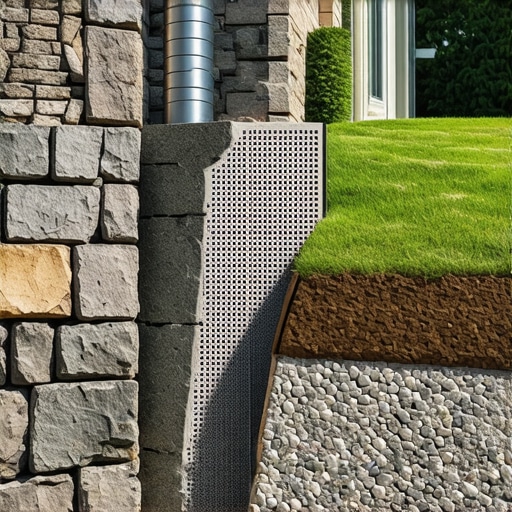
Building a dry creek bed requires understanding hydrostatic pressure and surface runoff coefficients to protect your home’s foundation from structural water damage. I recently got called out to tear up a $30,000 patio that was sinking because the previous contractor ignored a 2% grade slope leading directly into the house. The sub-base had turned into a literal soup because there was no escape route for the hydrostatic pressure building up behind the retaining wall. If you do not fix the soil grading first, every plant you put in the ground is just expensive compost. Water is the most destructive force in the landscape. It does not care about your design; it only cares about gravity and the path of least resistance. You have to create that path before the water creates its own through your basement wall.
The Engineering of Drainage Systems
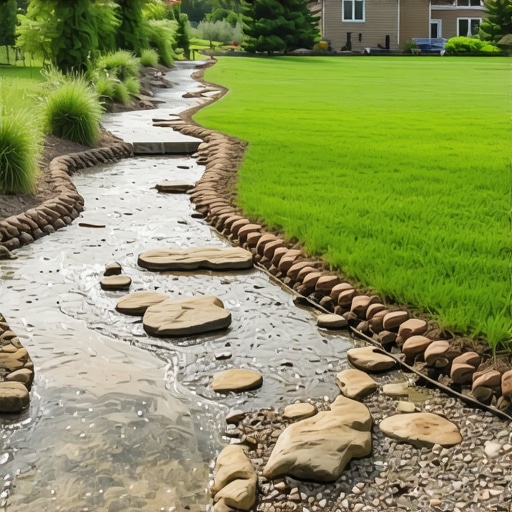
Before you pick up a shovel, you must calculate the watershed of your property. A dry creek bed is not just a pile of pretty stones; it is a bioswale designed to handle peak flow during heavy rain events.
“A retaining wall doesn’t fail because of the stone; it fails because of the water trapped behind it.” – Hardscape Engineering Axiom
This same logic applies to your entire yard. If you have standing water, you have a compaction or grading failure. In most residential settings, we are dealing with heavy clay or silty loam that has been compacted by construction equipment, leaving the soil with zero pore space for infiltration.
The Critical Planning Phase: Calculating Slope and Volume
To build a dry creek bed that successfully directs rainwater, you must excavate a trench with a 2% minimum slope, line it with heavy-duty non-woven geotextile fabric, and layer varying sizes of river rock and boulders to mimic a natural waterway. This ensures that water moves at a controlled velocity without undermining the banks of the trench. Most DIY attempts fail because the trench is too shallow or the stone is too uniform in size, which leads to the rocks being washed downstream in a heavy downpour.
How deep should a dry creek bed be?
A functional dry creek bed should have a depth of at least 8 to 12 inches at the center, tapering upward to the edges to create a concave profile. This depth allows for the placement of a 2 inch gravel base and 4 to 6 inches of larger river rock while still leaving enough freeboard to contain high-volume runoff without overflowing into the surrounding lawn care areas. If the trench is too shallow, the water will simply sheet over the top of the stones, rendering the entire project useless.
The Materials Hierarchy: Beyond the Big-Box Store
Professional hardscaping requires industrial-grade materials. Do not use the thin, woven weed barrier found at local hardware stores; it will tear within two seasons. Use a 4oz or 6oz non-woven geotextile. This fabric allows water to pass through into the soil while keeping the fines (dirt) from mixing with your clean stone. Once those fines migrate into your rock layer, the creek bed will clog and grow weeds. You are building a filter, not just a decorative path.
| Material Type | Primary Function | Recommended Size/Spec |
|---|---|---|
| Non-woven Geotextile | Separation and Filtration | 4oz to 6oz weight |
| Clean Crushed Stone | Foundation/Base Layer | 3/4 inch angular |
| River Rock | Flow Velocity Control | 2 to 5 inch rounded |
| Accent Boulders | Structural Anchoring | 12 to 24 inch fieldstone |
| Polymeric Sand | Joint Stabilization | High-flow ASTM-C144 |
The Step-by-Step Installation Protocol
Execution is where the