The Best Grass Seed for High-Traffic Dog Areas
Why Most Dog-Friendly Lawns Fail Within One Season
The best grass seed for high-traffic dog areas must possess a specific genetic profile that combines rapid rhizomatous repair, high wear tolerance, and a significant salt index resistance to survive the concentrated nitrogen in pet urine. Most homeowners fail because they choose aesthetics over structural integrity, ignoring the biological reality of root shear and soil compaction.
I recently got called out to a job where the homeowner was in a full-blown panic. They had spent thousands on a sod installation in May, and by August, their two Labradors had turned the backyard into a series of mud trenches and yellowed craters. They had tried to fix it by dumping ‘pet-safe’ fertilizer on top of what was already a high-salt environment, effectively chemically burning the few remaining root systems. It was a horticultural disaster. I had to tell them the truth: their soil was functionally dead because of compaction and osmotic stress. We had to scrape the top three inches, mechanical-core aerate the subsoil, and start over with a blend that actually matches the biological pressure of a 70-pound dog.
The Chemistry of Destruction: Why Dog Urine Kills Turf
To solve the dog lawn puzzle, you have to understand that dog urine is essentially a concentrated liquid urea fertilizer. While nitrogen is the primary driver of green growth, an over-concentration causes the plant’s cells to dehydrate through osmosis. The salt levels in the urine pull water out of the roots rather than letting the roots pull water in. This is exacerbated by the physics of the paw. A running dog exerts significantly higher PSI (pounds per square inch) than a human walking. This force shears the grass blades and compacts the soil, cutting off oxygen to the rhizosphere.
“Urea-based nitrogen in canine waste is chemically identical to concentrated ammonium nitrate fertilizer; without immediate dilution or high-CEC soil buffering, the result is localized plant desiccation.” – Agronomy Extension Research Manual
Selecting the Species: The Engineering of High-Traction Grass
Choosing the right seed is an engineering decision, not a decorative one. You need a blend that handles both the chemical load and the mechanical stress. Below is a professional-grade comparison of the top contenders for high-traffic canine environments.
| Grass Species | Repair Mechanism | Drought Resistance | Wear Tolerance | Best Use Case |
|---|---|---|---|---|
| Tall Fescue (Turf-Type) | Deep Taproots | Excellent | High | Drought-prone regions, large dogs |
| Kentucky Bluegrass | Rhizomes (Self-Repairing) | Moderate | Extreme | Cold climates, high-energy dogs |
| Perennial Ryegrass | Bunching (Fast Germination) | Low | Moderate | Quick overseeding, temporary fixes |
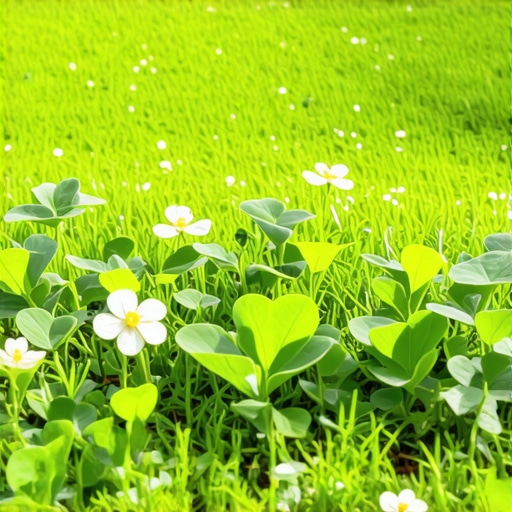
| Microclover Blends | Nitrogen Fixing | High | High | Low-maintenance, eco-friendly lawns |
How much seed do I need for a high-traffic area?
For a complete renovation, you should aim for 8 to 10 pounds of Tall Fescue blend per 1,000 square feet, or 2 to 3 pounds for Kentucky Bluegrass. In high-traffic dog areas, I always recommend increasing these rates by 20 percent to account for initial seedling loss due to traffic. High-density planting creates a tighter weave that resists paw penetration better than a sparse lawn.
Is microclover actually better for dog owners?
Microclover is a secret weapon for dog owners because it is a nitrogen-fixing legume that does not yellow when exposed to dog urine. Unlike turf grass, which thrives on nitrogen but dies at high concentrations, clover is much more resilient to the salt-load. However, it does not have the same shear strength as grass, so I typically recommend a 10 percent microclover mix within a heavy Fescue base. It stays green while the grass recovers.
The Ground-Up Build: A Professional Seeding Protocol
If you want a lawn that survives a dog, you cannot just throw seed on the ground and hope for the best. You need a structural foundation. Soil compaction is your greatest enemy. When soil is packed tight by paws, there is no pore space for water or oxygen. Your grass will suffocate long before the dog runs it over.
- Step 1: Core Aeration. Use a mechanical aerator to pull 3-inch plugs. This relieves compaction and creates a seed-to-soil contact point.
- Step 2: Soil Modification. Incorporate 1/4 inch of high-quality compost. This increases the Cation Exchange Capacity (CEC), helping the soil buffer the salts from urine.
- Step 3: Seed Selection. Use a certified ‘Blue Tag’ seed blend. Avoid big-box ‘contractor mix’ which is often 50 percent filler and weed seeds.
- Step 4: Consistent Hydration. Seed must stay moist. Not soaked, but damp. Water for 5-10 minutes, three times a day, until germination is complete.
- Step 5: Traffic Control. This is the hardest part. Keep the dogs off the area for at least 4 to 6 weeks. New seedlings have no root depth and will be ripped out instantly.
“A retaining wall doesn’t fail because of the stone; it fails because of the water trapped behind it. Similarly, a lawn doesn’t fail because of the dog; it fails because of the lack of pore space in the soil.” – Hardscape Engineering Axiom
The Maintenance Reality: Beyond the Seed
You cannot ‘set it and forget it’ with a dog lawn. It is a managed ecosystem. You should be top-dressing with sand or compost annually to level out the divots created by high-speed turns. I also tell my clients to keep their mower height at 3.5 to 4 inches. Tall grass has deeper roots. Short, scalped grass is a death sentence in a high-traffic zone. Deep roots provide the anchor that prevents the dog from ‘peeling out’ and taking the turf with them. If you see a yellow spot, flush it with two gallons of water immediately. Dilution is the only solution to the nitrogen spike. Don’t buy the ‘pet pills’ that claim to change your dog’s pH; they can cause kidney stones. Fix the soil, not the dog.
![Fix Patchy Bermuda: 3 Nitrogen Timing Rules [2026]](https://lawnmajesty.com/wp-content/uploads/2026/06/Fix-Patchy-Bermuda-3-Nitrogen-Timing-Rules-2026.jpeg)