Fix 2026 Paver Efflorescence with This $20 Acid Wash Trick
The Ghost in the Stone: A Forensic Autopsy of White Residue
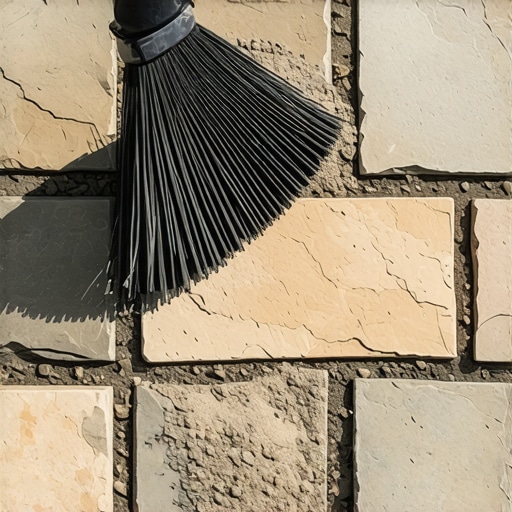
That white, chalky film creeping across your expensive pavers isn’t just an eyesore; it is a chemical signature of moisture migration. You spent thousands on a hardscape, and now it looks like it was dusted with flour. This is calcium carbonate. It is the result of water-soluble salts traveling through the pores of your concrete or brick, reacting with the air, and hardening into a stubborn crust. It does not mean your pavers are low quality. It means they are breathing. Efflorescence is the visible evidence of hydrostatic pressure and capillary action within your hardscape assembly, typically caused by mineral-rich water evaporating and leaving salt deposits behind. I recently got called out to tear up a $30,000 patio that was sinking because the previous contractor failed to install a proper drainage layer. The white film was the first warning sign. The owner ignored it. By the time they called me, the base was saturated, the fines had migrated, and the entire surface was undulating. We had to excavate 18 inches of sludge that used to be a structural base. Don’t let a $20 chemical fix turn into a $30,000 excavation. If you see the bloom, you need to act before the salt cycle starts pitting the surface of your stone.
“A retaining wall doesn’t fail because of the stone; it fails because of the water trapped behind it.” – Hardscape Engineering Axiom
The $20 Solution: Muriatic Acid and the Science of Neutralization
The most effective way to strip secondary efflorescence is a controlled acid wash using a 1:10 ratio of muriatic acid to water. This process costs less than $20 in raw materials but requires a precision mindset to avoid damaging the concrete matrix or the surrounding landscape. You are essentially performing a microscopic etch. The acid reacts with the calcium carbonate, dissolving it into a liquid state that can be flushed away. Stop buying the ‘mystery jugs’ at big-box stores. They are just watered-down acids with a 400% markup. Go to a masonry supply house or the pool chemicals section. Get the 31.45% concentration muriatic acid. It will hiss. It will smoke. It will work. But you must be fast. If the acid sits too long, it will eat the cement paste and expose the aggregate, ruining the finish.
How do I mix the acid solution safely?
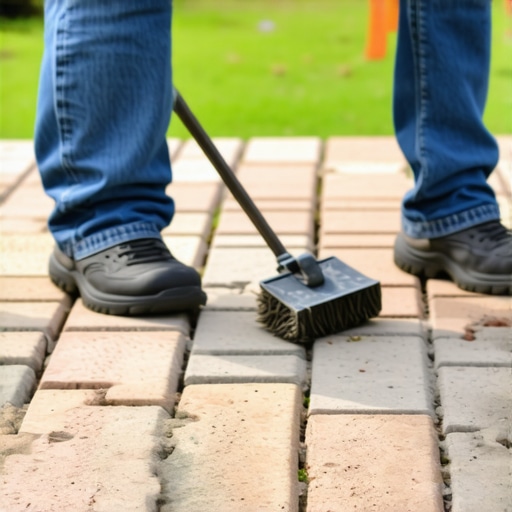
You must always add acid to water, never water to acid, to prevent an exothermic reaction that can splash concentrated chemicals onto your skin. Use a plastic five-gallon bucket and a long-handled nylon scrub brush to apply the solution to pre-wetted pavers. Never apply acid to dry stone. The dry pores will suck the acid deep into the paver, causing internal structural rot that shows up years later as crumbling.
| Material | Purpose | Estimated Cost |
|---|---|---|
| Muriatic Acid (1 Gallon) | Chemical Solvent | $12.00 |
| Baking Soda (5 lbs) | Neutralizing Agent | $5.00 |
| Nylon Scrub Brush | Mechanical Agitation | $3.00 |
| Total Cost | Professional Grade Fix | $20.00 |
Will muriatic acid damage my pavers?
Muriatic acid will only damage pavers if it is applied at a concentration higher than 10% or if it is not properly neutralized with a base like sodium bicarbonate after application. To ensure safety, always test a small, inconspicuous corner first to check for color lifting or excessive etching of the surface texture.
The Execution: Step-by-Step Remediation
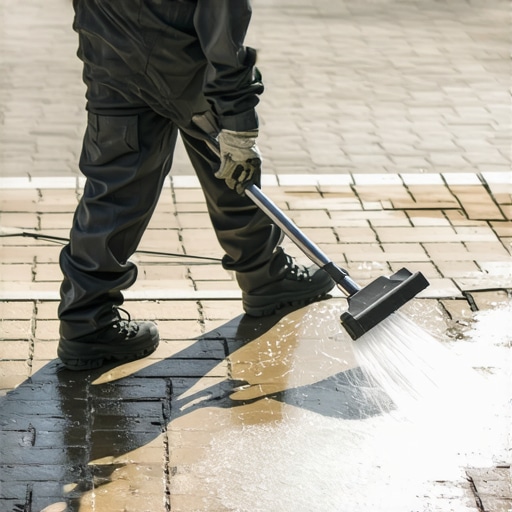
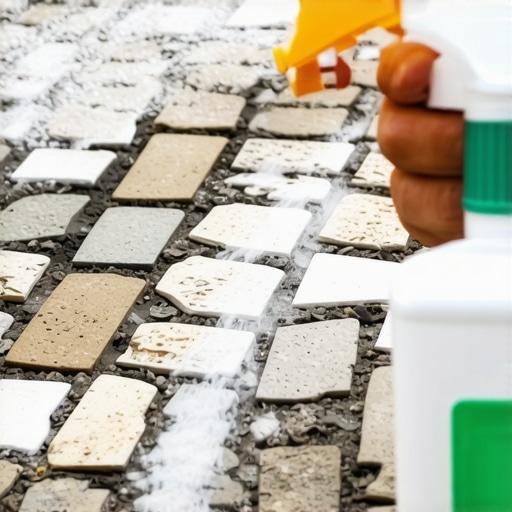
First, saturate the entire area with clean water. This fills the internal pores of the pavers so the acid stays on the surface. Mix your 1:10 solution. Scrub the affected areas in 25-square-foot sections. Work fast. The reaction should take no longer than 60 seconds. You will see a bubbling foam; that is the calcium carbonate being converted into CO2 and soluble salts. Flush the area immediately with a high-volume hose. Do not use a pressure washer for this; the high PSI will drive the dissolved salts back into the stone. After the initial rinse, sprinkle baking soda over the area or use a dedicated neutralizing wash to bring the pH of the stone back to 7.0. It will rot your grass if you don’t. Check the runoff. If the water hitting your lawn is still acidic, your grass will turn brown by morning.
- Pre-soak all stone and adjacent plants with fresh water.
- Apply the 1:10 acid solution using a plastic sprayer or brush.
- Agitate the stubborn white spots for 30 to 45 seconds.
- Rinse with high-volume, low-pressure water.
- Neutralize the surface with baking soda and water.
- Perform a final rinse to clear all debris.
“Efflorescence is the migration of a salt to the surface of a porous material, where it forms a coat.” – ICPI Tech Spec 2
Stopping the Return: Drainage and Vapor Barriers
Fixing the surface is a temporary victory if you don’t address the source of moisture. Efflorescence is a symptom of a wet sub-base. If your pavers are sitting in a ‘bathtub’ of clay, the water will continue to wick upward, bringing new minerals to the surface every time the sun hits the patio. This is why I drill into my crew: if you don’t fix the soil grading first, every plant or stone you put in the ground is just expensive compost. You need a modified gravel base (21A or 57 stone) that allows water to move away from the paver. If you are in a high-moisture area, consider a silane-siloxane sealer after the acid wash has dried for at least 48 hours. Unlike acrylic sealers, silane-siloxane is breathable. It allows water vapor to escape while preventing liquid water from entering the stone. If you use a cheap, film-forming sealer, you will trap the salts under the plastic layer. This creates ‘whitewash’ under the sealer that is nearly impossible to remove without specialized strippers. Don’t skip the drying time. The stone must be bone dry. If you seal in moisture, you are just laminating your failure.
Micro-Climate Considerations for 2026
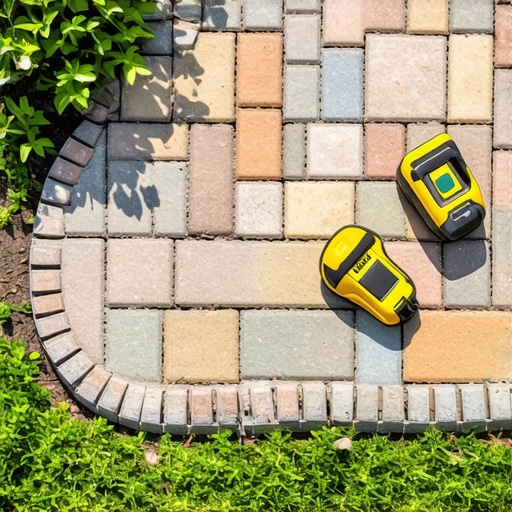
With the shift toward more volatile weather patterns, particularly the freeze-thaw cycles we are seeing in the Northeast and Midwest, efflorescence is becoming a yearly battle. The salt used on winter roads often migrates into driveways, accelerating the bloom. If you are in a region with heavy red clay, your drainage requirements are doubled. Clay holds water like a sponge, providing a constant reservoir for efflorescence cycles. Ensure your patio has a minimum 2% slope away from the foundation. One inch of drop for every four feet of run. This is non-negotiable. If your contractor didn’t use a transit or a laser level, they did it wrong. Period. Check your gutters. A single downspout dumping onto a paver corner is the leading cause of localized white staining. Redirect that water with a 4-inch PVC underground pipe to a pop-up emitter in the lawn. Keep the water off the stone, and the salts stay in the stone. It is basic physics.