Fix 2026 Sinking Flagstones with This Gravel Base
Why Flagstone Patios Fail by 2026
Flagstones sink primarily due to insufficient subgrade compaction and inadequate base depth. When water permeates the gaps between stones, it saturates the soil below, causing differential settlement. A minimum 6-inch base of compacted modified gravel is required to distribute load and prevent shifting. I recently got called out to tear up a $30,000 patio that was sinking because the previous contractor thought two inches of stone dust on top of uncompacted Georgia red clay was ‘good enough.’ It was not. Within eighteen months, the flagstones were rocking like loose teeth, and the homeowner was tripping over three-inch vertical offsets. We had to excavate the entire mess, haul away the contaminated soil, and start from the dirt up. This is the reality of hardscaping: if you cut corners on the base, you are just burying money in a shallow grave. Most ‘mow-and-blow’ outfits don’t understand that a patio is a bridge between the geology of your yard and the traffic of your feet. Without a proper bridge, gravity wins every single time.
“A retaining wall doesn’t fail because of the stone; it fails because of the water trapped behind it.” – Hardscape Engineering Axiom
The Forensic Autopsy of a Sinking Patio
When I step onto a failing patio, I can feel the incompetence through my boots. That squish of saturated earth and the ‘clack’ of stones hitting one another tells a story of poor drainage and even worse engineering. Most homeowners see a flat surface; I see hydrostatic pressure and capillary action. If you have standing water or sinking stones, your base is likely holding water instead of shedding it. We use a 3000-pound plate compactor for a reason. If you are using a hand tamper on a flagstone base, you are wasting your time. You cannot achieve 98 percent Proctor density with manual labor. The soil underneath needs to be stripped of organic matter. Roots, leaves, and topsoil will rot. When they rot, they leave voids. When voids exist, stones sink. It is simple physics. You need to excavate until you hit ‘virgin’ soil, which is often 8 to 12 inches below the surface depending on your local frost line and soil composition.
How much modified gravel do I need for a patio base?
To calculate your gravel needs, multiply the total square footage by the desired depth in feet, then divide by 27 to find the cubic yardage required for proper sub-base stability. For a standard 6-inch base, use 0.5 feet as your depth multiplier. Always add 10 percent for compaction loss and waste. Most amateurs forget that three inches of loose gravel becomes two inches once you hit it with a vibratory plate compactor. If you don’t account for this shrinkage, your finished grade will be too low, leading to drainage issues against your home foundation. Use a 21A or CR-6 modified crushed stone. This material contains both 3/4-inch stone and ‘fines’ or dust. The various sizes lock together to create a solid, nearly impermeable mass that still allows for microscopic drainage.
| Material Type | Drainage Rating | Compaction Quality | Best Use Case |
|---|---|---|---|
| Modified Gravel (21A) | Moderate | Excellent | Primary Load-Bearing Base |
| Clean #57 Stone | High | Good | Drainage Layers/French Drains |
| Stone Dust/Screenings | Poor | Fair | Leveling Layer Only (Risky) |
| Bank Run Sand | Excellent | Poor | Joint Filler Only |
Why is my flagstone patio shifting?
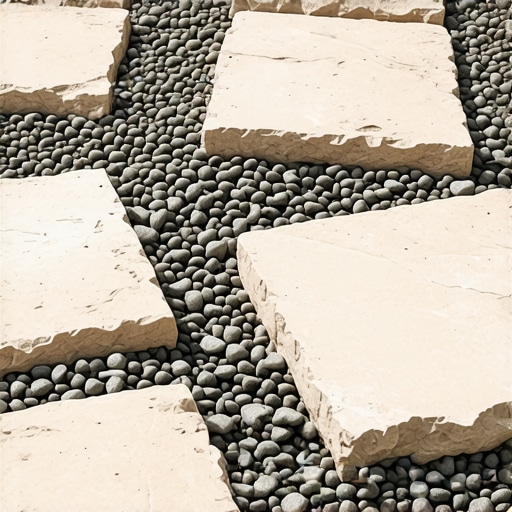
Shifting occurs when the edge restraints fail or the bedding layer is too thick, allowing stones to ‘float’ during freeze-thaw cycles. In regions with heavy clay, the coefficient of expansion for water trapped in the base can lift even heavy 2-inch thick flagstones. You must use a geotextile fabric between the raw soil and your gravel base. This fabric acts as a ‘soil separator.’ It prevents the heavy gravel from sinking into the soft clay over time while still allowing water to pass through. Without this fabric, your gravel base eventually disappears into the earth, and your patio follows it. Stop using pea gravel. It is like trying to build a house on top of marbles. You need angular, crushed stone that locks together under pressure.
“Base thickness must be determined by the load-bearing capacity of the subgrade soil and the anticipated traffic loads.” – ICPI Technical Specification Guide
The Engineering Protocol for a Permanent Fix
- Excavate 10 to 12 inches below finished grade to remove all organic matter and soft topsoil.
- Install a non-woven 4.5-ounce geotextile fabric across the entire excavation area.
- Lay 6 inches of modified gravel in 2-inch ‘lifts,’ compacting each lift with a vibratory plate compactor until the machine bounces.
- Ensure a 2 percent slope away from all structures to prevent hydrostatic pressure buildup.
- Use a 1-inch maximum layer of coarse bedding sand to level the individual flagstones.
- Fill joints with high-quality polymeric sand or a mortar-modified G2 sand to lock the surface.
Correcting the Base for 2026 Longevity
If you are planning for a patio to last into the next decade, you have to think about the 2026 freeze cycles now. Concrete sand is the only acceptable bedding material. Do not use stone dust for your leveling layer. Stone dust is a byproduct of the crushing process and contains high levels of fines that hold water. In the winter, that water freezes and creates ‘frost heave.’ You will spend every spring resetting your stones if you use it. Instead, use a washed concrete sand (ASTM C33). It provides a stable, free-draining bed for the stone. When you set the flagstones, use a dead-blow hammer. If the stone moves when you step on the corner, the base is not flat. Do not just shove more sand under it. Lift the stone, re-level the base, and drop it back in. It is tedious work. It is also the difference between a pro job and a hack job. We don’t do ‘quick fixes’ here. We do it right because I don’t want to see your yard again for another twenty years. Take the time to screed your bedding sand. Use one-inch outside diameter pipes as your guides. This ensures a uniform thickness that won’t settle unevenly. The goal is a monolithic structure that moves as one unit if the earth shifts, rather than individual stones popping up like toasted bread. Your joints should be tight. Large gaps filled with dirt are just nurseries for weeds. Use a stabilized jointing sand that hardens when wet. This prevents ants from mining out the sand and water from washing away your bedding layer. A patio is only as good as the dirt it sits on. Respect the soil, or the soil will swallow your investment.
![Build a $1000 2026 Flagstone Patio [DIY Step-by-Step]](https://lawnmajesty.com/wp-content/uploads/2026/05/Build-a-1000-2026-Flagstone-Patio-DIY-Step-by-Step.jpeg)