
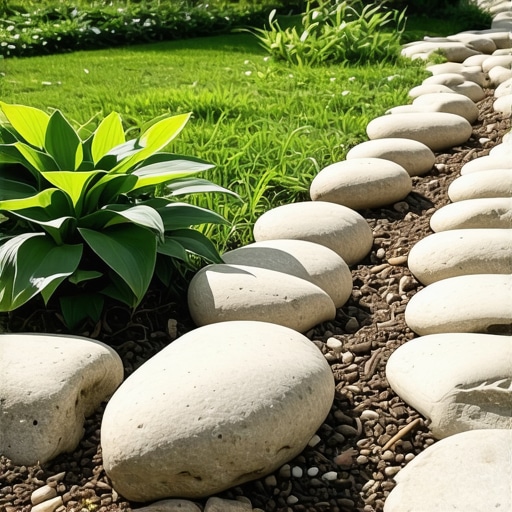
Build a $100 River Rock Edge to Stop 2026 Weeds
The Engineering of a Permanent Landscape Border
A river rock edge stops weeds by creating a multi-layered sterile zone that prevents rhizome encroachment and seed-to-soil contact. To build this for $100, you must focus on site-specific excavation, 4-ounce non-woven geotextile fabric, and properly graded 2-to-4-inch river stones that provide high-tensile structural integrity against soil movement.
I always drill into my new crew members: if you don’t fix the soil grading first, every plant or stone you put in the ground is just expensive compost. I’ve seen $50,000 installs fail in two seasons because the foreman didn’t understand the hydrostatic pressure of heavy clay or the persistence of Cynodon dactylon (Bermuda grass) rhizomes. This $100 project is a lesson in soil science. If your trench isn’t deep enough to sever the lateral root systems of invasive grasses, you aren’t landscaping; you’re just decorating a mess. We are looking for a 4-inch minimum depth. This isn’t a suggestion. It is a biological requirement to prevent the subterranean runners from surfacing inside your rock bed. I’ve spent twenty years digging up ‘pretty’ edges that were choked by weeds within twelve months because the installer thought 1 inch of gravel was enough. It never is.
Why Most Edging Fails by the Second Season
Edging fails because of frost heave and organic matter accumulation. Most DIYers buy the cheap plastic strip from a big-box store, hammer it in 1 inch deep, and wonder why it pops out like a spring in January. Soil is a living, moving medium. When the water in your soil freezes, it expands. Without a properly compacted trench and a heavy stone ballast, that expansion will eject your edging. Furthermore, weeds don’t just come from the bottom; they arrive as windblown seeds. If your river rock is too small, it traps dust and organic debris, creating a ‘micro-soil’ layer on top of your fabric where weeds germinate instantly. This is why we use 2-to-4-inch stones. They have enough void space to allow weed seeds to drop through to the fabric where they desiccate and die from lack of soil contact. It is about managing the micron-level environment.
“A retaining wall doesn’t fail because of the stone; it fails because of the water trapped behind it.” – Hardscape Engineering Axiom
Materials and Cost Breakdown for a 20-Foot Run
To stay under the $100 mark, you must bypass the retail bags. Go to a local bulk yard. You are looking for ‘River Jack’ or ‘Cobble.’ Buying in bulk is roughly 70% cheaper than buying plastic bags. You will need approximately 0.25 to 0.5 tons for a standard 20-foot run, depending on your trench width.
| Material | Quantity | Estimated Cost (Bulk) |
|---|---|---|
| Non-Woven Geotextile (4oz) | 25 ft Roll | $15 – $20 |
| 2-4″ River Rock (Bulk) | 0.5 Tons | $45 – $60 |
| 6″ Steel Landscape Staples | 50 Count | $10 – $15 |
| Marking Paint/String Line | 1 Roll/Can | $5 |
Total estimated cost: $75 to $100. If you pay more, you are paying for the convenience of the bag, not the quality of the stone. Don’t be a mark. Use a truck or a trailer.
The Installation Protocol: Step-by-Step
First, you mark your line. Use a garden hose for curves or a string line for straight runs. Do not eyeball it. Accuracy is the difference between a professional look and a hack job. Use a square-nose spade to cut a vertical wall against your turf. This wall acts as a physical barrier. You need to excavate a trench 6 inches wide and 4 inches deep. The depth is non-negotiable. If you hit heavy clay, keep going. You are creating a drainage channel as much as a visual border.
Next, clear all organic debris. Every leaf and stick left in that trench will rot and become fertilizer for the very weeds you are trying to stop. Once the trench is clean, hand-tamp the bottom. The ground should be firm enough that your thumb doesn’t leave an indentation. This prevents the stone from settling unevenly over the winter. Now, lay your 4-ounce non-woven geotextile. Do not use the ‘weed mat’ sold in the garden aisle; it’s paper-thin garbage. You want a fabric that feels like felt. This allows water to pass through but blocks 99% of light and root penetration.
“The longevity of any hardscape element is directly proportional to the quality of the subgrade preparation and the filtration layer used.” – Agronomy Manual Vol. 4
How deep should a river rock edge be?
A professional river rock edge should be exactly 4 inches deep. This depth allows for 1 inch of high-quality fabric overlap and 3 inches of stone ballast. At 4 inches, you are deep enough to sever the majority of turf-grass rhizomes and provide enough weight to prevent frost heave from shifting the stones.
What is the best fabric for river rock edges?
The only acceptable fabric for river rock is a 4-ounce or 6-ounce needle-punched non-woven geotextile. Unlike woven fabrics, non-woven geotextile has a high permittivity rate, meaning water flows through it easily, preventing the ‘bathtub effect’ where water pools under your rocks and rots the surrounding turf.
The Logic of Stone Gradation
When you place the stone, don’t just dump it. Hand-place the larger stones along the edges of the trench first. This ‘keys’ the edge in place. Then fill the center. By using a mix of sizes within the 2-to-4-inch range, you create an interlocking matrix. This is basic civil engineering. The smaller stones fill the voids between the larger ones, increasing the friction between the rocks. It won’t move. Even if you hit it with a leaf blower or a heavy rainstorm, that edge stays put. This is what we call structural stability in the trade. If you use 1-inch pea gravel, it will be in your lawn within a month. Use the heavy stuff.
Maintenance and the 2026 Outlook
By 2026, windblown dust will have settled in the gaps. This is inevitable. However, because you used non-woven fabric and 4-inch depth, those weeds won’t be able to reach the soil. They will be ‘air-pruned.’ A quick spray of high-concentration vinegar or a blast with a propane torch once a year is all you need. Do not use glyphosate; it’s a lazy man’s tool that ruins soil microbiology. Stick to mechanical or thermal removal for the few survivors. Check your edges after the first spring thaw. If a stone has shifted, kick it back into place. Landscaping is a game of inches and persistence. If you build it right the first time, the maintenance is a five-minute job, not a weekend-long ordeal. Stop buying the cheap stuff. Buy the right stuff once. It’s cheaper in the long run. Work smarter, but work harder on the foundation. The results speak for themselves.

![Build a $50 2026 Rain Barrel System [Save Water]](https://lawnmajesty.com/wp-content/uploads/2026/07/Build-a-50-2026-Rain-Barrel-System-Save-Water.jpeg)