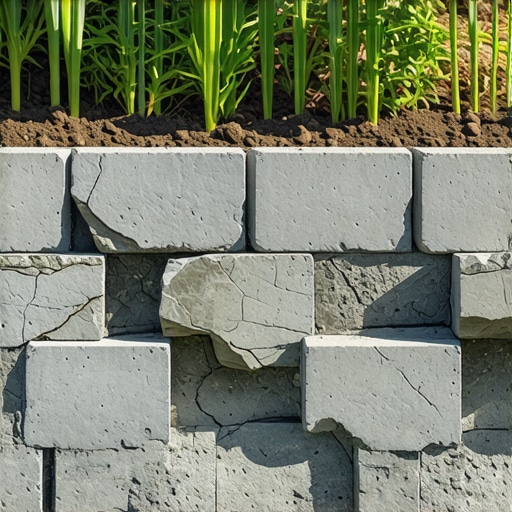
Why Your Retaining Wall is Cracking
The Hardscape Autopsy: Why Gravity and Water Always Win
Retaining wall cracking is rarely a cosmetic defect and almost always a symptom of structural failure caused by hydrostatic pressure, poor soil compaction, or a missing drainage system. When a wall begins to lean or separate, it indicates that the lateral force exerted by the soil behind it has exceeded the resisting force of the structure itself. I recently got called out to tear up a $30,000 patio that was sinking because the previous contractor used ‘native soil’ as backfill instead of clean, angular stone. The result was a waterlogged mess that expanded during the first freeze, shoving a six-foot wall three inches out of plumb. This is what happens when you treat hardscaping like masonry instead of civil engineering. A wall is a dam. If you do not account for the physics of water, the wall will fail. It is not a matter of if, but when. Most homeowners see a crack and think about mortar. I see a crack and think about soil friction angles and Standard Proctor Density. If you skip the foundation, you are just building a very expensive pile of rubble. Every block has a limit. Every soil type has a weight. When those numbers do not align, the wall moves.
The Physics of Lateral Earth Pressure
Lateral earth pressure is the force exerted by soil against the back of a retaining wall, which increases significantly when moisture levels rise within the backfill zone. Soil is heavy, but wet soil is a nightmare. A cubic foot of dry dirt might weigh 100 pounds, but once saturated, that weight jumps significantly, and the internal friction that keeps soil particles together vanishes. This is where the engineering fails.
“A retaining wall doesn’t fail because of the stone; it fails because of the water trapped behind it.” – Hardscape Engineering Axiom
Without a proper exit strategy for that water, the wall becomes a sieve that eventually bursts. We call this hydrostatic pressure. It builds up behind the blocks, pushing against the face of the wall until the friction between the courses is overcome. If you did not use geogrid to tie the wall into the soil bank, there is nothing holding it back but gravity and hope. Hope is not a construction strategy. In my twenty years of doing this, I have seen walls snapped in half because the builder forgot a simple four-inch perforated pipe. Don’t be that guy.
The Three Primary Killers of Segmental Retaining Walls
Structural failure in retaining walls is typically the result of poor base preparation, inadequate drainage, or improper backfill materials that do not allow for moisture migration. Each of these factors plays a critical role in the long-term stability of the project. If one fails, the whole system is compromised. Let’s break down the mechanics of the failure points.
How much modified gravel do I need for a patio base?
For a standard retaining wall base, you need a minimum of six inches of compacted 2A modified gravel, extending at least six inches in front of and behind the wall units. This base must be compacted in two-inch lifts to reach 95 percent Standard Proctor Density. Using a vibratory plate compactor is non-negotiable. If you just dump the gravel and walk on it, the wall will settle unevenly within the first year. The base is the only thing standing between your wall and the freeze-thaw cycle of the earth. When the ground freezes, it expands. A flexible gravel base allows for slight movement without cracking the blocks. A rigid concrete base, ironically, often leads to more cracks because it cannot move with the earth. Professional installers know that the base should be buried (embedded) to prevent the bottom of the wall from kicking out. This is called the ‘toe’ of the wall. If the toe is exposed, the wall has no resistance at the point of highest pressure.
The Drainage Blueprint: Why Weep Holes Matter
Retaining wall drainage requires a perforated SDR-35 pipe buried at the bottom of the drainage chimney, surrounded by clean 57 stone to ensure water can escape. This is the ‘Active Lane’ of the wall. Water should move through the stone, into the pipe, and out to a daylight exit.
“Soil moisture levels are the single most significant factor in the performance of segmental retaining walls, impacting both the shear strength of the backfill and the lateral pressure on the face.” – USDA Soil Engineering Guide
If you see white, chalky stains on your wall, that is efflorescence. It is a sign that water is trapped inside the blocks. It is the wall’s way of screaming for help. Eventually, that water will freeze, expand, and pop the faces off your expensive pavers. This is called spalling, and it is a permanent death sentence for the aesthetics of your hardscape.
Material Comparison for Wall Longevity
Choosing the right material for the backfill is the difference between a thirty-year wall and a three-year wall. Not all ‘dirt’ is created equal. Refer to the table below for material performance.
| Material Type | Drainage Capability | Compaction Rating | Structural Support |
|---|---|---|---|
| Clean 57 Stone | Excellent | High | Superior |
| 2A Modified Gravel | Moderate | Excellent | High |
| Native Clay Soil | Poor | Unstable | Dangerous |
| Masonry Sand | Good | Low | Insufficient |
As you can see, using native clay is a recipe for disaster. Clay holds water like a sponge. When it gets wet, it expands. When it dries, it shrinks. This constant movement will wiggle your wall blocks out of alignment until the wall starts to look like a snake. Always use clean stone for the first 12 to 18 inches behind the block. It never settles and it never holds water.
The Critical Checklist for Wall Inspection
If you are worried about your wall, run through this technical checklist. If you check more than two boxes, you need a professional intervention before the wall collapses.
- Separation of Coping: Are the top cap stones pulling away from the wall?
- Sediment Leaching: Is dirt washing out through the cracks between blocks?
- The Bowing Effect: Is the middle of the wall further forward than the top or bottom?
- Clogged Weep Holes: Is there water pooling at the base of the wall instead of draining out?
- Step Cracking: Are there diagonal cracks following the joints of the blocks?
How do you fix a leaning retaining wall without tearing it down?
To fix a leaning retaining wall, you must first relieve the hydrostatic pressure by excavating the soil behind the wall and installing a proper drainage system and geogrid reinforcement. In some cases, you can install soil nails or helical anchors to pull the wall back into place, but this is a specialized engineering task. For most residential walls, if the lean is more than 1 inch per foot of height, a full tear-down and rebuild is the only safe option. You cannot simply push it back. The structural integrity of the base has been compromised. If you try to ‘patch’ a leaning wall, you are just putting a band-aid on a broken leg. The physics don’t change just because you added some mortar to a crack.
The Surcharge Factor: Hidden Loads
A wall doesn’t just hold back soil; it holds back everything on top of that soil. We call this a surcharge load. If you have a driveway, a shed, or even a heavy fence near the top of the wall, that weight pushes down and then out. Many DIYers build a wall that looks great, then they park a truck above it and wonder why the wall starts to bulge. Any wall over three feet tall should be engineered if there is a surcharge load within a distance equal to the height of the wall. This is the ‘Influence Zone.’ If you put weight in that zone, the wall needs geogrid layers every two courses to tie the face into the earth. Without geogrid, you are relying on the weight of the blocks alone to hold back a vehicle. It will fail. It is physics. You can’t argue with it. Use a 12-inch thick base of stone for high-load areas. Don’t skip the compaction.
A Final Verdict on Wall Maintenance
Check your drainage outlets every spring. Clear out any debris, leaves, or mulch that might be blocking the pipes. If you see a small crack, seal it with a flexible masonry adhesive to keep water out, but monitor the width. If the crack grows, the soil is moving. Landscaping is not just about planting flowers; it is about managing the forces of nature. A well-built wall is a silent servant. A poorly built wall is a ticking time bomb in your backyard. Build it right, build it once. Don’t be the homeowner I have to charge $40,000 to fix a $20,000 mistake. Ground-up engineering is the only way to ensure your hardscape survives the decade.